Showing posts with label Miltarism. Show all posts

Friday, April 09, 2010

Frederick the Overrated I
Frederick II and the Outbreak of the Seven Years War.


Frederick the “Great”
One of the joys of historical research is finding out that some historical personages who are celebrated to the skies may not be quite as wonderful as their legions of worshipers / hagiographers, opps1 sorry, biographers / historians, claim that they are. Just recently I came across a book about the Seven Years War that in between describing the battles and campaigns of the Seven Years War in Europe manages to take assorted pot shots at Frederick the “Great's’” reputation. Those more than occasional interludes of truly cattish scratching are thoroughly enjoyable and frankly about time.2

Frederick is called the “Great” because he was successful at war, or should I say thought to be successful at war, and because he succeeded in conquering territory and making Prussia one of the great powers of Europe. Basically he is a “Great” man because he succeeded. The actual manner by which he achieved his success and the cost of his success for others is as per usual in these things downgraded / ignored. This worship of military success leads to the idea that Frederick was “Great” in all sorts of things and a fawning, hero worship that writhes in ecstasy at his “glorious” victories and genuflects at his shrine.3

One can go into the rather puzzling question about how a King who massively strengthened the militaristic nature of the Prussian state, and its Police State apparatus and in effect completed the process of turning the Prussian state from a State with an army to an Army with a State could for a moment fool anyone into thinking he was an “Enlightened” monarch. But then military success does tend to dazzle. But then Frederick easily put on “enlightened” airs and dazzled the literati of his day with a lot of words and pretty speeches about “enlightened” values while increasing the subordination of society to the state and its army. That Frederick was also incredibly vain, arrogant and loath to take responsibility for things if things went wrong, (blaming other people was a fine if childish art with Frederick). That Frederick was also in many respects a reckless diplomat and frequently engaged in political and other acts of fairly dubious morality is often forgotten.4

For example when Maria-Theresa inherited the Austrian throne in 1740, Austria had been going through a long term period of decline and it was only with difficulty that Maria-Theresa’s father Charles VI was able to arrange for the myriad domains of the house of Habsburg to accept the succession of his daughter Maria-Theresa; who became the only female ruler of the house of Habsburg. This so-called Pragmatic Sanction was then accepted by the various major powers of Europe through the tireless diplomacy of Charles VI who was anxious to avoid a diplomatic crisis upon the accession of his daughter. Also there was his concern that the other powers would seek to take advantage of Maria-Theresa’s accession to attack Austria and attempt to partition the empire between them.

Despite the anticipation of crisis Maria-Theresa succeeded her father in 1740 and at first it looked as if the various powers would accept the Pragmatic Sanction and let Maria-Theresa reign in peace. Frederick who had recently come to the throne of Prussia decided that given that so many powers were just waiting to attack Austria and carve her up that he would start the whole process, this was after he had signed a treaty saying he would respect the Pragmatic Sanction.5

The result was the war of Austrian Succession an interminable 8 year war during which Prussia was able to wrest the province of Silesia from Austria. Despite the serious decay of Austrian institutions and military during Charles VI’s reign, (Charles was a good diplomat but not a good administrator and Austria fell behind and looked like ripe pickings for the other powers), Maria-Theresa, who had not been educated or trained in any fashion to rule proved to be a very capable if not great ruler, and despite her almost total lack of experience rose to the challenge.6

Frederick went to war, made peace and unmade alliances almost at will with little regard to any moral imperatives or even his word. Frederick blithely betrayed his allies twice by making separate peace treaties with Austria and broke his agreements with Austria with equal facility. In the end though Frederick ended up with Silesia a province that increased the population of Prussia by more than 50% and a even larger increase in wealth. In fact Prussia’s pretensions of being a great power were dependent on possession of Silesia.7

Frederick had inherited from his father, Frederick William I, (a man whose behavior indicated a psychopathic personality), an excellent, large standing army that by means of the most draconian exploitation of the country he was able to extract from his fairly small country. Frederick had great ambitions and from the first wanted to take Austrian lands to further those ambitions.8

Austria was able fight off this attempt to partition her. Aside from Silesia Austria lost very little territory. But the war convinced Maria-Theresa of the urgent need to reform and revitalize the state. As an “enlightened” monarch Maria-Theresa easily puts Frederick in the shade and unlike him the challenges that she faced and difficulties she had to overcome were quite significantly greater. Further unlike Frederick Maria-Theresa had real moral scruples which did affect her behavior and policies. The idea of subordinating the state to the army was anathema to her. If Maria-Theresa had inherited a ramshackle state she was with remarkable skill able to hold the great majority of it together despite everything.9

Despite the ohhs and awws of the literati Frederick’s double dealing in this period had left a bad taste in the mouths of many including that of Frederick’s allies, especially France. Although many were dazzled by Frederick’s military victories, Frederick had a serious enemy in Maria-Theresa, who wanted Silesia back and it would have been prudent for Frederick to make every effort to remain an ally of France in order to hold Austria back from a war of revenge. Well to put it bluntly Frederick muffed it.10

The story of the long diplomatic intrigues that eventually resulted in the alliance of Russia, France and Austria against Prussia belongs in another essay suffice to say Frederick proved a clumsy and basically inept diplomat at the time. The fact that he was suspected of having further massive territorial designs especially on the lands of the Austrian monarchy, which were in fact true, increased the determination of Maria-Theresa to cut him down to size. Prussian schemes to annex parts of Poland increased Russian anxieties and France was utterly infuriated by Frederick’s behavior during the war of Austrian Succession and felt it could not trust him at all.11

In the end France, reversing a policy of long standing (centuries) signed an alliance with Austria and Russia joined in. Now this alliance, which was only formalized after Frederick attacked Saxony, was defensive in nature and frankly neither France nor Russia was really all that interested in a war to gain Silesia back for Austria, but all three powers were determined to contain Prussia, and its King who they viewed as a loose cannon liable to go off in any direction.12

Frederick muffed it again. In 1756 he invaded Saxony and then Austria deliberately starting a war with France, Austria and Russia.

Faced with a circle of enemies Frederick decided to attack. Frederick’s defenders have from that day to this have defended his action as a preventive strike designed to anticipate his enemies and hence a move a great boldness.

Further Frederick is congratulated for trying to break up his enemies by attacking first and trying to drive Austria out of the alliance and thus breaking up the coalition against him. This is of course to take Frederick’s self serving apologia at face value. What is forgotten is that Austria, Russia and France had a defensive alliance not an offensive one. Neither France nor Russia were terribly eager to fight a war solely for Austria to get back Silesia. Further Frederick attacked Saxony an ally of Austria, not Austria. What is forgotten is also that Frederick did indeed want to defeat Saxony and Austria quickly, and then impose on both a peace that would satisfy his long standing desire for much more territory from both of them. In other words Frederick attacked Austria and Saxony in order to extract from both has much territory as possible not just to break up a coalition against him. He also had plans to impose a heavy indemnity on both. What happened is that both Russia and France pursuant to their alliance with Austria declared war on Prussia. Thus Frederick had, with great efficiency, created a powerful coalition against himself.13

Having thus set himself up for failure and being crushed by a much more powerful coalition, Frederick would spend most of the next seven years desperately trying to save himself from the predicament he had so expertly put himself in. Needless to say the Frederick gawkers would spend centuries afterwards writhing in ecstasy at Frederick’s “greatness” in holding off a much more powerful coalition and repeating Frederick’s self serving apologia that the war was inevitable and that he was thus justified in attacking first, carefully avoiding the fact that the so-called inevitable attack was NOT inevitable. Further that Frederick’s behavior was in effect a self fulfilling prophecy and that Frederick had very ambitious territorial ambitions, against Austria, Saxony and Poland, which he was most anxious to satisfy. In other words Frederick's attack was an act of aggression designed to seize territory, at least in part.14

It takes real incompetence to put your head in the noose the way Frederick did. Frederick in the end was only saved one of the most bizarre strokes of good fortune ever, for which he could take no responsibility. Another time I will go into that stroke of fortune. Meanwhile the people of Prussia, Saxony, Austria, Russia, Germany, and France would pay for Frederick’s incompetent diplomacy, lack of scruple and ambition in spades.15

1. The number of suck-up biographies of Frederick the “Great” is legion perhaps the most stomach turning, at least in English, is Carlyle, Thomas, History of Frederick the Great, Six Volumes, Robson and Son, London, 1858-1865. Google Books, Here, see also Fuller, J. F. C., A Military History of the Western World, v. 2, DaCapo, New York, 1955, pp. 192-215.

2. Szabo, Franz A., The Seven Years War in Europe 1756-1763, Pearson, Longman, London, 2008.

3. See Carlyle above and Duffy, Christopher, Frederick the Great: A Military Life, Routledge, London, 1985 for many examples.

4. See Duffy, pp. 195-196, Szabo, pp. 87-88, 238-240, 253-255, Williams, E. N., The Ancien Regime in Europe, Penguin Books, London, 1970, pp. 372-398, Waite, Robert, G. L., The Psychopathic God, Signet, New York, 1977, pp. 306-311, Ogg, David, Europe of the Ancien Regime 1715-1783, Harper Torchbooks, New York, 1965, pp. 212-217, Hufton, Olwen, Europe: Privilege and Protest: 1730-1789, Fontana Books, London, 1980, pp. 191-219.

5. IBID, Waite, Williams, pp. 430-432, Ogg, pp. 124-127.161-168.

6. No really good biography of Maria-Theresa exists in English, but see Williams, pp. 435-459, Ogg, 206-211, Hufton, pp. 160-73.

7. Hufton, pp. 191, 206.

8. See Williams, pp. 335-351, Waite, 306-307, Williams, 376-378, Hufton, 205-206, Ogg, 161-168.

9. Ogg, pp. 210-211, Williams, 435-459, Hufton, 160-173.

10. Williams, pp. 437-438, Ogg, pp. 138-143, Duffy, pp. 82-85, Szabo, pp. 8-18.

11. IBID.

12. IBID.

13. IBID, and Szabo, pp. 10, 37, 82.

14. IBID.

15. Duffy, pp. 242, 244, Hufton, pp. 211-212. Prussia for example lost 400-500 thousand people.

Pierre Cloutier

Thursday, January 14, 2010

The Great Victory that never was
Lutzen, 1632

Gustavus Adolphus (left) Wallenstein (right)

In a previous posting I reviewed a book1 on the Thirty Years War. In the review I stated that I felt that the reputation of the Swedish King Gustavus Adolphus was seriously overrated.

In fact this inflation of reputation is such that a sort of massaging of the actual historical record is required. An excellent example of that is the battle of Lutzen, November 16, 1632, during which Gustavus Adolphus got himself killed.

Now the mythologizing about Gustavus Adolphus is to a large extent from him being celebrated by military men and his use in Military colleges and other educational institutions as a an example of military genius. For example “Gustavus Adolphus was the one great captain of this century”2. What is interesting is that the very account of Gustavus Adolphus’ own military operations in the book do not support this assessment at all.3

In the nineteenth century celebrations of Gustavus Adolphus would break all barriers and approach incredible heights of hagiography and hero worship. An excellent example is Gustavus Adolphus, by Theodore Ayrault Dodge.4

This massaging is especially necessary when describing the battle of Lutzen and in fact what happens is in effect outright falsification. However before we go into the falsification let us review what actually happened before and during the battle.

Gustavus Adolphus had after his crushing victory at Breitenfeld, September 17, 1631, gone on to undue most of the successes achieved by the Imperial armies since 1618. In fact Gustavus Adolphus seemed to have become arbitrator of central Europe and on the verge of achieving final victory over the Emperor and giving the Protestant cause hegemony in central Europe.5

Of course those dreams were mere delusions and fantasies. Gustavus Adolphus managed to alienate many of his allies, and he, himself showed a singular lack of diplomatic ability. This was not helped by the fact that the Imperialists led again by Wallenstein staged a remarkable military recovery.6

The campaign that resulted is embarrassing to those who promote the idea that Gustavus Adolphus was a “Great Captain”. In a campaign of maneuver and entrenchments Wallenstein out thought Gustavus Adolphus.

Basically Wallenstein maneuvered Gustavus Adolphus into the city of Nuremburg and so stymied him that Gustavus Adolphus, his army wasting away from disease etc., in exasperation attacked Wallenstein’s entrenched army at Alte Veste, September 3 & 4, 1632. Gustavus was defeated losing at least 2,400 casualties, (probably more than 3,000). Wallenstein lost less than 1,000. Further c. 29,000 men had died in the Swedish camp and after the battle 11,000 men deserted his army. Shortly afterwards Gustavus Adolphus retired from Nuremberg intending to winter in Swabia, in southern Germany. Wallenstein instead of going into winter quarters invaded Saxony and by threatening to cut Gustavus Adolphus’ communications with Sweden forced the Swedish King to come north.7

So far in the contest between Wallenstein and Gustavus Adolphus, Wallenstein was winning.

The Saxons had sent most of their army into Silesia and so were almost entirely defenceless when Wallenstein invaded. He very quickly occupied large areas of the duchy.8

Gustavus Adolphus with his communications threatened had no choice but to go north, he also had to prevent his most important ally Saxony from making peace or going over to the Imperials. Further Gustavus Adolphus’ prestige had been seriously undermined by the campaign so far.

In this situation Gustavus decided he had to seek and win a battle to restore his prestige and shore up his faltering system of alliances.

Wallenstein had other ideas. Winter had set in and he was dispersing his army for winter quarters. Wallenstein just did not think Gustavus Adolphus would try for battle at this time of cold and when food was hard to find. Further Wallenstein had detached c. 5,000 men under Pappenheim, (at Pappenheim’s request) to reinforce Imperial garrisons in Westphalia and Wallenstein sent 2,500 men to watch the city of Torgau. Gustavus was almost desperate for a battle and Wallenstein, very ill, did not think anyone would want to fight a battle under the conditions prevailing.

Wallenstein when he found out that Gustavus Adolphus was marching on him gathered together what troops he could. Even so he only had c. 12,350 against Gustavus Adolphus’ c. 19,200. Wallenstein not surprisingly sent urgent requests to Pappenheim to return as soon as possible.9

It is entirely in order to praise Gustavus Adolphus for surprising Wallenstein at this stage and forcing a battle with him having a numerical advantage. For once Gustavus Adolphus had outsmarted Wallenstein. Gustavus Adolphus however proceeded to lose most of the advantage gained.

First Gustavus Adolphus was delayed for one day by a small cavalry detachment and second of all Wallenstein guessed what Gustavus Adolphus would do and planned accordingly.

Map of Battle of Lutzen
Swedes White, Imperials Black

Wallenstein took up position next to the village of Lutzen. He stationed troops in the village and posted musketeers in the road just out side his front lines. He organized his camp followers to suggest his army was larger than it was. Wallenstein guessed that Gustavus Adolphus would try to outflank him and so organized his army that Gustavus Adolphus would gain nothing from his manoeuvre except having to make another frontal attack. Of course Wallenstein sent another urgent message to Pappenheim and expected him to arrive just before or during the battle.10

The battle started at c. 10:00am in the morning when Gustavus Adolphus mounted an all out attack. This frontal attack made little progress has Gustavus Adolphus’ troops were unable to take Lutzen or the hill in front of it, (Windmill hill) where Wallenstein had posted artillery. Gustavus Adolphus’ troops were able to make progress on the other flank, but by then smoke from fire and gunpowder was making it difficult to see what was going on. About 1:00pm Pappenheim returned with 2,300 cavalry and drove the Swedes back on the flank that they had been pushing back. Pappenheim was killed in the attack. The battle now degenerated into mishmash of small units attacking and defending and both Gustavus Adolphus and Wallenstein largely lost control of the battle.

In the confusion Gustavus Adolphus was wounded twice by bullets the second wound killing him. His body was not retrieved until later. Moral in the Swedish army was adversely affected by Gustavus Adolphus’ death. It appears that at least some of the Swedish commanders suggested retreat but Bernard, a German in Swedish service, managed to get the Swedes to agree to more attacks. These attacks finally took Windmill hill and captured some of Wallenstein’s artillery.

Fighting subsided and finally ended around 5:00pm. About an hour later Pappenheim’s 3,000 infantry arrived. Wallenstein had suffered 3,000 casualties. The Swedes had suffered c. 6,000 casualties.

Wallenstein, ill and shaken by his severe casualties and unsure that Gustavus Adolphus was actually dead decided to retreat; abandoning his artillery. Interestingly the Swedes where on the point of retreat when they found out the Imperial army had withdrawn.11

So basically the battle was tactically indecisive although because of the Imperial retreat the Swedes were able to claim victory and certainly the imperial evacuation of Sweden’s ally Saxony after the battle would seem to indicate a strategic Swedish victory. However this “victory” had cost the life of Sweden’s King, created a dangerous situation in Germany for Sweden and put Gustavus Adolphus’ 8 year old daughter Christina on the throne.12

It was only Wallenstein’s retreat that allowed the Swedes to claim victory and that was likely the worst military decision Wallenstein ever made. Otherwise Wallenstein had managed to recoup quite successfully from being caught with his pants down and despite being outnumbered through out the battle, (this includes the reinforcements that arrived during it) had fought the battle to a draw and inflicted significantly greater casualties on his enemies. Gustavus Adolphus’ generalship just before and during the battle are not impressive. Gustavus Adolphus seems to have tried simply to use his large superiority of numbers to crush his enemy in an unimaginative frontal assault. Wallenstein was overall better that Gustavus Adolphus just before and during the battle. It was after the battle that Wallenstein lost it so to speak.13

Now calling this mess of a battle “a great Swedish victory”14 seems at best to be an exaggeration and most likely simply false.

Now my account of the battle is largely from Wilson’s book on the Thirty Years War,15 and it appears to be overall accurate. What do other accounts say?

Now accounts that describe the battle has a less than a stunning Swedish victory do exist and are not new.16 So this is hardly revisionism. It appears that the sources of this error are the result of a whole series of mistakes and revisions that work to inflate the Swedish kings reputation.

For example various accounts state that the Imperials either out numbered the Swedes or had equal numbers to them at the beginning of the battle. Even some of the accounts that dispute the idea of a “great Swedish victory” accept this. To give a few examples. Fuller gives Wallenstein 25, 000 men excluding Pappenheim who he says had 8,000 with him. He gives Gustavus Adolphus 18,000 men.17

The Dupuys give Wallenstein 20,000 men excluding Pappenheim’s 8,000. Gustavus Adolphus is given 18,000 men.18

Dodge says:

It is only certain that Gustavus’ army was much weaker than Wallenstein’s. It may have numbered eighteen thousand men, while the Imperialists can scarcely have had less than twenty-five thousand; and this number was to be reinforced by fully eight thousand more, whenever Pappenheim should come up.19

Parker states that both sides had about the same number of men; 19,000. It is unclear if Parker is including the forces of Pappenheim that arrived during and just after the battle. If it does the statement is true if it is meant to just indicate forces that each side had at the beginning of the battle it is incorrect.20

Wedgwood gives Swedish forces as c. 16,000 strong and gives Wallenstein including Pappenheim 26,000 men. Assuming that Wedgwood thought Pappenheim had c. 8,000 men this would give Wallenstein 18,000 men to Gustavus Adolphus’ 16,000.21

Thus Gustavus Adolphus’ actual out numbering Wallenstein by more than 50% at the beginning of the battle is turned into being slightly outnumbered or significantly outnumbered by Wallenstein. Even historians who do not buy the “great Swedish victory” myth accept part of the myth of at least equal odds at the beginning of the battle.

Further is the idea that all of Pappenheim’s 8,000 men during the battle arrived at once is stated in some accounts.22 This is false 2,300 arrived during the battle and 3,000 just after it ended. I further note that the forces Pappenheim brought to join Wallenstein did not number 8,000 but 5,300. Altogether with Pappenheim’s reinforcements Wallenstein had 17,650 men brought to the battlefield. As against Gustavus Adolphus’ 19,200 men.23

Now the matter of casualties Fuller gives the number as the Imperials losing 3-4,000 dead and the Swedes 1,500.24 Dodge gives Imperial casualties as between 10-12,000 and Swedish as comparable.25 Dupuy & Dupuy, give Imperial casualties has c. 12,000 and Swedish has c. 10,000.26 Parker gives the Imperial dead has 6,000 but gives no other casualties.27

The above figures have one thing in common they greatly inflate the actual casualties of the battle. As indicated above it appears that Swedish casualties were about double Imperial (6,000 against 3,000). Given the size of the armies involved these are certainly severe losses. But the figures giving more Imperial losses than Swedish are simply wrong and part of the effort to inflate the battle as “a great Swedish victory”. In fact rather than inflicting more losses than they suffered the Swedes in fact suffered double the losses of their enemy. But of course in order for it to be “a great Swedish victory” casualties must be large and the "loser" must lose more than the "winner".

Finally accounts of the battle must be amended Fuller for example says:
The King’s body was recovered, Wallenstein’s guns were retaken, then lost and captured again, but after this the Swedes carried all before them and the Imperial army broke up and scattered as night crept over the field.28
Well the part about recovering the King’s body and taking the guns is correct but the rest did not occur in this Universe but in an alternate one. Dodge however manages to be really over the top:

One more effort was made for the manes of the dead hero, and the charge was given with the vigor of loving despair. The decimated ranks of the Northlanders closed up shoulder to shoulder, the first and second lines were merged into one, and forward they went in the foggy dusk, with a will which even they had never shown before. Nothing could resist their tremendous onset. On right, centre, left, everywhere and without a gap, the Swedes carried all before them. The imperial army was torn into shreds and swept far back of the causeway, where so many brave men had that day bitten the dust. At this moment some ammunition chests in rear of the imperial line exploded, which multiplied the confusion in the enemy's ranks. Darkness had descended on the field; but the Swedes remained there to mourn their beloved king, while the imperial forces sought refuge from the fearful slaughter and retired out of range.29

No the Swedes did NOT sweep all before them. The Imperial army was NOT torn into shreds. Dodge is describing a battle that never happened. Dodge’s purple prose about the spirit of the dead hero Gustavus Adolphus and his men avenging his death is charming to read but not history but hagiography. Dodge then writes:
Lutzen has been called a drawn battle. It was unequivocally a Swedish victory.30
Well if you say so (sic). Dodge than goes on to give bogus imperial casualties, (12,000) and refer to Imperial units fleeing the battlefield. All of it quite mythical. Has I said before the Imperial army suffered about ½ the casualties of the Swedish army and withdrew it did NOT flee. But then Dodge’s hero Gustavus Adolphus must have a great victory in death even when he did not. Dodge is not finished however:
The Swedes had destroyed the last army of the emperor. At the opening of the year Ferdinand had been at the end of his resources, when Wallenstein came to his aid; and the great Czech had now been utterly defeated.31
This is a collection of falsehoods. The Swedes had NOT destroyed the “last” army of the Emperor. That army was still largely intact. Further the Emperor did have other armies although Dodge does not seem aware of them. Wallenstein was NOT utterly defeated in any sense. It is arguable that Wallenstein was not defeated at all. In fact in the coming year Wallenstein although gravely ill and probably not having much time to live would reach the height of his power, before a combination of his own arrogance and double dealing would lead to him being assassinated with the Emperor’s approval in early 1634.32

Dodge was engaged in what can only be described as telling a big lie that due to constant repetition is believed by so many. In this case the lie is the alleged great victory. Well there never was a great victory at Lutzen. Instead we have a bloody inconclusive battle that ended in a sort of victory for the side losing more men because the other side withdrew from the battlefield.

Gustavus Adolphus is credited with originating many of the features of modern armies, with creating a military machine of unique sophistication vastly superior to the armies of his enemies.33 An unbiased look at his campaigns and battles reveals that this is very overdrawn. His armies were not vastly superior to his enemies. The battle of Lutzen clearly indicates that Swedish superiority was not huge and that whatever elements Gustavus Adolphus’ army had that were superior could be countered. Further it does appear that Gustavus Adolphus although a very competent general was not greatly, if at all, superior to Wallenstein as a general.34

Dodge among many others contends that Gustavus Adolphus would have imposed peace and only his unfortunate death prevented it.35 This is pure fantasizing. This is the idea of the “Great Man” as Saviour and Messiah. It speaks of hero worship and yes again of hagiography. It does not belong in sober historical writing.

Of course a lot of this reflects the stunning long term success of the Swedish and their allies propaganda system that boosted the Swedish king and his accomplishments.36

Wedgwood in her book wrote a sober assessment of Gustavus Adolphus37 that should be required reading for all those who genuflect to the ghost of Gustavus Adolphus. In it Wedgwood writes of the relief of so many of Sweden’s allies in Germany and elsewhere that the Swedish king was dead. That his inability to make or implement practical or even reasonable diplomacy would no longer screw things up; that this bull in the china shop was gone. Wedgwood concludes:
…he [Gustavus Adolphus] could break the Habsburg Empire, but he could build nothing, and he left German politics, as he left her fields, a heap of shards.38
In the end peace was finally made in 1648 at Westphalia with much of the Empire in ruins and everyone exhausted.

In order to properly rate Gustavus Adolphus the battle of Lutzen must be properly evaluated and in this case what actually happened was not what so many since have thought happened. Thus did the real battle of Lutzen disappear down a memory hole to be replaced by a mythical “great victory” that never happened.

Europe in 1648 at the Peace of Westphalia

1. Wilson, Peter H., The Thirty Years War: Europe’s Tragedy, Harvard University Press, Cambridge MASS, 2009.

2. Dupuy, R. Ernest, & Dupuy, Trevor N., The Encyclopedia of Military History, Revised Edition, Harper & Row, Pub., New York, 1977, p. 522.

3. IBID, pp. 537-539, 573-574, 577.

4. Dodge, Theodore Ayrault, Gustavus Adolphus, Houghton Mifflin and Co., New York, 1895. See especially pp. 398-411.

5. Wilson, pp. 476-487, Fuller, J. F.C., A Military History of the Western World, v. II, Da Capo Press Inc., New York, 1955, pp. 64-66.

6. Wilson, pp. 485-487, IBID, Fuller, Wedgwood, C.V., The Thirty Years War, Penguin Books, London, 193, pp. 268-278.

7. Wedgwood, pp. 283-286, Wilson, pp. 501-506.

8. IBID.

9. Wilson, pp. 507-508, Fuller, pp. 68-69.

10. Wilson, pp. 506-508.

11. Wilson, pp. 507-511, Fuller, pp. 69-71, Wedgwood, pp. 287-291.

12. Wilson, pp. 512-519, Wedgwood, pp. 296-302.

13. Wilson, pp. 510-511.

14. Dupuy, Trevor N., The Military Life of Gustavus Adolphus, Scholastic Library Pub., New York, 1969, p. 147.

15. Wilson, pp. 507-511.

16. Wedgwood, pp. 289-291, Parker, Geoffrey, The Thirty Years War, Second Edition, Routledge, New York, 1997, pp. 117-118, also same author, Europe in Crisis, Fontana Books, London, 1979, p. 228. It is interesting to report that although Parker 1997, although reporting the battle has indecisive in the text has a map, (after p. 202 map 3 of the war) which lists the battle has a Swedish victory. Polisensky, J. V., The Thirty Years, New English Library, London, 1970, p. 212.

17. Fuller, pp. 69-70.

18. Dupuy & Dupuy, pp. 538-539.

19. Dodge, p. 384.

20. Parker, 1997, p. 117.

21, Wedgwood, pp. 287-288.

22. Dupuy & Dupuy, p. 539, Fuller p. 71.

23. Wilson, pp. 507-511.

24. Fuller, p. 71. Fuller’s account of the battle is very brief pp. 68-71.

25. Dodge, p. 396-397.

26. Dupuy & Dupuy, p. 539.

27. Parker, 1997, p. 118.

28. Fuller, p. 71.

29. Dodge, p. 396.

30. IBID.

31. IBID. p. 397.

32. Parker, 1997, pp. 123-125.

33. Dupuy & Dupuy, pp. 522-524.

34. See Wilson, pp. 492-511.

35. Dodge, p. 397.

36, Parker, 1997, Plates 9-15, pp. 99-100, 112, Wilson, pp. 475-476, 511.

37. Wedgwood, pp. 291-295.

38. IBID, p. 295.

Pierre Cloutier

Wednesday, May 06, 2009

Mayan Math

The Mayan mathematical system was both sophisticated and different from the one we use today. The following is brief overview of that system.

The Maya used a "vegistmal" or 20 based math system unlike our 10 based system. The Maya also used a zero within that system. Place notation was vertical rather than horizontal. The following is a list of the basic Mayan numbers. Note Mayan numbers could be written in a number of different ways including as complicated Glyphs.


Thus the figure of 8,456 would be written.


The figure 1, 576,234 would be written.

The system works in the following way.


Sixth line = etc.

Fifth line = 160, 000’s

Fourth line = 8,000’s

Third line = 400’s

Second line = 20’s

First line = 1’s

In each line the base amount is twenty times greater than the base amount of the previous line. It is important to note that in Mayan Calendrics a Tun does not equal 400 but 360, i.e., 18 x 20 not 20 x 20, and this effects all the numbers above it which work out as for example 7,616 days:

This was done apparently to round off a Tun so it was approximately 1 year long, even though the Maya recorded dates by the total number of days since particular events not in years.

Bibliography

Coe, Michael D., The Maya 6th Edition, Thames and Hudson, London, 1998.

Hagen, Victor W. World of the Maya, Mentor Books, New York, 1960.

Schele, Linda, Freidel, David, Parker, Joy, Maya Cosmos, William Morrow Company Inc., New York, 1993.

Schele, Linda, Freidel, David, A Forest of Kings, William Morrow Company Inc., New York, 1990.

Foster, Lynn V., Handbook to Life in the Maya World, Oxford University Prtess, Oxford, 2002.

Martin, Simon, Grube, Nikolai, Chronicle of the Maya Kings and Queens, 2nd Edition, Thames and Hudson, London, 2008.

Longhena, Maria, Maya Script, Abbeville Publishers, New York, 2000.

Pierre Cloutier

Friday, March 06, 2009

Sargon the Great


Bronze head of a Akkadian King possibly Sargon

1. Sargon, the mighty king, king of Akkadê am I,
2. My mother was an entum; my father I did not know;
3. The brother of my father dwelt in the mountain.
4. My city is Azupiranu, which is situated on the bank of the Purattu [Euphrates],
5. My mother the entum conceived me, in secret she brought me forth.
6. She placed me in a basket of reeds; she closed my entrance with bitumen,
7. She cast me upon the rivers which did not overflow me.
8. The river carried me; it brought me to Akki, the irrigator.
9. Akki, the irrigator, in the goodness of his heart lifted me out,
10. Akki, the irrigator, as his own son brought me up;
11. Akki, the irrigator, as his gardener appointed me.
12. When I was a gardener the goddess Ishtar loved me,
13. And for four and … years I ruled the kingdom.
14. The black-headed peoples I ruled, I governed;
15. Mighty mountains with axes of bronze I destroyed (?).
16. I ascended the upper mountains;
17. I burst through the lower mountains.
18. The country of the sea I besieged three times;
19. Dilmun I captured (?).
20. Unto the great Dur-ilu I went up, I . . . . . . . . .
21 . . . . . . . . . .I altered. . . . . . . . . . . . . . .
22. Whatsoever king shall be exalted after me,
23. . . . . . . . . . . . . . . . . . . . . . . . . . . . . . . . . . . .
24. Let him rule, let him govern the black-headed peoples;
25. Mighty mountains with axes of bronze let him destroy;
26. Let him ascend the upper mountains,
27. Let him break through the lower mountains;
28. The country of the sea let him besiege three times;
29. Dilmun let him capture;
30. To great Dur-ilu let him go up.2
Such is the piece of writing called The Legend of Sargon. Which a few centuries after the death of Sargon the Great illustrates the legends that had began to encrust his life.

Sargon the Great, (2334-2279 B.C.E.) or Sharru-kin, was ruler of the city of Kish and created, as far as we can tell, of the worlds first true empire.3

Sargon was apparently of humble origin one account says as follows:

Then Sargon -- his city was the city of ……, his father was La’ibum, his mother …… -- Sargon …… with happy heart. Since he was born …….4
Other accounts make him the son of a date grower. Other accounts give his father the name Akki. Although the later legend recorded in The Legend of Sargon make him a gardener and his home town the city of Azupiranu not to far from Kish. Somehow, we not sure how, he became the cup-bearer of Urzababa king of Kish in Babylonia and one of the most powerful cities in Babylonia. A version of events is has follows:

One day, after the evening had arrived and Sargon had brought the regular deliveries to the palace, Ur-Zababa was sleeping (and dreaming) in the holy bed-chamber, his holy residence. He realized what the dream was about, but did not put into words, did not discuss it with anyone. After Sargon had received the regular deliveries for the palace, Ur-Zababa appointed him cup bearer, putting him in charge of the drinks cupboard. Holy Inanna did not cease to stand by him.5
It appears that Urzababa was involved in efforts to get rid of Sargon.6 A document from a later time say:
In those days, writing on tablets certainly existed, but covering tablets with envelopes did not exist. King Urzababa wrote to Sargon, chosen of the gods, a tablet which would cause his own death, and dispatched it to Lugalzagesi in Uruk.7
These efforts failed and Sargon took the throne after disposing of, probably violently, of Urzababa. Apparently one of the first things he did was take the name Sharru-kin (Sargon) meaning righteous and / or legitimate ruler probably has a way of dealing with his patent usurpation of the throne of Kish. What Sargon’s “real” name was is unknown.8

The most powerful ruler that Sargon had to deal with next was Lugalzagesi king of Uruk, ruler of most of southern Babylonia and apparently involved in the plot to kill Sargon with Urzababa. An inscription from a later period records events as follows:

(Sargon, the king of Agade, the … of Inanna [Ishtar], king of Kish, anointed of Anu [sky-god], king) of lands, governor of Enil, [supreme Sumerian deity] conquered the city of Uruk and destroyed its walls. He challenged (the man of) Uruk in battle and took Lugalzagesi, the king of Uruk, prisoner in the course of the battle; he lead him in a wooden collar to the gate of Enil.

Sargon, king of Agade, challenged (the man of) Ur in a battle and defeated the city and destroyed its walls. He defeated E-Nin-kimara (town probably between Ur and Lagash) and destroyed its walls and conquered its land from Lagash to the sea. He washed his weapons in the sea. He challenged Umma in a battle (and defeated the city and destroyed its walls).

To Sargon, king of lands, Enil gave no rival: Enil gave him the Upper Sea and the Lower Sea. From the Lower Sea, citizens of Agade held the government. Mari and Elam were subject to Sargon, King of lands. Sargon, king of lands, restored Kish and made (its fugitive inhabitants re)occupy the city.9

Another record of the Reign of Sargon is the Sumerian King List which records the events of Sargon’s ascension has follows:
In Unug [Uruk], Lugalzagesi became king; he ruled for 25 (other ms. have 34) years. 1 king; he ruled for 25 (other ms. Have 34) years. Then Unug was defeated (other ms. Have Then the reign of Unug was abolished.) and the kingship was taken to Agade.
In Agade, Sargon, whose father was a gardener, the cup bearer of Urzababa, became king, the king of Agade, who built Agade (other ms. has Under whom Agade was built); he ruled for 56 (other ms. 55 or 54) years.10...  
 Mesopotamian Seal

Sargon built the first great ancient Royal city that of Agade. The location of which is unfortunately still unknown. He also instituted a system of royal governors to police and keep the subject kings under control. He also apparently began the process of greatly increasing the sanctity of the ruler. It appears for example that he claimed to be the lover of Ishtar (in Sumerian Inanna).11
 
It appears that alone with Royal Governors, (Ensi) Sargon established a system of garrisons with a permanent standing army. It appears that Sargon had generals (Sagina) under his command who were separate from the civil administration. There appear to have been bureaucratic staff and record keepers associated with the upkeep and maintenance along with the creation of a permanent bureaucracy, to organize the maintenance of the administrative structure of the empire and to ensure the payment of tribute.
 
As mentioned in the quotes above Sargon tried to ensure compliance with the Imperial will by among other things destroying the wall of cities he conquered so has to make rebellion far more difficult. The settling in place of a cadre of Royal officials also helped to ensure loyalty.
 
These officials were granted personal estates to both ensure their loyalty and to enable them to fulfill financially their duties. It appears that land was acquired by conquest and that the land owned by the previous dynasty of cities conquered was expropriated by Sargon for himself and his family.12
 
We know that some high officials owned great amounts of land for example one Mesag, who was Governor of Umma, held about 1,270 hectares of land.13 The governor was responsible for agriculture, distribution of the harvest, labour and draft animals, human labourers, sheep and goats, hunting and fishing, oils fats and perfumes and manufacturing, food production and commerce.
 
Some land was held directly for the king although in all cases the harvest was carefully monitored probably to make sure that the portion going to the king and his servants was fully paid up. Cargoes that went to Agade were carefully inspected and sealed to prevent tampering and theft. It appears that the system was designed to breakdown local loyalties and create an elite that would be loyal to the ruling dynasty, by creating a mass extended royal household.14
 
It appears for example from the archives found so far that such things as fishing and hunting were closely regulated with the royal governors distributing mass quantities of food stuffs as many as 60,000 at a time.15 Even the baking of bread and mass production of pottery was controlled by the governors along with carpenters and smiths also on the state ration list.
 
The records indicate a uniformity of governmental system across the empire. In some areas colonies of Mesopotamians were established and centres like Susa in Southern Iran) established to maintain control over conquered areas.16

This state certainly sounds very bureaucratic, authoritarian and frankly “statist”. I doubt however the people of Sargon’s empire would have made the distinction between public and private enterprise that we would make. Aside from Elam it appears that the empire of Sargon controlled Sumer, Assyria northern Mesopotamia, parts if not all of Syria and parts of Asia Minor. Later accounts would credit him with conquests in Crete and Egypt. Those are not likely to be true.17
 
It appears that Sargon by taking control of Kish had established himself in a very powerful position in that it appears that Kish dominated central Mesopotamia for centuries compared to the far more divided south. Also Kish may have had a more centralized, authoritarian kingship along with possibly sanctifying, sacralizing it more.18
 
It also appears that Sargon’s empire was likely the culmination of efforts to achieve the creation of empire based on efforts of his Sargon’s predecessors. Sargon, however, seems to have been vastly more successful.
 
Although Sargon established his rule through Akkadian governors over the largely Sumerian southern cities and used Akkadian, a Semitic language, as the language of administration it appears that there were little what we call ethnic hostility between the groups. What evidence we have seems to indicate that virtually every city state in central and Southern Babylonia at this time had both Semitic and Sumerian speakers and ethnic discord played little if any role in the politics of that time.19
 
In fact Sargon had his daughter Enheduanna made a priestess (Entum) of the Nanna, the moon god of the southern city of Ur. A position of considerable power and authority. Later centuries attributed a whole series of hymns in Sumerian to the goddess Inanna (Ishtar), who was her fathers personal deity and supposedly his lover, to her making her the first author in history who we can name. For hundreds of years after predominant Mesopotamian rulers would make one of their daughters the priestess of Nanna at Ur.20
Portrait of Enheduanna

We have samples of the hymns attributed to Enheduanna, for example:
“My own trial is not yet over, but a stranger sentence surrounds me as though it were my sentence. (complaint) To the radiant bed, I did not stretch out my hand. Nor did I reveal the words of Ningal to that ‘someone’ The radiant en-priestess of Nanna am I, (protest) My Queen, beloved of An, may your heart be calmed for me.
“you are even greater than your own mother, full of wisdom, foresight, queen over all lands, who allows existence too many, I now strike up your fate-determining song! All powerful divinity, suitable for the ME, that which you have said magnificently is the most powerful! Of unfathomable heart, oh highly driven woman, of radiant heart, your ME I will list for you now!”21
Sargon finally built the great royal city of Agade apparently with temple palaces to the various gods of Mesopotamia including, not surprisingly Ishtar (Inanna).22
Sargon reigned for c. 55 years towards the end of his reign a great revolt happened and as an ancient account say:
All the lands revolted against him, and they besieged him in Agade. …He went forth to battle and defeated them; he knocked them over and destroyed their vast army…Subartu [nomads] in their might attacked, but they submitted to his arms, and Sargon settled their inhabitants, and he smote them grievously.23
So Sargon was able to bequeath his empire to his successors and it reached its height under the reign of his grandson Naram-Sin. Shortly after Naram-Sin’s death it collapsed leaving to subsequent generations a myth of power and glory and of a series of “God-Kings”. 24

In a later Sumerian poem called The Curse of Agade, which denounces the corruption and pride of Agade and of Naram-Sin especially has leading to the Gods arranging the destruction of the city there is still this invocation of Agade during the reign of Sargon:
In those days the dwelling of Agade were filled with gold,
Its bright-shining houses were filled with silver,
Into its granaries were brought copper, lead (and) slabs of lapis lazuli,
Its silos bulged at the sides,
Its old women were endowed with counsel,
Its old men were endowed with eloquence,
Its young men were endowed with the “strength of weapons”,
Its little children were endowed with joyous hearts,
The nurse raised children of the governors, played on the algarsur instruments,
Inside the city (was full of) tigi music,
Outside it (was full of) reed pipe (and) zamzam music,
Its quay where the boats docked were all abustle,
All lands lived in security,
Their people witnessed (nothing but) happiness…25
 Head of Akkadian King
 
1. an Entum is a female cultic functionary of high status. See Kuhrt, Amelie, The Ancient Near East: c. 3000-330 BC, v. 1, Routledge, London, 1995, p. 58.
 
2. George A. Barton, Archaeology and The Bible, 3rd Ed., (Philadelphia: American Sunday-School Union, 1920), p. 310. Prof. Arkenberg of Cal. Tech. has modernized the text. See Ancient History Source Book, Here. I have made a few more changes to the translation using other translations. Such as Legend of Sargon, at Here. See also translation in Pritchard, James B., Editor, The Ancient Near East: An Anthology of Texts, v. 1, Princeton University Press, Princeton NJ, 1958, pp. 85-86.
 
3. Roux, Georges, Ancient Iraq, Penguin Books, London, 1992, pp. 151-155, 500, Saggs, H.W.F., The Greatness that was Babylon, New American Library, New York, 1962, pp. 66-68, Kuhrt, pp. 58-60, Yoffee, Norman, Myths of the Archaic State, Cambridge University Press, Cambridge, 1005, pp. 142-144, Lloyd, Seton, The Archaeology of Mesopotamia, Revd. Edition, Thames and Hudson, London, 1984, pp. 137-138, Michalowski, Piotr, Memory and Deed, in Akkad The First World Empire, Ed. Liverani, Mario, Tipografia Poligafica Moderna, Padua, 1993, pp. 69-90.
 
4. See ETCSL, at Here
 
5. IBID.
 
6. Roux, pp. 152-153, Kuhrt, pp, 48-49. Urzbaba’s attempts to get rid of Sargon are given as follows in an ancient account:
After five or 10 days had passed, King Ur-Zababa …… and became frightened in his residence. Like a lion he urinated, sprinkling his legs, and the urine contained blood and pus. He was troubled, he was disturbed like a fish living in brackish water. 
It was then that the cup bearer of Ezina's wine-house, Sargon, lay down not to sleep, but lay down to dream. In the dream, holy Inanna drowned Ur-Zababa in a river of blood. The sleeping Sargon groaned and gnawed the ground. When King Ur-Zababa heard about this groaning, he was brought into the king's holy presence, Sargon was brought into the presence of Ur-Zababa (who said:) "Cupbearer, was a dream revealed to you in the night?" Sargon answered his king: "My king, this is my dream, which I will tell you about: There was a young woman who was as high as the heavens and as broad as the earth. She was firmly set as the base of a wall. For me, she drowned you in a great river, a river of blood." 
Ur-Zababa chewed his lips, he became seriously afraid. He spoke to ……, his chancellor: "My royal sister, holy Inanna, is going to change (?) my finger into a …… of blood; she will drown Sargon, the cup bearer, in the great river. BeliÅ¡-tikal, chief smith, man of my choosing, who can write tablets, I will give you orders, let my orders be carried out! Let my advice be followed! Now then, when the cupbearer has delivered my bronze hand-mirror (?) to you, in the E-sikil, the fated house, throw them (the mirror and Sargon) into the mould like statues." 
BeliÅ¡-tikal heeded his king's words and prepared the moulds in the E-sikil, the fated house. The king spoke to Sargon: "Go and deliver my bronze hand-mirror (?) to the chief smith!" Sargon left the palace of Ur-Zababa. Holy Inanna, however, did not cease to stand at his right hand side, and before he had come within five or 10 nindan of the E-sikil, the fated house, holy Inanna turned around toward him and blocked his way, (saying:) "The E-sikil is a holy house! No one polluted with blood should enter it!" Thus he met the chief smith of the king only at the gate of the fated house. After he delivered the king's bronze hand-mirror (?) to the chief smith, BeliÅ¡-tikal, the chief smith, …… and threw it into the mould like statues. 
After five or 10 days had passed, Sargon came into the presence of Ur-Zababa, his king; he came into the palace, firmly founded like a great mountain. King Ur-Zababa …… and became frightened in his residence. He realized what was it about, but did not put into words, did not discuss it with anyone. Ur-Zababa became frightened in the bed-chamber, his holy residence. He realized what was it about, but did not put into words, did not discuss it with anyone.
From ETCSL, at Here

7. Cooper, Jerrold S., Paradigm and Propaganda: The Dynasty of Akkade in the 21st Century, in Ed. Liverani, pp. 23, p. 18.
 
8. See Footnote 6.
 
9. Kuhrt, p. 49.
 
10. See ETCSL, at Here
 
11. See Footnote 3.
 
12. Foster, Benjamin R., Management and Administration in the Sargonic Period, in Ed. Liverani, pp. 25-39.
 
13. IBID. p. 29.
 
14. IBID. pp. 29-31.
 
15. IBID. pp. 31-32.
 
16. IBID. pp. 32-34.
 
17. See Footnote 3, Michalowski, Roux, Kuhrt.
 
18. Steinkeller, Piotr, Early Political Development in Mesopotamia and the Origins of the Sargonic Empire, in Ed. Liverani, pp. 107-129, at pp.118-121.
 
19. See Roux, pp. 146-155.
 
20. Kuhrt, p. 50, Roux p.153.
 
21 Enheduana, website Here
 
22. Roux. p. 152.
 
23, Roux, p. 155.
 
24 Roux, pp. 155-160, Kuhrt, pp. 50-55, Saggs, pp. 66-70.
 
25, Pritchard, James B., The Ancient Near East: A New Anthology of Texts, v. 2, Princeton University Press, Princeton NJ, 1975, p. 206.
 
Pierre Cloutier

Tuesday, March 03, 2009

Treaty of Wichale / Uccialli

On the second of May 1889 Emperor Menelik of Ethiopia signed a treaty of assistance with Italy with the Italian Diplomat Count Pietro Antonelli. The treaty defined the boundary of the Italian colony of Eritrea and the Ethiopian Empire. It also set the stage for the tragic intermeshing of Ethiopia and Italy well into the twentieth century.
Menelik II

The treaty was one of mutual assistance and exchange. Italy agreed to provide Menelik II with a certain quantity of modern arms and financial assistance and support for Menelik II’s claim to be Emperor, in exchange Menelik II agreed to put aside Ethiopia’s claim to the port of Massawa and to accept expanded borders for the Italian colony of Eritrea. In the years before Menelik II had been an ally of Italy and had in exchange for assistance been aiding them against Italy’s enemy in Ethiopia Emperor Yohannes IV.1

Yohannes IV had been King of Tigre and had made himself Emperor of Ethiopia. In 1875 a force of Egyptian soldiers who were encroaching into the Highlands of Ethiopia were destroyed at Gundet. The following year a much larger Egyptian force was badly defeated at Gura. The remnants of the army retreated to Massawa on the coast. The Egyptians eventually transferred the port of Massawa to the Italians. Yohannes IV was furious and this lead to a series of conflicts and small battles climaxing in the destruction of an Italian force of 500 men at Dogli on January 25, 1887. During all of this Yohannes IV was engaged in a off again on again Struggle with Menelik II, then King of Shoa, who also claimed the imperial crown. Yohannes eventually recognized Menelik II as his successor but Menelik continued to intrigue against him.2

During all of these relations with the Dervish Mahdi regime of the Sudan changed from bad to worst with a border war starting. In the escalating war the Dervish forces sacked the Ethiopian city of Gondor. Yohannes IV called off his intermittent struggle with the Italians and attacked the Dervishes at Gallabat / Metemma on March 9, 1889. In the ensuing violent but generally inconclusive battle Yohannes IV was killed at the moment of victory and his army retreated rendering the battle inconclusive.3

After this Menelik II seized the chance to claim the Imperial throne and assume the title Negus Nagasti meaning King of Kings or Emperor. Because his claim was not universally accepted in Ethiopia and to reward the Italians for their help in his struggle with Yohannes IV he agreed to Italian expansion in the north. The fact that such expansion was at the expense of Tigre ruled now by Yohannes IV’s illegitimate son Mangasha who refused to accept Menelik II's imperial title, was simply fine with him.4

That is why shortly after Yohannes IV's death Menelik negotiated and signed the Treaty of Wichale.

Map illustrating Boundary created by Treaty of Wichale

Count Antonelli had been over the years a frequent visitor / resident at the court of Menelik II and had negotiated several agreements with Menelik II previously. It appears that before Count Antonelli arrived to negotiate with Menelik II he had drafts of a possible treaty. Now the main interest of the treaty is not the usual mutual interest clauses or the clauses regarding commerce or the import of arms but two particular clauses. Article 3 which gave Italy a firm foothold in the highlands, including the town of Asmara and article 17. Article 17 was the nightmare. In it Menelik II, in the Italian version, consented to using the Italian government for all his dealings with the other powers. The Amharic version stated that Menelik II may use the Italian government for his dealing with the other powers.5 In the Amharic version the Article 17 goes has follows:

Article 17, in Amharic
For whatever needs the Emperor of Ethiopia may have vis-a-vis European potentatres, he can avail himself of the liason services of the Italian governement.6
The Italian wording replaces "he can avail himself of" with "he consents to use".7 There can be little doubt that since it is now known that Antonelli came to his negotiations with Menelik II with a draft treaty with a clause similar to the clause in the Italian version of the treaty, and given that Antonelli was familiar enough with Amharic to know what the clause meant in that language to indicate what can only be called conscious, deliberate deception.8

After signing the treaty Menelik sent Dejatch Maconnen back with Antonelli to Rome for further negotiations. On October 1, 1889 a modification of the Treaty of Wichale was signed in Rome between Crispi, the Italian Prime Minster and Maconnen which modified the original treaty in that it changed the boundary agreements to allow the boundary to be drawn at de facto possession of land, which infuriated Menelik II when he found out, and to allow Menelik II to borrow four million lire with the Italian government guaranteeing the loan with the customs revenue of the province of Harrar passing to Italy should Menelik II fail to pay the interest. One half of the loan would be paid in silver the other half would be in a Italian bank for purchases that Menelik would wish to make in Europe.9

Maconnen left Italy on December 4, 1889. On October 11, 1889 Italy informed other European powers through formal diplomatic channels of her protectorate over Ethiopia and used as evidence article 17 of the Treaty of Wichale. Most of the European powers accepted the alleged Italian protectorate.10

When in December 1889 Antonelli returned with Maconnen from Italy for further negotiations. Menelik II He did not inform Menelik II about the "protectorate", This was even after Crispi the Italian Prime-Minister had taken Antonelli to task for Menelik II having violated Article 17 (by sending a letter to the powers announcing his Coronation, for more see below), in February 1890. Menelik did not discover the protectorate until c. August 1890 and at the time he was already angry with the Italians over the fact that they had advanced well beyond the boundaries agreed too at the Treaty of Wichale. After signing the Treaty of Wichale and Menelik II’s coronation has Emperor he had sent letters to the various European powers announcing his accession to the throne. When the letters sent in reply from the European powers were translated Menelik II became quietly livid with rage. The Italian representative Salimbeni who was unaware of the differences between the two versions of the treaty, was on the receiving end of Menelik II’s anger. The letter from Queen Victoria especially made Menelik II angry. In it Queen Victoria replied to the letter in which Menelik II had informed the British of his coronation and of his desire to send representatives to both France and Britain. In her letter Queen Victoria told him that given article 17 in the Treaty of Wichale he should make all such approaches only through the Italian government.11

The resulting diplomatic wrangle was characterized by various Italian attempts to get Menelik II to accept the protectorate and Menelik II and his truly formidable Empress Taitu making it very clear that they would not accept the protectorate that had been deceptively foisted on them.

Empress Taitu

Antonelli attempted to blame Menelik II’s interpreter. There, however, can be no doubt that Menelik II never understood the clause to ever mean what the Italian version said and it is virtually certain that if he had understood it to mean that that he would ever have agreed to such an arrangement. Further it seems virtually certain that Antonelli knew enough Amharic to know that the Italian and Amharic versions were different.12

Upon learning the contents of Italian version of the Treaty of Wichale the Empress Taitu is supposed to have told Menelik II
How is it that Emperor Yohannes never gave up a handful of our soil, fought the Italians and the Egyptians for it, even died for it, and you, with him for an example, want to sell your country! What will history say of you? 13
Already the Italians had violated the Treaty of Wichale by advancing beyond the boundaries agreed to in that treaty. The deception indicated by article 17 convinced Menelik II that the Italians were not to be trusted.14

The resulting diplomatic rumble lasted for years. Although most European powers accepted the alleged protectorate, Russia, France and the Ottoman Empire did not. And Menelik II kept up a relentless diplomatic campaign and at the same time made every effort to militarily strengthen his kingdom.15

On September 27th, 1890 Menelik II wrote to Umberto the king of Italy to inform him that Ethiopia was no protectorate of Italy in it Menelik II said:
While talking to Count Antonelli at the time when the treaty was being brought to a conclusion, I questioned him with great seriousness, and he answered me in the following manner: ‘If it suits your convenience, you can employe us as your intermediaries; if not, you are free not to do so.’ I said to him: ‘If it is merely a question of friendship why should I emloy anyone but you in my external negotiations?’ I accepted at that time no obligatory agreement and I am not a man to accept it, nor could you advise me to do so”16
A rather tiresome series of negotiations, conducted with much verbal fighting, then proceeded to happen. Count Antonelli returned to Ethiopia and in early 1891 was negotiating in earnest with Menelik II basically to do anything to get Menelik II to agree to the protectorate. This included giving way on the frontier issue. 17

What is hilarious about the whole thing is that Antonelli thought he had got Menelik II to agree to the protectorate and signed an Italian and Amharic version of the new treaty. Count Antonelli then discovered to his absolute horror that the Amharic version of the treaty entirely abrogated the protectorate. When Antonelli confronted Menelik II about this Menelik II attributed the mistake to Antonelli’s interpreter and refused to discuss the issue further. Antonelli then repudiated the new treaty. 18

Since Antonelli had throughout this negotiations talked about how embarrassing it would be for Italy to disallow the protectorate, how injurious it would be to the honour of Italy etc. It is frankly likely that Menelik II and /or his Empress Taitu decided to teach Antonelli a lesson and see how he Antonelli liked having the same trick pulled on him. If the evidence we have is anything to go on Antonelli seemed to have been blissfully unaware of this and instead was self righteously upset and ripped up the treaty in front of Menelik II. I guess its all right to pull this sort of trick on a so-called “uncivilized savage”, but utterly unacceptable if the “uncivilized savage” pulls the same stunt on you. Ah the pleasures of hypocrisy.19

Amazingly during all this the Italians deliberately ignored article 19 of the Treaty of Wichale which stated:
The Treaty shall be written in duplicate in Amharic / (Ethiopic) and in Italian languages and both have equal validity and legal force.20
In that case then Menelik was being perfectly accurate when he stated that given the conflicting versions article 19 made the Italian and Ethiopian versions of Article 17 null and void and therfore abrogated the protectorate.21

The Italian response to all this was to try to create an alliance with Mangasha, the king of Tigre, and to try to buy and or bribe Menelik II. Basically The Italians tried to use the bank loan that Menelik II had created and the two million cartridges that Menelik II had bought with it. Menelik II in the meantime was making every effort to pay off the Italians so he would be under no obligation to them whatsoever. The attempt to bribe Menelik II with cartridges he had purchased failed. On February 27, 1893 shortly after he had received the cartridges Menelik II formally denounced the Treaty of Wichale in its entirety.22

The steady deterioration of relations between Menelik II and the Italians continued until war happened. Menelik II proved to be a first class diplomat and the Italians continued to underestimate him. For example the Italians through a series of foolish moves turned Mangasha of Tigre into their enemy. When Menelik II, in 1893, formally abrogated the Treaty of Wichale he relied on Article 16 which allowed either side to amend the Treaty five or more years after the signing if that side seeking the admendment gave one years notice of the admendment sought. Even assuming that the Italian reading of Article 17 was correct it would only last for 5 years if the Ethiopians gave such notice. Needless to say the Italians made no such admission, but acted like the alleged protectorate was forever. Gradually Menelik was able to establish his undisputed rule over the divided kingdoms of Ethiopia and to cement profitable economic and military arrangements with various European powers like Russia and France. He was able to purchase even more modern military hardware and also get the services of military advisors from France and Russia. 23

The end of all this was on March 1, 1896 an Italian Army of c. 18,000 men was crushed at Adowa by the Army of Menelik II numbering c. 80,000 including at least 60,000 modern rifles, plentiful ammunition, and 54 pieces of modern artillery. Over 4000 Italians were killed and along with c. 2000 Askari locally raised infantry and 1,428 Italians were wounded. About c. 2000 Italians captured along with a smaller number of Askari.24


Battle of Adowa

A few months later a treaty was signed at Addis Ababa by which Italy recognized the complete independence of Ethiopia. Among elements of Italian society this humiliation left a bitter taste and thirst for revenge. Eventually Italy under Mussolini would plan and carry out a war of conquest against Ethiopia in 1935-1936. The deceptive ease of the military conquest would prove to be a trap that would engulf Italy in a protracted, costly and brutal colonial guerilla war that would end in disaster for Italy in 1940-1941 when with amazing ease Italian rule in Ethiopia collapsed upon the invasion of very small British forces.25

All of this from the attempt to deceive Menelik II, who Antonelli, the deceiver, could not take seriously because he was an African. Sometimes nemesis comes in two steps.
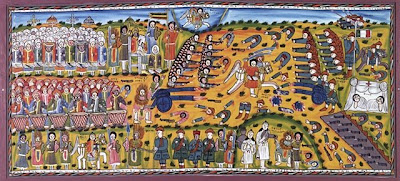
 Battle of Adowa - Ethiopian Painting

1. Rubenson, Sven, The Protectorate Paragraph of the Wichale Treaty, Journal of African History, v. 2 (1964), pp. 243-283, at pp. 243-245, and Pakenham, Thomas, The Scramble for Africa, Avon Books, New York, 1991, pp. 472-473, for an over view of Menelik's foreign policy see Gabre-Selassie, Dejazmach Zewde, Continuity and Discontinuity in Menelik's Foreign Policy, in Ed. Milkias, Paulos, & Metaferia, Getachew, The Battle of Adwa, Algora Pub., New York, 2005, pp. 89-132.

2. Pakenham, pp. 470-473, Gabre-Sellassie, Zewde, Yohannes IV of Ethiopia, Clarendon Press, Oxford, 1975, pp. 58-75, Erlich, Haggi, Ras Alula and the Scramble for Africa, Red Sea Press Inc., Lawrenceville NJ, 1996, pp. 98-109, Rubenson, Sven, The Survival of Ethiopian Independence, Heinemann Educational Books Ltd., London, 1976, pp. 290- 291, 316-329.

3. IBID. Pakenham, Berkeley, G. F-H., The Campaign of Adowa and the Rise of Menelik, Negro Universities Press, New York, 1969, (original pub. 1902), pp. 3-5.

4. Berkeley, pp. 17-18, Pakenham, 472.

5. Rubenson, 1964, pp. 249-251, Caulk, Richard, "Between the Jaws of Hyenas": A Diplomatic History of Ethiopia (1876-1896), Harrassowitz Verlag, Wiesbaden, 2002, 153-176.

6, Ayle, Negussay, Adowa 1896: Who was Civilized and Who was Savage?, in Milkias, pp. 133-179, p. 145. The Treaty of Wichale is as follows:
1. King Umberto I of Italy and Emperor Menelik II of Ethiopia commit themselves to the [Wichale] Treaty and Friendship and Commerce in mutual pursuit of peaceable and friendly realtions for themselves and for succeeding generations.

2. There shall be dipolomatic and consular exchanges between Ethiopia and Italy which shall operate with the immunities and privileges recognized in Europe.
3. Broad boundary delimitation line from Arafali on the Red Sea coast to the Sudan border with Halay, Segeneiti and Asmara falling within Italian Jurisdiction.

4. Debre Bizen monastry within the Italian zone is to remain Ethiopian territory in perpetuuity and to be permanently demilitarized.

5. Ethiopia can import / export merchandise via Massawa by paying 8% port duty.

6. The Emperor can import arms through Massawa free of charge and Italy will provide escort for their safe entry into Ethiopia.

7. There shall be free trade and commericial transit of people between the two countries but no large scale armed crossing of borders.

8. People of each country can live, move and do business in each other's territory in accordance with the respective local laws and customs.

9. When people from one territory become residents in the jurisdiction of another, they will retain their faith and denomination.

10. Disputes among Italian residents or among Ethiopian residents will be adjudicated by a judge they choose and if the dispute is between Ethiopian and Italian residents the case will br adjudicated jointly by Italian and Ethiopian jurists.

11. In the event Italian or Ethiopian residents pass away within the jurisdiction of one or the other government, their property shall be safeguarded until claimed.

12. Residents of one jurisdiction who commit capital crimes within another jurisdiction will be tried in their own national courrts and in accordance with their own laws.

13. The two Governments agree to extradite nationals wanted for capital crimes.

14. The Ethiopian Emperor shall take all measures to combat slave trading in his country.

15. The Treaty willl be in effect throughout Ethiopia.

16. The parties to the Treaty may change or amend the provisions of the Treaty five years after its adop[tion by giving a one-year notice regarding such intent; however, this is applicable to provisions relating to commerce and not to boundaries.

17. For whatever needs the Emperor of Ethiopia may have vis-a-vis European potentates, he can avail himself of the liason services of the Italian government.

18. In the event that there are two bids for goods or services of equal merit or value offerrred by an Italian national and by the national of another country, the Italian offer is to be favored by the Emperor.

19. The Treaty shall be written in duplicate in Amharic / (Ethiopic) and in Italian languages and both shall have equal validity and legal force.

20. For his part Emperor Menelik has hereby signed and affirmed the Treaty in the presence of Italian plenipotentiary Pietro Antonelli, on March 25, 1881 (Ethiopian Calendar) or May 2, 1889 (Gregorian Calendar) at Wichale, Ethiopia, and it shall be ratified in Rome at the earlist convenience.
From Negussay, pp. 144-145.

7. IBID. 147-150, Caulk, pp. 157-160.

8. IBID. Rubenson. pp. 260-265, Caulk, & pp. 194-199, 219-221, 230-233, Rubenson pp. 384-392.

9. Berkeley, pp. 17-22, Caulk, pp. 189-209.

10. IBID. Berkeley, p. 22.

11. IBID. Berkeley, pp. 24-33, Rubenson, 1964, pp. 247-251, 391-392, Caulk, pp. 214-225, Menelik II Website Here.

12. IBID. p. 33, Rubenson, pp. 260-265, 386., see Footnote 8, Caulk p. 252.

13. Caulk, p. 215, Menelik II website.

14. Berkeley, pp. 24-30, Caulk pp. 231-233.

15. Pakenham, 472-475, Caulk, pp. 269-324.

16. Berkeley, quoting Menelik II’s letter p. 33.

17, IBID. p. 32, Caulk, pp. 235-237.

18. IBID. pp. 34-35, Rubenson, p. 251, Caulk, pp. 235-267.

19. IBID. pp. 36-38, Caulk, pp. 243-260.

20, Negussay, p. 145.

21, Rubenson, p. 394.

22, Berkeley, pp. 36-38, Caulk, 235-267.

23. IBID. pp. 51-56, Pakenham, pp. 475-477, Rubenson, 395-397, Caulk, 269-324.

24. Pakenham, p. 484, Parkenham at p. 485 lists Ethiopian casualties as 7,000 dead and 10,000 wounded, Berkeley, 345-346, Berkeley gives Ethiopian casualties as 7,000 killed and 10,000 wounded, Caulk, p. 563-564, gives Italian losses has c. 4,900 dead + 1,000 Askari dead with 1,500 more wounded; all 56 of their guns, 11,000 riflesand c. 2,700 prisoners of which c. 1,900 were Italian and 800 were Askari, on pp. 566-567 Ethiopian losses are given as c. 4,000 dead with 6,000-8,000 wounded, Rubenson, pp. 403, lists the following casualties Italian (includes Askari), 7,000 dead, 1,500 wounded, and c. 3,000 prisoners. A letter dated March 31, 1896 from Yosef Neguse, (Menelik's Interpreter) states casualties has follows, 3,886 dead Ethiopians, 1,785 dead + captured Italians it gives the number of Askari killed or captured as 4,471, From Tafla, Bairu, Ethiopian Records of the Menilek Era, Harrassowitz Verlag, Wiesbaden, , 2000, Doc. 151, pp, 457-464, at 463, Wylde, Augustus B., Modern Abyssinia, Methuen & Co., London, 1901, gives the following figures, 4,000 captured Italians and Askari in equal numbers, 5,000-6,000 Ethiopian dead and c. 8,000 badly wounded of whom c. 25% died at p. 212.

25. Pakenham, p. 486, Berkeley, p. 356, for the disastrous Ethiopian war of 1935-1941, see Sullivan, Brian R., More than Meets the Eye: the Ethiopian War and the Origins of the Second World War, in The Origins of the Second World War Reconsidered, 2nd Edition, Ed. Martel, Gordon, Routledge, London, 1999, pp. 178-203, by same author, The Italian-Ethiopian War, October 1935-November 1941: Causes, Conduct, and Consequences, in Great Powers and Little wars, Ed. Ion, A. Hamish, & Errington, E.J., Praeger Publishers, Westport CT, 1993, pp. 167-201.

Pierre Cloutier

Tuesday, February 10, 2009

April 6, 1917

This is not a date that most people today remember but it is likely to be remembered has the most important date and event of the twentieth century. It was the day on which the United States declared war on the Central Powers in World War One and basically decided that Germany and her allies would lose, unless they very quickly won. Germany had in effect only a little over a year to achieve this result otherwise she was doomed to lose.

So just how did that epoch making event occur? In a few words it was the result of truly awesome stupidity, on the part of certain German leaders, directly related to their ignoring of Clauswitz’s dictum that war is a political tool and instead they subordinated politics to military “necessity”.

On February first 1917 the Kaiser as advised by his chief military advisers, who were in effect rulers of Germany, Hindenburg and Ludendorff, launched a campaign of unrestricted submarine campaign against Allied and neutral shipping. This was done despite knowledge that this would almost certainly get the United States in the war against Germany and her allies. So why was it done?


Hindenburg (Left) Ludendorff (Right)

At the time Britain was blockading Germany and her allies in an attempt to deprive Germany and her allies of essential materials. This caused significant distress and hunger in Germany and her allies and led to casting about for a way to retaliate, or counter blockade Britain.

Germany had tried at various times to use U-Boats to take / sink ships that were bringing goods to England during the early part of the war. There had even been various stabs at unrestricted submarine warfare, which led to such disasters as the sinking of the Lusitania, in which over 1100 people died including more than 100 Americans. This incident came close to starting a war between America and Germany and the Germans brought this experiment to an end.

Essentially submarine attacks on ships were a continuation of the old guerre de course, or privatering that European powers had engaged against each other during their past wars. In this case the u-boats were rather vulnerable to being rammed, or blown out of the water if they stuck to the recognized practice of stopping ships and searching them and enabling the crews to escape and then sinking them. This was highly dangerous. With torpedoes and deck guns there was, not surprisingly, a tendency to simply blow the ship out of the water without stopping it. Not only did stopping ships put the u-boat at risk but taking the time to search a ship put the u-boat at risk of being found in the meantime and sunk.

World War I U-Boat

Added to this was the problem that neutral vessels, especially American ships were sending war material to Britain and the other allied powers. Sinking such vessels, especially if you killed a lot of passengers at the same time, ran the risk of infuriating the neutral involved. In the case of the United States this involved infuriating a great industrial / economic power.

The U.S. was in the meantime doing excellent business with the Allied powers in terms of munitions and raw materials for war production. Also U.S. financial institutions played an important role in upholding allied finances and credit.

Not surprisingly the Germans were infuriated both by the Allied blockade and by the fact that America was aiding the allies in many ways. America was officially neutral and certainly President Woodrow Wilson made all the right noises about trying to arrange a sort of peace deal and was apparently fully sincere in wanting peace.

By then it was clear that if anything the Americans were pro-Allied, by reason of cultural and historical ties to Britain, and out of self interest. Although it must be emphasized the U.S. government and people did not want to be involved in a war. And frankly the American government wanted the war to end before it possibly interfered with American interests. A peace that in effect returned things more or less to the situation of early August 1914 before the war started was one that the American government found most appealing.

Americans were emerging only recently from a long term foreign policy direction of trying to isolate themselves from the politics and struggles and internal competitions of the European great powers. Traditionally American policy had concentrated on issues involving the Western Hemisphere with the proviso that America would not interfere with the great European powers if she was left alone in the Western Hemisphere. That had begun to change with such developments has the Spanish American War, which led to the conquest of the Philippines and acquiring of an American colonial empire. Further developments such has the acquiring of the Panama Canal Zone and the building of the Panama Canal, (opened 1914) also signaled a change indicating the emergence of the United States as a world power. In 1905 Theodore Roosevelt mediated the end of the Russian / Japanese war. All this signaled that the U.S. had arrived as a major player on the world scene.

Despite the above America was still profoundly leery of foreign entanglements and isolationism was a powerful force in the United States. Interestingly in the 1916 Presidential elections the main slogan of Woodrow Wilson’s campaign was “He kept us out of war!” Despite the fact that, if anything, Americans in general and Wilson in particular favored the Allied powers America did not want to be involved in the war. Given this how did it happen?

Woodrow Wilson

Well it was because America was heavily trading with the Allied powers, in munitions and raw materials and trade in other items. Trade with the Central Powers was virtually impossible due to the British blockade, so that there did not emerge a interest group in favor of keeping up trade with the Central Powers but there did emerge a interest group in favor of unimpeded trade with the Allied powers, which was proving to be highly beneficial to U.S., financial, trade and manufacturing interests. Further there was the simple fact that attacks on U.S. ships were obviously direct threats to the lives of U.S. citizens. Obviously attacks on British ships could be explained and justified on the grounds that British ships were ships of an enemy of Germany and therefore legitimate targets. However what about neutral vessels that were importing into Britain war material? Were they not targets? Here things get dicey if only because such vessels were from powers not at war with Germany and hence not real targets, but they did contain munitions and war material! The further complication that the rules governing such transactions in past wars involving European powers allowed the stopping and searching of neutral vessels bound for belligerent ports, especially with war material and allowed for confiscation of cargoes etc., also specified that crews would be saved and ships sunk only under very rigid circumstances. The existence of deck guns and torpedoes which allowed ships to be sunk on sight were not envisioned by these rules, neither was the fact that the “privateers” in this war, (u-boats), being so vulnerable to being sunk, made sinking ships on sight very tempting. The result was a series of mishaps and diplomatic disasters.

The Lusitania crisis was a prime example. This started after the Germans had declared an unrestricted submarine campaign in the waters around the British Isles. Due to a series of mistakes involving what the Germans thought was the prime purpose of the Lusitania. The ship was sunk by torpedo and over a thousand passengers were killed, including over 100 Americans. The idiocy of large elements of the German press in celebrating this “achievement” didn’t help. It nearly resulted in war between Germany and the U.S. It appears that the Lusitania was carrying war material, which was frankly in violation of the then current war rules. This fact and the fact that Germany rescinded the unrestricted campaign and U.S. didn’t want war prevented war from happening then.

Given the fact that the United States was by 1900 was the greatest industrial power on the planet, with huge financial, trade and raw material resources etc; war with her was an obviously iffy proposition to be engaged in only if there was little choice. Further by 1900 the United States had a larger population than any European power, with the exception of Russia. In effect the United States was second only to the British Empire in terms of overall power world wide. The British Empire was a fairly ramshackle affair that had great difficulty using / concentrating it's power in any one particular area, so that its effective power was less than adding up its resources, population would indicate. It was just common sense not to want war with the U.S.

Here however is where human idiocy / stupidity enters the picture. Simply a look at basic U.S. figures of population, industrial output etc., would have made it clear to any German statesmen that however annoying American trade during wartime with the Allied powers was, under no circumstances should Germany do anything to provoke America into a war. One should never underestimate the power of wishful thinking and sheer dumbness however. Despite the facts Germany's leaders stupidly did in fact provoke the United States into a war! It went as follows.

By the early winter of 1916 the war had entered its third year of bloody stalemate. Millions of soldiers on both sides were dead. Economies were straining at the end of their tether and Germany was going through a period of severe shortages due to the blockade, of food and other materials. The population was angry, and the generals were seeking a way out of the stalemate; for a quick easy solution. The desire to strike back at Britain was very strong so that as the winter went on pressure built up to strike at Britain through a counter blockade enforced by unrestricted submarine warfare.

Here is where the stupidity came into it. The fact is anger and rage are not conducive to clear thinking in terms of policy goals and how to achieve them, and in this case the various German generals, specifically Ludendorff and Hindenburg, who by this time had established what was in effect a Military Dictatorship over Germany dedicated to winning the war, had come to believe that Britain must be driven out the war by the quickest means possible. So various studies had been done and these studies had determined that sinking 800,000 tons of shipping per month for a period of 6 months would reduce Britain to famine and starve Britain of war material. So that Britain would be driven out the war in 6 months. The military studies done by the various elements of the German armed forces, especially the Naval department were characterized by distortion and a huge amount of wishful thinking and stunning over the top optimism of the prospects of unrestricted submarine warfare. Individuals like Admiral Tirpitz pushed for unrestricted submarine warfare with blind optimism and a cavalier disregard for alternatives or the possibility of failure.

In fact it should have been obvious that failure was not simply a distinct possibility it was a virtual certainty. The U-boats of the First World War had very slow underwater speeds, their torpedoes were very poor and their ability to coordinate operations with other U-boats virtually non-existent. Thus the vast majority of ships sunk by U-boats in this war were sunk by the deck guns of U-boats; and the vast majority of ships sunk were sailing alone. Given their technical limitations their ability to damage ships sailing in convoy was very limited. It should have been obvious that should the British convoy ships unrestricted submarine warfare would fail. A few escort or one escort ship per convoy would be enough to sink or drive off U-boats the great majority of time. This was both obvious and clear at the time. Further the time table for this too work was absurdly optimistic even if it had worked.1

At the same time it was clear by the fall of 1916 that Russia was in the process of internal collapse. The possibility of Russia falling apart or leaving the war was enormous, and in fact in February 1917 a popular insurrection overthrew the Tsarist regime and Russia’s ability to prosecute the war already visibly declining disintegrated further. This would give Germany the prospect of transferring troops etc., to the western front and enable them to either attack in an effort to gain victory or to secure a favorable peace.

So given the facts above why under those circumstances did the leaders of Germany embark on this foolish venture? To add America has their enemy just when Russia was collapsing meant replacing one enemy with a far more powerful enemy. The simple fact is many of the German leaders were prey to delusions. The fact that many in the German government thought that America's entry on the side of the Allies inevitable, if only for the Americans to help recover the huge sums they had loaned to the allies, made many people in the German government think that if America entered the war sooner rather than later it would make little difference. Of course this was nonsense the sensible policy would have been to put off American entry into the war has long as possible to the point where American help to the allies would have made no difference. Another delusion was that submarine warfare would work, ignoring the skeptics who pointed out the obvious problems. That American intervention would only add more supplies / financial aid to the Allied war effort. That any American expeditionary force would be small and so forth. In other words a stew of wishful thinking. Further America was simply underestimated and Ludendorff and Hindenburg remained quite happily ignorant of American economic power. It was pointed out that the American army was by European standards absurdly small, but ignored that given American economic power a huge Army could be created in less than two years. It was claimed that U-boats would sink troop ships and therefore prevent any substantial number of troops coming over the Atlantic. These fantasies, which is what they were, clouded clear thinking it was what Ludendorff, Hindenburg and their cortege wanted to hear so they heard it.2

The fact that since the war began the British Admiralty, in a fit of bull headed idiocy had utterly refused to institute convoys for various empty headed reasons had helped to reinforce German delusions about the efficiency of submarine warfare. In fact only if the British refused to institute convoys did the plan have even a ghost of a chance of working and frankly counting on the British being so stupid to the bitter end was foolish in the extreme. The fact that Lloyd George, who became British Prime Minister in 1917, was pressing for adoption of convoys made adoption a virtual certainty. Faced with this constellation of circumstances i.e., Russia leaving the war, unrestricted submarine warfare almost certainly to fail, and the U.S. entering the war if unrestricted submarine warfare was declared. The sensible option would have been not to do so but to sit tight.

The results were predictable, the fact that Germany allowed certain of their diplomats to make foolish moves like encouraging Mexico to attack the United States and offering an alliance with Mexico directed against the United States were mere infuriating icing on the cake. The United States simply did not want war with Germany but with great foolishness German leaders infuriated the U.S. government, citizens and businesses, (by trying to end their profitable trade with the Allied powers). It is by any standards one of the greatest examples of plain stupid policy making in world history.

The effects shaped the world we have today, even more than the Russian Revolution. America entered the war. Britain adopted the convoy system. Submarine warfare, despite the idiotic reluctance of the British Admiralty to adopt convoys, didn’t even come close to driving Britain out of the war.3 It simply failed. Replacing America with Russia ensured allied victory. More than 2 million American troops were sent to Europe and less than 50 were killed by U-boat attacks. The U-boats proved spectacularly ineffective in attacking convoys or sinking troop ships. Germany’s had to attack in the west before American troops arrived en mass. The chances of the attack working were not good and frankly any chance of Germany victory had evaporated by June 1918 and any reasonable chance of German victory had probably evaporated by the time the first German western offensive was launched in March 1918.

After the war both Hindenburg and Ludendorff helped to manufacture the stab in the back legend i.e., that politicians, liberals, Socialists etc., had betrayed Germany and caused the loss of the war. This was nonsense, it was their own single minded and foolish choices has military men that lost Germany the war, but blaming the politicians who had to clean up the mess they created was more psychologically satisfying I guess. This was part of a wholesale campaign by various people within German society to undermine the Weimer Republic. Thus did the men who lost the war for Germany help pave the way for Hitler.

In world terms this marked the establishment of the United States has the worlds predominant power, in finance, trade, culture etc., a dominance that only recently in a very Americanized world has began to fade. It appears that Communism for example, was mainly a bump that disguised the predominant fact of the twentieth century, the large scale westernization of the world through the medium of American power and culture.

And that is why April 6, 1917 is so important.

1. Blair, Clay, Hitler’s U-Boat War: The Hunters, 1939-1942, Modern Library, New York, 1996, pp. 9-22. This is a brief section that briefly surveys German U-Boats in World War I.

2. Ibid.

3. Ibid.

Books consulted.

Fuller, J.F.C., A Military History of the Western World, vol. 3, Da Capo, New York, 1956, pp. 265-275.

Stone, Norman, Europe Transformed 1878-1919, Fontana Books, London, 1983, pp. 355-358.

Keegan, John, The First World War, Vintage Canada, Toronto, 1998, pp. 350-360.

Epstein, Klaus, Gerhard Ritter and the First World War, in The Origins of the First World War, Ed. Koch, H. W., Taplinger Pub. Co., New York, 1972, pp. 298-303.

Zechlin, Egmont, Cabinet versus Economic Warfare in Germany, in Koch, pp. 206-214.

Craig, Gordon A., Germany 1866-1945, Oxford University Press, Oxford, 1978, pp. 378-390.

Hart, Liddell, History of the First World War, Pan Books Ltd., London, 1934, pp. 214-216, 308-312.

Pierre Cloutier