Friday, May 23, 2014
Thursday, June 04, 2009
In 1918 the Polish revolutionary Rosa Luxemburg penned a short pamphlet called The Russian Revolution, that outlined her views on the then happening Russian Revolution. I have previously mentioned her in a post about the Russian Revolution and here I want to discuss Rosa Luxemburg’s critique.
Rosa Luxemburg was born in a very assimilated Jewish family near the then border of Russian Poland in 1871.1
Rosa Luxemburg became involved in radical politics in Poland and strikes. And in the mid 1890’s began writing on Marxist theory. She was always a very radical thinker. Rosa Luxemburg did not believe in any sort of compromise with the “Capitalist” system.
For example she consistently opposed the “Revisionism” of the German Social Democratic Party that, in her opinion, fatally compromised with the status-quo. She was also a suspicious of and opposed to Nationalist movements believing them a snare and a diversion from the real struggle against “Capitalism”.
In 1898 she married a German by the name of Gustav Lübeck and moved to Germany, where she spent most of the remainder of her life.2 Rosa Luxemburg wrote various books on Marxist theory including The Accumulation of Capital, that sought to explain Imperialism and its effects.3
In 1914 she opposed Germany’s entry into World War I, and violently denounced what she saw as the treason of the German Social Democrats in supporting the war. Rosa Luxemburg left the party in disgust. Rosa Luxemburg was jailed for this during which time she wrote many letters, and articles.
Rosa Luxemburg was released in October of 1918 and with Karl Liebknecht founded the Spartakist party. In In January 1919, against her advice the Spartakists rose in revolt. The revolt was crushed and Rosa Luxemburg and Karl Liebknecht were killed and their bodies dumped into a canal.4
As a thinker Rosa Luxemburg was an all too typical Marxist dogmatician of the time period with the usual superficial appeals to science and objectivity. Both of which this sort of thinking conspictiously lacked.
However unlike the case of Lenin and many others, Rosa Luxemburg had a great distrust of the idea of the “masses” being led around by the noses by a “enlightened” elite. Rosa Luxemburg believed both in the spontaneous action of the “masses” and in democratic control of politics and politicians. This was even more the case in that although Rosa Luxemburg had little use for either “bourgeois” Parliamentary democracy of “Bourgeois” freedom of the press. In both cases she thought that the solution was in one case a massive extension and deepening of democracy and in the other a similar massive extension and deepening of press freedom.5 Which was radically different from Lenin’s solution which was to abolish both and replace them by dictatorship and censorship / press control.6
In the fall of 1918 Rosa Luxemburg wrote her pamphlet The Russian Revolution. What we have is an uncompleted rough draft that Rosa Luxemburg’s death prevented her from revising and completing. It was published after her death. Since the Spartakist party that she founded was the germ of the German Communist party, there were periodic attempts to suppress and generally ignore this work which was considered rather embarrassing to the party hacks in awe of Lenin and later Stalin.7
It is important to remember that because of Rosa Luxemburg’s disputes with the intellectual leading lights of the German Social Democratic party that Rosa Luxemburg’s attitude was strongly coloured by her strong antipathy to the leadership of the Social Democrats and to those she perceived as their allies. The result was that because the German Social Democrats had in her eyes betrayed the cause of the “masses” by supporting the war she instantly disallowed their reaction that revolution was premature in Russia given that the economic and social forces were not conducive to a “Proletariat” revolution and the best that could be hoped for would be “Bourgeois” “Capitalist” revolution. Thus Rosa Luxemburg states:
In this, the Russian Revolution has but confirmed the basic lesson of every great revolution, the law of its being, which degrees: either the revolution must advance at rapid, stormy and resolute tempo, break down all barriers with an iron hand and place its goals ever further ahead, or it is quite soon thrown backwards behind its feeble point of departure and suppressed by counter revolution. To stand still, to mark time on one spot, to be contented with the first goal it happens to reach, is never possible in revolution.8
Some of the points in Rosa Luxemburg’s essay seem both rather doctrinaire and short sighted. For example in her section on Bolshevik land policy she critiques the policy of the Bolsheviks in allowing the seizure of large landed estates and the subsequent division of the land among the peasantry. Rosa Luxemburg argues that this has created a large class of middle and “rich” peasants who will be enemies of the revolution. Rosa Luxemburg contends that the Bolsheviks should have nationalized the large landed estates and had the state run them. Aside from being dogmatic Rosa Luxemburg seems not to know that the Bolsheviks did not give the land to the peasants but merely ratified peasant seizure of the land. Any attempt to seize back or disallow the seizure would have been both counter productive and futile. Further Rosa Luxemburg does not seem to know that the source of peasant antagonism to the regime was not just simple greed for profit but the break down of industry in the period after the Bolshevik Revolution that left little with which to buy peasant produce so of course the peasants would not sell. Further the reckless policies of “War Communism”, which included road blocks and battalions of armed men going into the country side and seizing peasant produce was another, very real, source of peasant antipathy to the regime.10
In another chapter Rosa Luxemburg criticises the nationality policy of the Bolsheviks, especially the idea the different ethnic groups of the Russian Empire have a right to self determination. Like so many Marxists Rosa Luxemburg believed that nationalism was a type of false consciousness and that the “proletariat” had no country but only their “class interests”, and that Nationalism was basically reactionary. Interestingly Rosa Luxemburg took the statements of the Bolshevik about self determination seriously, when in actuality it was in reality different. That the Bolsheviks intended to use nationalism for their own ends and once the “proletariat” (i.e., the Bolsheviks seize power), self determination becomes nothing more than quaint cultural rights and real self determination becomes “bourgeois” and “reactionary”. Rosa was so welded to the dogmatic idea of the “class interests” of the “workers” / “proletariat” that she had no real conception of the power or basis of nationalism. This is probably at least partially based on the assimilated, secular upbringing she had. It left her with little feel for particular, national, ethnic or religious interests. For example she never felt any particular link or understanding of the particular interests of the Jews living in Czarist Russia.11
However it is the above mentioned chapter that Rosa Luxemburg’s fundamental criticisms of the Bolsheviks begin. For example:
While they showed quite cool contempt for the Constituent Assembly, universal suffrage, freedom of the press and assemblage, in short, for the whole apparatus of the basic democratic liberties of the people which, taken all together, constituted the “right to self determination” inside Russia, treated the right of self determination of peoples as a jewel of democratic policy for the sake of which all practical considerations of real criticism had to be stilled.12.
In another chapter13 Rosa Luxemburg discusses the dissolution of the Constituent Assembly in January of 1918. After making the rather the rather obvious point that before and during the overthrow of the Provisional Government in October of 1917 the Bolsheviks made much to do about the Provisional Government delaying the Constituent Assembly. Further the Bolsheviks made this one of the reasons for their overthrowing the government in October of 1917. The Bolsheviks, (i.e., Lenin and Trotsky gave has reasons the “fact” that the situation had changed decisively and that the assembly was out of date. Rosa Luxemburg writes about this “reason”:
All this is very fine and quite convincing. But one can’t help but wondering how such clever people as Lenin and Trotsky failed to arrive at the conclusion that follows immediately from the above facts.
... …then it follows automatically that the outgrown and therefore still-born Constituent Assembly should have been annulled, and without delay, new elections to a new constituent Assembly should have been arranged.14
Yet how all historical experience contradicts this! Experience demonstrates quite the contrary: namely, that the living fluid of the popular mood continuously flows around the representative bodies, penetrates them, guides them.Rosa Luxemburg concludes:
…
It is precisely the revolution that which creates by its glowing heat that delicate, vibrant, sensitive political atmosphere in which the waves of popular feeling, the pulse of popular life, work for the moment on the representative bodies in most wonderful fashion.15
To be sure, every democratic institution has its limits and shortcomings, things which it doubtless shares with all other human institutions. But the remedy which Trotsky and Lenin have found, the elimination of democracy as such, is worse than the disease it was supposed to cure; for it stops up the very living source from which alone can come the correction of all innate shortcomings of social institutions. That source is the active, untrammelled, energetic political life of the broadest masses of the people.16In another chapter17 Rosa Luxemburg criticises the Bolshevik policy of restricting the right to vote to those who work with their own hands and eliminating the right to vote for members of “hostile classes”. Rosa Luxemburg considers those policies wrong headed and counter productive. Rosa Luxemburg writes:
For those attacks (on democratic rights), the arguments of Trotsky cited above, on the cumbersome nature of democratic electoral bodies, are far from satisfactory. On the other hand, it is a well-known and indisputable fact that without a free and untrammelled press, without the unlimited right of association and assemblage, the rule of the broad mass of the people is unthinkable.18The next chapter,19 The Problem of Dictatorship, is basically a short masterpiece of political analysis which damns the entire Communist, Marxist-Leninist experiment right at birth.
Rosa Luxemburg accuses the Bolsheviks of denying the “masses” the experience that is necessary for them to exercise political power just when such experience is in fact most necessary. In one outstanding passage Rosa Luxemburg talks about freedom:
Freedom only for the supporters of the government, only for the members of one party – however numerous they may be – is no freedom at all. Freedom is always and exclusively freedom for the one who thinks differently. Not because of any fanatical concept of “justice” but because all that is instructive, wholesome and purifying in political freedom depends on this essential characteristic, and its effectiveness vanishes when “freedom” becomes a special privilege.20Thus does Rosa Luxemburg damn both one party states and severe restrictions of press freedom in such states.
Rosa Luxemburg further states:
The tacit assumption underlying the Lenin-Trotsky theory of the dictatorship is this: that the socialist transformation is something for which a ready-made formula lies completed in the pocket of the revolutionary party, which needs only to be carried out energetically in practice. This is, unfortunately – or perhaps fortunately – not the case.21This being the case Rosa Luxemburg contends that public control and freedom is absolutely necessary in order to work things out. Lack of public input will only make things vastly more difficult. For Rosa Luxemburg the Lenin / Trotsky idea of “Socialism” is that it can “be decreed from behind a few official desks by a dozen intellectuals.”22
Regarding Lenin’s methods Rosa Luxemburg states
But he is completely mistaken in the means he employs. Decree, dictatorial force of the factory overseer, draconic penalties, rule by terror – all these things are but palliatives. The only way to a rebirth is the school of public life itself, the most unlimited, the broadest democracy and public opinion. It is rule by terror which demoralizes.23In this uncannily prophetic passage Rosa Luxemburg sees the future all to clearly:
When all this is eliminated, what really remains? In place of the representative bodies created by general popular elections, Lenin and Trotsky have laid down the soviets as the only true representation of the laboring masses. But with the repression of political life in the land as a whole, life in the soviets must also become more and more crippled. Without general elections, without un-restricted freedom of press and assembly, without a free struggle of opinion, life dies out in every public institution, becomes a mere semblance of life, in which only the bureaucracy remains as the active element. Public life gradually falls asleep, a few dozen party leaders of inexhaustible energy and boundless experience direct and rule. Among them, in reality only a dozen outstanding heads do the leading and an elite of the working class is invited from time to time to meetings where they are to applaud the speeches of the leaders, and to approve proposed resolutions unanimously – at bottom, then, a clique affair – a dictatorship, to be sure, not the dictatorship of the proletariat, however, but only the dictatorship of a handful of politicians, that is a dictatorship in the bourgeois sense, in the sense of the rule of the Jacobins (the postponement of the Soviet Congress from three-month periods to six-month period!) Yes, we can go even further: such conditions must inevitably cause a brutalization of public life: attempted assassinations, shooting of hostages, etc. (Lenin’s speech on discipline and corruption.)24Thus within the first year of the Bolshevik’s taking power a very radical thinker, very sympathetic to the Bolshevik’s goals, saw where their methods were leading and uncannily saw the future of the Leninist style of political party and a pattern that was to be, with monotonous regularity, duplicated around the globe for the next 60+ years.
After this the final chapters of Rosa Luxemburg’s pamphlet are a bit of a let down. However Rosa does have a few pertinent things to say about the use of terror to deal with corruption and social breakdown.
Indeed, every persistent regime of martial law leads invariably to arbitrariness, and every form of arbitrariness tends to deprave society.In the last chapter26 Rosa Luxemburg attacks her “revisionist” enemies in the German Social Democratic party and the Bolsheviks. It is fascinating to record that her idea of the “Dictatorship of the Proletariat” is not rule by a cast of politicians but “class” rule by workers which “…means in the broadest public form on the basis of the most active, unlimited participation of the mass of the people, of unlimited democracy.”27
…
Against this, [corruption, social breakdown] draconian measures of terror are powerless. On the contrary, they cause still further corruption. The only anti-toxin: the idealism and social activity of the masses, unlimited political freedom.25
Rosa Luxemburg then deals with Lenin and Trotsky’s attacks on “Bourgeois” democracy and agrees with them but says that does not mean eliminating democracy altogether but to create real or “Socialist” democracy. For Rosa Luxemburg Democracy:
…it [democracy] does not come as some sort of Christmas present for the worthy people who, in the interim, have loyally supported a handful of socialist dictators. Socialist democracy begins simultaneously with the beginnings of the destruction of class rule and the construction of socialism.Rosa Luxemburg then proceeds to attack the Social Democrats for being partially responsible for what happened in Russia and also mentions that the rather disastrous external situation did not help the Bolsheviks very much. Rosa Luxemburg does mention that she is worried the Bolsheviks may:
…
But this dictatorship [i.e., the class rule of the “Proletariat”] must be the work of the class and not of a little leading minority in the name of that class -...28
Make a virtue of necessity and want to freeze into a complete theoretical system all the tactics forced upon them by those fatal circumstances, and want to recommend them to the international proletariat as a model of socialist tactics.29That is exactly what happened. For the next 60+ years Moscow sought to mold every so called Marxist-Leninist (Communist) party in precisely this way with disastrous effects all over the world.
The last page and half are a sort of backhanded hymn to the Bolsheviks for having dared to try a “Socialist” revolution, and given Rosa Luxemburg’s antipathy to both “Revisionism” and “Capitalism” not a surprise but still in the context of the work as a whole it is faint praise indeed.
Rosa Luxemburg’s Pamphlet was basically ignored by all save a few radical leftists and was an embarrassment to her former colleagues in the Spartakist party who help found the Communist party of Germany which was slavishly submissive to Russia. It is hard to believe that Rosa Luxemburg would have had much truck with the Soviet Union and given her then formidable international reputation probably very fortunate for Soviet efforts to create Communist parties in Western Europe that she was murdered in 1919, by a right wing death squad. It was so much better to have her as a dead martyr than eloquent opponent.
As for the cogency of her prophecies. They were all too accurate. Much of the history of the twentieth century was a bloody working out of the Bolshevik “mistake”. If Rosa Luxemburg was in many ways a dogmatic thinker in this instance she saw without blinkers and what she saw appalled her.
1. See Wikipedia, article, Rosa Luxemburg, Here
2. IBID.
3. A copy can be found at the Rosa Luxemburg, Internet Archive, Here
4. See Footnote 1.
5. IBID.
6. See Farber, Samuel, Before Stalinism, Verso, London, 1990, pp. 19-61 & 90-112.
7. Luxemburg, Rosa, The Russian Revolution and Leninism or Marxism?, University of Michigan Press, Ann Arbor, 1961, pp. 15-24. A copy can be found at the Rosa Luxenburg, Internet Archive, Here
8. IBID. p. 36.
9. See Ulam, Adam B., The Bolsheviks, Collier Books, New York, 1965, pp. 343-381, Leonhard, Wolfgang, Three Faces of Marxism, Paragon Books, New York, 1970, pp. 47-94, Kolakowski, Leszek, Main Currents of Marxism: 2. The Golden Age, Oxford University Press, Oxford, 1978, pp. 332-336.
10, See Luxemburg, pp. 41-46. See also Figes, Orlando, A People's Tragedy, Penguin Books, New York, 1996, pp. 608-630.
11. Luxemburg, pp. 47-56, See also Leonhard, pp. 60-62, Kolakowski, pp. 88-94, 398-405.
12. Luxemburg, p. 48.
13. IBID. 57-62.
14. IBID. p. 59.
15. IBID. pp. 60-61.
16. IBID. p. 62.
17. IBID. pp. 63-67.
18. IBID. pp. 66-67.
19. IBID. pp. 68-72.
20. IBID. p. 69.
21. IBID. p. 69.
22. IBID. p. 71.
23. IBID. p. 71.
24. IBID. p. 72-73.
25. IBID. pp. 74-75.
26. IBID. pp. 76-80.
27. IBID. pp. 76-77.
28. IBID. pp. 77-78.
29. IBID. p. 79.
Thursday, May 21, 2009
Of course a ‘hot button” issue like this one is exceptionally useful in keeping peoples mind off real issues and have them getting obsessed with what their neighbours are doing.
Pornography is one of those issues and it has been and is exceptionally useful in getting people’s minds off the important stuff.
Of course porn has been around a very long time and has not always caused the same level of hysteria and sheer mockish stupidity.
For example lets us look at such things as this rather interesting Herm from ancient Greece with their very erect penises and stood on street corners in many Greek cities.
Or how about this much larger than life size penises from Delos.
There is also this painting from Pompeii which is shall we say explicit.
And for you fans of the truly kinky how about a little bestiality.
The above is not my cup of tea or dare I say of much interest to any but a small minority of humans.
What is of interest is how such images did not disturb the equilibrium of Greco-Roman society. It simply never occurred to anyone that such images were problematic and disturbing. They might be refined, well done or crude and tasteless but they would not have been considered some sort existential threat to that society.
The result when these items were rediscovered was some of the most absurd stupidities by the modern guardians of morality. There is in Naples a collection of art and artefacts collected from Pompeii called The Secret Collection, which until very recently was kept locked away from regular museum goers least its pornographic and erotic images, confuse and scandalize the poor simple minded average museum visitor.1
I would think that the ancient Romans and Greeks would have laughed quite loudly at such no-nothing brainless idiocy.
Considering that Greeks and Romans considered public displays of phallic imagery as a good luck charm they would have been quite non-plussed by so many moderns getting hysterical about it.
So what really bothers moderns about porn?
The answer is quite simple. Porn shows sex. Now if it was really about issues that you would think are legitimate problems and concerns you would not see the level of hysteria over it that is indeed there.
This level has its roots in the idea that sex is dangerous and needs to be controlled and regulated and that it is a dark and mysterious force that is tainted with diabolical and evil qualities.2
I remember a series of programs called A Third Testament, (1976) narrated by Malcolm Muggeridge from the mid 70’s. In an episode about the Russian novelist Leo Tolstoy Malcolm refers to “CCC-ARNALL – PP-LEASURES!!. While saying that Malcolm squints, furrows his forehead and looks like he is having a severe migraine combined with a coronary. Like a vast number of older people Malcolm, who when he was younger indulged deeply in “carnal pleasures”, now that he was older and past all that, he thought it would be a good idea to deny other people “carnal pleasures”. No doubt having both satiated himself and gotten too old to indulge in “carnal pleasures”, it would be most satisfying for him to deny others “carnal pleasures”. The look of satisfaction that crossed his face as he talked about denying others “carnal pleasures” indicated that despite his supposed wish to help others escape being enslaved to “carnal pleasures”, that he was just has enslaved to them as ever. Only in this case being unable to enjoy them himself he would get perverted pleasure from denying others similar “pleasures”.3
It is indeed remarkable how obsessed so many of those who complain about other people being obsessed with sex are with sex. Instead they think constantly about how wicked it is for other people to have sex and how they have to be brought under control and how wicked them having sex is. Like the most sex obsessed orgiest these people never stop thinking about sex, only in this case how wicked and evil it is and how other people are having it and how they have to be stopped. Thus like Malcolm Muggeridge they writhe in prurient ecstasy at the thought of “CCC-ARNALL - PP-LEASURES!!” and think constantly and obsessively about sex.
One could go into the roots of this obsessive prurience but it is not necessary except to note that it seems to be at least partially related to a certain style of Christian values.
This notion of sex has dangerous, disgusting and prurient and this obsession with what other people are doing is behind most of the anti-pornography hysteria that exists in our society. This hysteria has lead to a seeming inability to discuss pornography in any sort of rational manner.4
Now it can easily be argued, and in my opinion obviously true, that pornography has problematic aspects.
For example. It is true that much pornography is in fact involves the use and rather unpleasant exploitation of the women, and yes sometimes at least men involved in producing it.
There is of course the issue of child porn and bestiality, which involves issues of consent and exploitation.
There is also the problem of extremely violent pornography that sexualizes, rape, sadistic, brutal degradation and humiliation, especially of women.5
Those are genuine issues of concern and certainly subject to analysis and critique. What are not reasonable are the following pieces of nonsense.
The idea that pornography is responsible for the subordination of women. A position advanced by the late Andrea Dworkin and by Catherine McKinnon. Are they seriously advancing the position that the existence of pornography is the main reason why women are oppressed? A position whose light headedness should cause it to float away and disperse.
Lets see most Muslim states especially the more religious ones prohibit most pornography and Scandinavian countries have lots of available porn. Guess which countries women have a better, socio-economic and political position in? Would it be sensible to argue that pornography caused women to have a better position in Scandinavia? Of course not but that is where this sort of logic leads us.6
Another popular idea, adopted for example by Courts in various places is the idea that pornography causes “harm”. In Canada this idea largely via Catherine A. MacKinnon, has caught on with the courts basically as a way of avoiding the old “community standards” rule which was pretty useless and the old “artistic merit” debate.7
It is ironic that the so-called anti-pornography Feminists who use this argument allow themselves to be allied to anti-pornographic so-called “Christian” groups who are quite convinced of the harm done by Feminist speech and the need to curtail, if not eliminate that form of speech.
The problem is the “harm” described is pretty nebulous and lacks concrete specifics. Finally even if it causes “harm” is that a reason to ban it? Well it can be easily shown that Hitler’s Mein Kampf caused and causes real harm. Yet it is available. So are the works of Karl Marx and of countless thinkers whose ideas were used as an excuse by some to cause mayhem.
One could of course easily list all sorts of works that incited people to resist or rebel violently; say the works of Thomas Paine? So the “harm” idea in my opinion is nothing more than the old disgust, prurient argument. I.E., “this is revolting and disgusting so of course it causes harm”. Even assuming pornography causes “harm” is that a reason to ban it, after all lots of speech causes harm and is not banned.8
It is routine among anti-pornography crusaders to demonize the makers of pornography. A favourite story is the infamous snuff film story. What is fascinating is that despite decades of efforts to track down this elusive film we have yet to find a real snuff film. I.E., a film of an actual person being killed as the “climax” of a sadistic sex scene in a porn movie. It appears that certain films have had simulated death, although even those are very hard to find, but that a bona-fide for real snuff film seems to be nonexistent. Frankly that surprises me given just how perverse and vicious humans can be. The language of disgust is generally in full flower when anti-pornographers describe the makers of pornography. It seems to do so because anti-pornographers conceive of the world in manichean terms of the sons of light against the sons of darkness. They also seem to have no desire to find out in any depth or detail how the pornography industry actually works.9
Another argument, very frequently used, is that pornography is not “speech” and hence not eligible for being protected by freedom of speech guarantees, like the Canadian Charter of Rights or the American Constitution. The argument is that the guarantees only protect “political” speech. This is an interesting argument although in the end it amounts to the usual disgust argument. I.E., “pornography disgusts me so it isn’t legitimate speech”. Well lots of speech disgusts me such as Holocaust denial bilge and Racist vomit and Stalinist excrement but I would never dream of banning it because I find it disgusting. Of course there is Gore Vidal’s answer to this point of view “Sex is politics”. In fact his point is that sex is deeply political given that it is about on the most intimate level about how we relate to each other.10
By giving pornography deep existential importance and allying it to fundamental forces of society the anti-pornographers have elevate pornography from a diversion to a fundamental cosmic principle. It is not and never was.
Perhaps the most significant development in the pornographic industry lately has been the development of cams and other recording devices that make it very easy for people to make their own pornography. Thus escaping the censor and the prurient prude. Just how are the anti-pornographers going to control and regulate that?
The Greco-Romans had it right Pornography is nothing to get your knickers in a knot about.
1. Mulas, Antonia, Eros in Antiquity, The Erotic Art Book Society, New York, 1978., pp. 9-13.
2. See Richards, Jeffrey, Sex, Dissidence and Damnation, Routledge, London, 1991, pp. 22-41, Moore, R. I., The Formation of a Persecuting Society, 2nd Edition, Blackwell Pub., London, 2007, pp. 94-116.
3. For more information on A Third Testament, see Here
4. See Footnote 2.
5. For a overview of these issues see Diamond, Sara, Pornography: Image and Reality, in Women Against Censorship, Edited by Burstyn, Varda, Douglas & McIntyre, Toronto, 1985, pp. 40-57.
6. See Dworkin, Andrea, Pornography: Men Possessing Women, Plume, New York, 1991, MacKinnon, Catherine A., Are Women Human?: And Other International Dialogues, Cambridge University Press, Cambridge, 2006.
7. The main case in question as been R. v. Butler, [1992] 1 S.C.R. 452, which uses this frame work and adopted largely from Catherine A. MacKinnon’s ideas.
8. See the essays in Burstyn, Varda.
9. For more about the apparent non-existence of snuff films see Stine, Scott Aaron, The Snuff Film: The Making of an Urban Legend, Here.
10. For the view that pornography is not real speech see McKinnon, Catriona, Toleration: A Critical Introduction, Routledge, London, 2006, pp. 137-152. For the view of sex as politics see Vidal, Gore, Sex is Politics, in The Second American Revolution and other Essays 1976-1982, Random house, New York, 1982.
Pierre Cloutier
Saturday, April 11, 2009
A Fantasy
A persistent myth in the historiography of Witchcraft and the Witchcraze is the idea that underneath the distortions of the witch hunters and the hysteria of alleged “Devil Worship” was a real “Witch religion” that the Church was suppressing. The idea that the craze was about something that was nonexistent is very hard for a lot of people to swallow.
The modern origin of this notion can be reduced to three figures. The French historian Jules Michelet in his book La Sorciere1, published originally in 1862. Another writer who helped to launch the idea of an organized Witch religion was the writer Montague Summers, who wrote among a number of Books on Witchcraft, including The History of Witchcraft and Demonology, who published translations of many Witch Hunter manuals including the infamous Malleus Maleficarum, published 1486, by Heinrich Kramer and James Sprenger. 2 The third writer was Margaret Murray, an Egyptologist, who wrote The Witch-cult in Western Europe, (1921) and God of the Witches, (1933).3
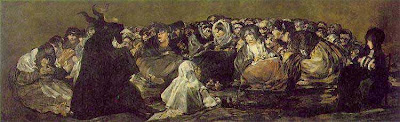
To begin with Jules Michelet. His book La Sorciere contains a description of the Black Mass which is a tissue of conjecture and fantasy. It was based on his idea that the “witch” religion was a response to severe oppression by the en-serfed peasant population:
They decked an altar to the arch-rebel of serfs to him who had been so wronged, the old outlaw hunted out of heaven, “the Spirit by whom earth was made, the Master who ordained the budding of the plants.”4
Michelet goes on to describe the ceremony as being organized by a “Witch”:
She is described:At the back of all is the Witch, dressing up her Satan, a great wooden devil, black and shaggy. By his horns, and the goat-skin near him, he might be Bacchus; but his manly attributes make him a Pan or a Priapus. It is a darksome figure, seen differently by different eyes; to some suggesting only terror, while others are touched by the proud melancholy wherein the Eternally Banished seems absorbed.*5
The Devil's bride was not to be a child : she must be at least thirty years old, with the form of a Medea, with the beauty that comes of pain; an eye deep, tragic, lit up by a feverish fire, with great serpent tresses waving at their will: I refer to the torrent of her black untamable hair. On her head, perhaps, you may see the crown of vervein, the ivy of the tomb, the violets of death.6
Michelet than describes the stories of the “orgies” and incest and pronounces them basically and quite justifiably as incredible. But he then goes into a long declamation in explaining why those things may have happened.8
It is all in all a good read but quite fantastic and in fact a complete myth. The ceremony Michelet describes is a reconstructed fantasy with little basis in reality. It is formed from not his reading of the source material but from his deep sympathy for two oppressed groups-peasants and women.9
To quote a modern historian concerning the veracity of this fantasy:
Now none of this figures in any contemporary account of the witches’ sabbat. Not one mentions a priestess, or so much as hints that a single woman dominates the ritual. As for the ‘black mass’ celebrated on a women’s back - that notion was born in an entirely different historical context: the ‘affair of the poisons’, which took place in Paris around 1680. Nor was the sabbat, even at its first appearance, imagined as a festival of serfs – already in 1460, at Arras, rich and powerful burghers were accused of attending it, along with humbler folk. To give his account even a shadow of plausibility, Michelet has to pretend that all extant accounts of the sabbat date from the period of its decadence; the true, original sabbat being something quite different. The argument is not likely to commend itself to historians.10
For we know that the Continental stories of witch gatherings are with very few exceptions the chronicle of actual fact. It must be confessed that such feeble skepticism, which repeatedly mars his summary of the witch-trials, is a serious, blemish in Professor Notestein's work, and in view of his industry much to be regretted.11
Keen intelligences and shrewd investigators such as Gregory XV, Bodin, Guazzo, De Lancre, D'Espagnet, La Reynie, Boyle, Sir Matthew Hale, Glanvill, were neither deceivers nor deceived.12
In the following pages I have endeavoured to show the witch as she really was an, evil liver; a social pest and parasite; the devotee of a loathly and obscene creed; an adept at poisoning, blackmail, and other creeping crimes; a member of a powerful secret organization inimical to Church and state; a blasphemer in word and deed; swaying the villagers by terror and superstition; a charlatan and a quack sometimes; a bawd; an abortionist; the dark counselor of lewd court ladies and adulterous gallants; a minister to vice and inconceivable corruption; battening upon the filth and foulest passions of the age.13
The President of the Sabbat was in purely local gatherings often the Officer of the district; in the more solemn assemblies convened from a wider area, the Grand Master, whose dignity would be proportionate to the numbers of the company and the extent of his province. In any case the President was officially known as the “Devil” and it would seem that his immediate attendants and satellites were also somewhat loosely termed “devils” which formal nomenclature has given rise to considerable confusion and not a little mystification in the reports of witch trials and the confessions of offenders. But in many instances it is certain and orthodoxy forbids us to doubt the possibility - that the Principle of Evil, incarnate, was present for the hideous adoration of his besotted worshippers.14
It was far other in the twelfth century; the wild fanatics who fostered the most subversive and abominable ideas aimed to put these into actual practice, to establish communities and to remodel whole territories according to the programme which they had so carefully considered in every detail with a view to obtaining and enforcing their own ends and their own interests. The heretics were just as resolute and just as practical, that is to say, just as determined to bring about the domination of their absolutism as is any revolutionary of to-day. The aim and objects of their leaders, Tanchelin, Everwacher, the Jew Manasses, Peter Waldo, Pierre Autier, Peter of Bruys, Arnold of Brescia, and the rest, were exactly those of Lenin, Trotsky, Zinoviev, and their fellows. There were, of course, minor differences and divergences in their tenets, that is to say, some had sufficient cunning to conceal and even to deny the extremer views which others were bold enough or mad enough more openly to proclaim. But just below the trappings, a little way beneath the surface, their motives, their methods, their intentions, the goal to which they pressed, were all the same. Their objects may be summed up as the abolition of monarchy, the abolition of private property and of inheritance, the abolition of marriage, the abolition of order, the total abolition of all religion. It was against this that the Inquisition had to fight, and who can be surprised if, when faced with so vast a conspiracy, the methods employed by the Holy Office may not seem——if the terrible conditions are conveniently forgotten——a little drastic, a little severe? There can be no doubt that had this most excellent tribunal continued to enjoy its full prerogative and the full exercise of its salutary powers, the world at large would be in a far happier and far more orderly position to-day. Historians may point out diversities and dissimilarities between the teaching of the Waldenses, the Albigenses, the Henricans, the Poor Men of Lyons, the Cathari, the Vaudois, the Bogomiles, and the Manichees, but they were in reality branches and variants of the same dark fraternity, just as the Third International, the Anarchists, the Nihilists, and the Bolsheviks are in every sense, save the mere label, entirely identical.
In fact heresy was one huge revolutionary body, exploiting its forces through a hundred different channels and having as its object chaos and corruption. The question may be asked——What was their ultimate aim in wishing to destroy civilization? What did they hope to gain by it? Precisely the same queries have been put and are put to-day with regard to these political parties. There is an apparent absence of motive in this seemingly aimless campaign of destruction to extermination carried on by the Bolsheviks in Russia, which has led many people to inquire what the objective can possibly be. So unbridled are the passions, so general the demolition, so terrible the havoc, that hard-headed individuals argue that so complete a chaos and such revolting outrages could only be affected by persons who were enthusiasts in their own cause and who had some very definite aims thus positively to pursue. The energizing forces of this fanaticism, this fervent zeal, do not seem to be any more apparent than the end, hence more than one person has hesitated to accept accounts so alarming of massacres and carnage, or wholesale imprisonments, tortures, and persecutions, and has begun to suspect that the situation may be grossly exaggerated in the overcharged reports of enemies and the highly-coloured gossip of scare-mongers. Nay, more, partisans have visited the country and returned with glowing tales of a new Utopia. It cannot be denied that all this is a very clever game. It is generally accepted that from very policy neither an individual nor a junto or confederacy will act even occasionally, much less continually and consistently, in a most bloody and tyrannical way, without some very well-arranged programme is being thus carried out and determinate aim ensued, conditions and object which in the present case it seems extremely difficult to guess at and divine unless we are to attribute the revolution to causes the modern mind is apt to dismiss with impatience and intolerance.
Nearly a century and a half ago Anacharsis Clootz, "the personal enemy of Jesus Christ" as he openly declared himself, was vociferating "God is Evil," "To me then Lucifer, Satan! whoever you may be, the demon that the faith of my fathers opposed to God and the Church." This is the credo of the witch.15
Further Summers states that:
So that Summers concludes:Although it may not be generally recognized, upon a close investigation it seems plain that the witches were a vast political movement, an organized society which was anti-social and anarchical, a world-wide plot against civilization. Naturally, although the Masters were often individuals of high rank and deep learning, that rank and file of the society, that is to say, those who for the most part fell into the hands of justice, were recruited from the least educated classes, the ignorant and the poor. As one might suppose, many of the branches or covens in remoter districts knew nothing and perhaps could have understood nothing of the enormous system. Nevertheless, as small cogs in a very small wheel, it might be, they were carrying on the work and actively helping to spread the infection.16
For as Summers says elsewhere:There can be no doubt—— and this is a fact which is so often not recognized (or it may be forgotten) that one cannot emphasize it too frequently——that witchcraft in its myriad aspects and myriad ramifications is a huge conspiracy against civilization. It was as such that the Inquisitors knew it, and it was this which gave rise to the extensive literature on the subject, those treatises of which the Malleus Maleficarum is perhaps the best known among the other writers.17
…yet when every allowance has been made, every possible explanation exhausted, there persists a congeries of solid proven fact which cannot be ignored, save indeed by the purblind prejudice of the rationalist, and cannot be accounted for, save that we recognize there were and are individuals and organizations deliberately, nay, even enthusiastically, devoted to the service of evil, greedy of such emotions and experiences, rewards the thralldom of wickedness may bring,…18
Among the groups Summers approves the violent and murderous suppression of is the Vaudois, also called Waldesians. This is almost funny except that what Summers is approving of is the violent suppression, i.e., torture, mass murder, etc., of a quite harmless group of proto-Protestant “heretics” whose patient endurance of martyrdom and persecution deserve respect not gleeful satisfaction in their misery. What also seems to have escaped Summers is that the Waldesians still exist.19
Summers thus accepts fully the fantasies of the Witch Hunters and approves of their murderous activities.
To quote one writer about Summers:
What is certain is that he [Summers] was a religious fanatic: a Roman Catholic of a kind almost extinct – obsessed by thoughts of the Devil, perpetually ferreting out Satan’s servants whether in past epochs or in the contemporary world; horrified yet at the same time fascinated by tales of Satan-worship, promiscuous orgies, cannibalistic infanticide and the rest.20
I have omitted the opinions of the authors, and have examined only the recorded facts, without however including the stories of ghosts and other “occult” phenomena with which all the commentators confuse the subject. I have also, for the reason given below, omitted all reference to charms and spells when performed by one witch alone, and have confined myself to those statements only which show the beliefs, organization, and ritual of a hitherto unrecognized cult.21
Murray describes her “finds” as follows:
Ritual Witchcraft or, as I propose to call it, the cult embraces the religious beliefs and ritual of the people known in late mediaeval times as ‘Witches’. The evidence proves that underlying the Christian religion was a cult practiced by many classes of the community, chiefly, however, by the more ignorant or those in the less thickly inhabited parts of the country. It can be traced back to pre-Christian times, and appears to be the ancient religion of Western Europe. The god, anthropomorphic or theriomorphic, was worshipped in well-defined rites; the organization was highly developed; and the ritual is analogous to many other ancient rituals. The dates of the chief festivals suggest that the religion belonged to a race which had not reached the agricultural stage; and the evidence shows that various modifications were introduced, probably by invading peoples who brought in their own beliefs. I have not attempted to disentangle the various cults; I am content merely to point out that it was a definite religion with beliefs, ritual, and organization as highly developed as that of any other cult in the world.22
The deity of this cult was incarnate in a man, a woman, or an animal; the animal form being apparently earlier than the human, for the god was often spoken of as wearing the skin or attributes of an animal. At the same time, however, there was another form of the god in the shape of a man with two faces. Such a god is found in Italy (where he was called Janus or Dianus), in Southern France (see pp. 62, 129), and in the English Midlands. The feminine form of the name, Diana, is found throughout Western Europe as the name of the female deity or leader of the so-called Witches, and it is for this reason that I have called this ancient religion the Dianic cult. The geographical distribution of the two-faced god suggests that the race or races, who carried the cult, either did not remain in every country which they entered, or that in many places they and their religion were overwhelmed by subsequent invaders.23
The Chief or supreme Head of each district was known to the recorders as the "Devil’. Below him in each district, one or more officers according to the size of the district were appointed by the chief. The officers might be either men or women; their duties were to arrange for meetings, to send out notices, to keep the record of work done, to transact the business of the community, and to present new members. Evidently these persons also noted any likely convert, and either themselves entered into negotiations or reported to the Chief, who then took action as opportunity served. At the Esbats [Sabbats] the officer appears to have taken command in the absence of the Grand Master; at the Sabbaths the officers were merely heads of their own Covens, and were known as Devils or Spirits, though recognized as greatly inferior to the Chief. The principal officer acted as clerk at the Sabbath and entered the witches' reports in his book; if he were a priest or ordained minister, he often performed part of the religious service; but the Devil himself always celebrated the mass or sacrament. In the absence of all direct information on the subject, it seems likely that the man who acted as principal officer became Grand Master on the death of the previous Chief. Occasionally the Devil appointed a personal attendant for himself, who waited upon him on all solemn occasions, but does not appear to have held any official position in the community. 24
About the “Black Mass” Murray says:
The exact order of the ceremonies is never given and probably varied in different localities, but the general rule of the ritual at the Sabbath seems to have-been that proceedings began by the worshippers paying homage to the Devil, who sat or stood in a convenient place. The homage consisted in renewing the vows of fidelity and obedience, in kissing the Devil on any part of his person that he chose to indicate, and sometimes in turning a certain number of times widdershins. Then followed the reports of all magic worked since the previous Sabbath, either by individuals or at the Esbats, and at the same time the witches consulted the Master as to their cases and received instructions from him how to proceed; after which came admissions to the society or marriages of the members. This ended the business part of the meeting. Immediately after all the business was transacted, the religious service was celebrated, the ceremonial of which varied according to the season of the year; and it was followed by the ‘obscene’ fertility rites. The whole ceremony ended with feasting and dancing, and the assembly broke up at dawn.25
Murray even brings child sacrifice into it:
The child-victim was usually a young infant, either a witch's child or unbaptized; in other words, it did not belong to the Christian community. This last is an important point, and was the reason why unbaptized children were considered to be in greater danger from witches than the baptized.27
In her later books Murray went a little nuts. For example:
In the entire history of Rufus, more particularly in the stories of his death, it is clear that the whole truth is not given; something is kept back. If, however, Rufus was in the eyes of his subjects the God Incarnate, Man Divine, who died for his people, the Christian chroniclers would naturally not record a fact which to them would savour of blasphemy, and the Pagans, being illiterate, made no records.
The date of Rufus's death, August 2nd, seems significant; it is always emphatically called "the morrow of Lammas". Lammas, the 1st of August, was one of the four great Festivals of the Old Religion and there is evidence to show that it was on the great Sabbaths only that the human sacrifice was offered. If then my theory is correct Rufus died as the Divine Victim in the seven−year cycle.29
In God of the Witches Murray engages in similar fantasizing and historigraphical murder to shoehorn in Joan of Arc and Thomas Becket. Joan of Arc has a pagan is especially risible.
What however makes all of this even more hard to take is that Murray engaged in what amounted to deception in order to make her “Witch-Cult” believable by leaving out the more fantastic parts of the testimony:
The Forfar witches had many feasts; Helen Guthrie says of one occasion: “They went to Mary Rynd's house and sat doune together at the table, the divell being- present at the head of it; and some of them went to Johne Benny's house, he being a brewer, and rought ale from hence . . . and others of them went to Alexander Hieche's and brought aqua vitae from thence, and thus made themselfes mirrie; and the divill made much of them all, but especiallie of Mary Rynd, and he kist them all except the said Helen herselfe, whose hand onlie he kist; and shee and Jonet Stout satt opposite one to another at the table.”30
…and brought ale from hence, and they (went) through a little hole like bees, and took the substance of the ale…31
Helen Guthrie of Forfar (1661) said “that her selfe, Isobell Shyrie, and Elspet Alexander, did meit togither at ane aile house near to Barrie, a litle befor sunsett, after they hade stayed in the said house about the spaice of ane houre drinking of thrie pintis of ale togidder, they went foorth to the sandis, and ther thrie other women met them, and the divell wes there present with them all . . . and they parted so late that night that she could get no lodging, but wes forced to lye at ane dyk syde all night”32
…and the Devil was there present with them all, in the shape of a great hoorse; and they decided on sinking of a ship, lying not far off from Barrie, and presently the said company appointed herself to take hold of the cable tow, and to hold it fast until they did return, and she herself did presently take hold of the said cable, and she thought, and about the space of an hour thereafter, they returned all in the likeness as before, except that the Devil was in the shape of a man upon his return, and the rest were sorely fatigued…33Above I had quoted Murray’s comment in her introduction that she had deliberately excluded “ghosts” and “occult” phenomena which Murray claimed only “confuse” the subject. Of course such features would also make her effort to “rationalize” the subject impossible by revealing the whole “Witch-Cult” to be a fantasy so the irrational features had to be rigorously excluded, downplayed and largely ignored as inconsequential.
As a critic has said:
Murray is of course aware of these fantastic features – but she nevertheless contrives, by the way she arranges her quotations, to give the impression that a number of perfectly sober, realistic accounts of the sabbat exist. They do not; and the implications of that fact are, or should be, self-evident. As soon as the methods of historical criticism are applied to Murray’s argument that women really met to worship a fertility god, under the supervision of the god’s human representatives, it is seen to be just as fanciful as the argument which Michelet had propounded, with far greater poetic power, some sixty years earlier.34If the Witch religion is a delusion what accounts for the idea that it is for real? Well many people cannot imagine how such a coherent set of beliefs, or why people would conjure up such a fantasy, without some basis.
Given the events of the Twentieth century people should not be surprised. Not only did events like the infamous Great Terror in Russia during the thirties reveal that fear and terror and utter irrationality on the part of those in power could generate seemingly consistent and supposedly logical grand conspiracies with NO basis. In fact that such fear / paranoia could generate “confessions" from un-tortured people who gave “proper” answers from a combination of leading questions and knowing to a large extent what was expected. Torture, the threat of torture and coercion produced seemingly “convincing” evidence of widespread conspiracy. Many people, weak minded, and deluded freely “confessed” to things that never happened also further adding to the flames.35
To cap it off we in fact did see in the late Twentieth century see a reoccurrence of the fantasy of the great conspiratorial Satanic religion in the Satanic Ritual abuse scare. Practically the whole demonology of the Witchcraze was reproduced, including babies bred for sacrifice, a vast Satanic religion conspiring against civilization, the “Black Mass”, the Sabbat, and of course the worship of Satan.36
Like the Witchcraze this modern version of it saw lots of people voluntarily confessing to being abused or in some cases to being abusers and testifying in great depth with lots of consistency to events etc., that never happened. Along with this we also had / have large numbers of people confessing and voluntarily talking about being abducted by Aliens.37
Given that the coherence of the whole intellectual apparatus that seemed to make belief in a vast “Witch” conspiracy / religion collapses if similar fantasies can exist today and people by coercion and delusion aided by true believing “inquisitors” can create seemingly logical and sensible, “facts” despite the sheer absurdity of the idea then the idea that the “Witch” religion / conspiracy is a fantasy should not be so hard to credit.
The three authors writing above were arguing in different ways the argument from incredulity. It was simply incredible to them that so much consistent, seemingly plausible stories could be a fantasy; they must have some basis! They underestimated the human capacity for delusion and forgot that sometimes there is no fire just smoke. If the Twentieth century taught us anything it is that myths can be murderous fantasies. As Trevor-Roper said regarding the times of the Witchcraze:
Unfortunately, we have seen them return. With the advantage of after-knowledge, we can look back and we see that even while the liberal historians were writing., their Olympian philosophy was being threatened from beneath. It was in the 1890’s that the intellectual foundations for a new witch-craze were being laid.38Thus does Trevor-Roper describe the beginnings of modern day anti-Semitism. We who have lived in a more recent time when supposedly sensible people at large conferences concerning law enforcement actually talked about mass human sacrifice by Satanic covens and conspiracies to take over the world by same should be warned that human delusion is ever present and no joke to its many victims.
2. Summers, The The History of Witchcraft and Demonology can be found at The Internet Archive, Here, Summers translation of the Malleus Maleficarum can be found at Sacred Texts, Here.
3. The Witch Cult in Western Europe, can be found at Gutenberg, Here, God of the Witches, can be located at Here.
4. Michelet, Jules, La Sorciere: The Witch of the Middle Ages, Simpkin, Marshall, and Co., London, 1863, p. 149.
5. IBID. p. 150.
6. IBID. p. 151.
7. IBID. p. 150-156.
8. IBID. p. 157-167.
9. Cohn, Norman, Europe’s Inner Demons, Revd Ed., Pimlico, London, 1993, pp. 150-152.
10. IBID. pp. 150-151.
11.Summers, Montague, The History of Witchcraft and Demonology, Alfred A. Knopf, 1926, pp. xi-xii.
12. IBID. p. xii.
13. IBID. p. xiv
14. IBID. p. 133.
15. Summers, Montague, Introduction to the Malleus Maleficarum, in Malleus Maleficarum, See Footnote 2.
16. IBID.
17. IBID.
18. Summers, 1926, p. 4.
19. See Wikipedia Waldensians, Here.
20. Cohn, p. 160.
21. Murray, Margaret Alice, The Witch Cult in Western Europe, Oxford University Press, 1921, p. 11.
22. IBID. pp. 11-12.
23. IBID. p. 12.
24. IBID. p. 186.
25. IBID. p. 124.
26, IBID. pp. 148-151.
27. IBID. p. 156.
28. See Nathan, Debbie & Snedeker, Satan’s Silence, Basic Books, New York,1995, Victor, Jeffrey S., Satanic Panic, Open Court, Chicago, 1993, Hicks, Robert D., In Pursuit of Satan, Prometheus Books, Buffalo, 1991, Hsia, R. Po-chia, The Myth of Ritual Murder, Yale University Press, New Haven CONN., 1988.
29. Murray, Margaret, Alice, William Rufus, in God of the Witches, in Footnote 3.
30. Murray, 1921, pp. 140-141.
31, Cohn, p. 157.
32. Murray, 1921, p. 98.
33. Cohn, p. 157. For more examples of Murray’s deceptions see Cohn pp. 154-160.
34. IBID. p. 160.
35. Conquest, Robert, The Great Terror: A Reassessment, Pimlico, London, 2008, pp. 71-131.
36. See Footnote 28. For a look at the Witch Hunters which reveals, unintentionally, how similar they are to modern investigators of “Satanic Ritual Abuse”, see Trevor-Roper, H. R., The European Witch-Craze of the 16th and 17th Century, Penguin Books, London, 1969, pp. 11-23, See also Crews, Frederick, The Revenge of the Repressed, Part I & II, pp. 91-133, Demonology for an Age of Science, pp. 134-152, The Trauma Trap, pp. 153-170, The Mind Snatchers, pp. 200-216, in Follies of the Wise, Shoemaker & Hoard, Emeryville CA., 2006.
37. IBID.
38. Trevor-Roper, p. 22.
Friday, March 27, 2009
Thomas More was born on February 7, 1478.2 Thomas More studied at the various Inns of Court and became a Lawyer. Thomas More wanted to be a Priest or Monk but decided reluctantly to get married to a woman named Jane Colt. When Jane Colt died in 1511, Thomas More almost immediately married a rich widow by the name of Alice Middleton who survived him. He served as advisor to the great Cardinal Wolsey and made friends with the great Humanist, Renaissance scholar Erasmus with whom he had a life long friendship.3
Of course Thomas More wrote Utopia, 4, (meaning no place), which was published in 1516. Much as been made of the religious tolerance of the Utopians. For example:
This passage and several others have been used as evidence that Thomas more was a tolerant man however it ignores that the Utopians were not tolerant of atheists:…for this is one of their most ancient laws, that no man ought to be punished for his religion. At the first constitution of their government, Utopus having understood that before his coming among them the old inhabitants had been engaged in great quarrels concerning religion, by which they were so divided among themselves, that he found it an easy thing to conquer them, since instead of uniting their forces against him, every different party in religion fought by themselves; after he had subdued them, he made a law that every man might be of what religion he pleased, and might endeavor to draw others to it by force of argument, and by amicable and modest ways, but without bitterness against those of other opinions; but that he ought to use no other force but that of persuasion, and was neither to mix with it reproaches nor violence; and such as did otherwise were to be condemned to banishment or slavery.
This law was made by Utopus, not only for preserving the public peace, which he saw suffered much by daily contentions and irreconcilable heats, but because he thought the interest of religion itself required it. He judged it not fit to determine anything rashly, and seemed to doubt whether those different forms of religion might not all come from God, who might inspire men in a different manner, and be pleased with this variety; he therefore thought it indecent and foolish for any man to threaten and terrify another to make him believe what did not appear to him to be true. And supposing that only one religion was really true, and the rest false, he imagined that the native force of truth would at last break forth and shine bright, if supported only by the strength of argument, and attended to with a gentle and unprejudiced mind; while, on the other hand, if such debates were carried on with violence and tumults, as the most wicked are always the most obstinate, so the best and most holy religion might be choked with superstition, as corn is with briars and thorns.
He therefore left men wholly to their liberty, that they might be free to believe as they should see cause;…5
…only he [Utopus] made a solemn and severe law against such as should so far degenerate from the dignity of human nature as to think that our souls died with our bodies, or that the world was governed by chance, without a wise overruling Providence: for they all formerly believed that there was a state of rewards and punishments to the good and bad after this life; and they now look on those that think otherwise as scarce fit to be counted men, since they degrade so noble a being as the soul, and reckon it no better than a beast's: thus they are far from looking on such men as fit for human society, or to be citizens of a well-ordered commonwealth; since a man of such principles must needs, as oft as he dares do it, despise all their laws and customs: for there is no doubt to be made that a man who is afraid of nothing but the law, and apprehends nothing after death, will not scruple to break through all the laws of his country, either by fraud or force, when by this means he may satisfy his appetites. They never raise any that hold these maxims, either to honors or offices, nor employ them in any public trust, but despise them, as men of base and sordid minds: yet they do not punish them, because they lay this down as a maxim that a man cannot make himself believe anything he pleases; nor do they drive any to dissemble their thoughts by threatenings, so that men are not tempted to lie or disguise their opinions; which being a sort of fraud, is abhorred by the Utopians. They take care indeed to prevent their disputing in defence of these opinions, especially before the common people; but they suffer, and even encourage them to dispute concerning them in private with their priests and other grave men, being confident that they will be cured of those mad opinions by having reason laid before them.6Further it is clear from Thomas More’s comments that one of the signs of the Utopians superiority is that they are eager to listen too and be converted to Christianity. Further since the Utopians are non-Christians they would have to be religiously tolerant to be able to more easily receive Christianity.7
There is no question that Thomas More believed utterly and completely in the absolute truth of the Catholic version of Christianity
Perhaps the best indication of the “true” Thomas More is in his myriad writings about heresy.
We have for example the fate of James Bainham. Thomas More while Lord Chancellor of England was involved in his arrest, questioning and imprisonment. James Bainham was charged with heresy and had after his first arrest been given the choice of being burned or recanting. James Bainham had not surprisingly recanted. After all who wants to die? Afterwards, filled with guilt, James Bainham recanted his recantation and soon afterwards was arrested again. As a relapsed heretic he was shortly afterwards burned. Foxe in his Book of Martyrs, claimed that Thomas More, who had been involved in questioning James Bainham, had him tortured and whipped. These claims are doubted today yet Thomas More wrote about the death of Bainham and other “heretics”:
And for heretics as they be, the clergy both denounce them. And they be well worthy, the temporalty doth burn them. After the fire of Smithfield, hell doth receive them where the wretches burn forever.8Another example of Thomas More’s victims was Thomas Hitton a priest who was sympathetic to various aspects of Protestantism. Thomas More writes that Thomas Hitton was:
…an apostle, sent to and fro betwene our Englysshe heretykes beyonde the see and such as were here at home. The spirit of errour and lyenge hath taken his wretched soul with him strayte from the shorte fyre to ye fyre ever lastyng. And this is lo sir Thomas Hitton, the dyuyls [devil's] stynkyng martyr, of whose burnynge Tyndale maketh boste.9When a man named John Twekesbury was burned Thomas More stated:
burned as there was never wretche I wene better worthy.10While he was Lord Chancellor Thomas More violated rules of English law to get at heretics and he continued to rejoice until his own death in the destruction of heretics.11 He carried out until his death a vicious vendetta against William Tyndale the translator of the New Testament into English. Thomas More described William Tyndale as:
beste oute of whose brutyshe bestely mouth cometh a fylthy fome.12Eventually Thomas More played a role, even though Thomas More was in the tower at the time awaiting his own execution in William Tyndale’s horrible death by fire.13.
Thomas More in 1529 published a book called A Dialogue Concerning Heresies,14 In it we find such good words as:
The Author showeth his opinion concerning the burning of Heretics and that it is lawful, necessary, and well done.15
…a fond friar, to an apostate, to an open incestuous lecher, a plain limb of the devil, and a manifest messenger of hell.16
there is no fault that more offendeth God.17
...with deep feeling. I find that breed of men [heretics] absolutely loathsome, so much so that, unless they regain their senses, I want to be as hateful to them as anyone can possibly be for my increasing experience with these men frightens me with the thought that the whole world will suffer at their hands.18
To stand before a man at an inquisition, knowing that he will rejoice when we die, knowing that he will commit us to the stake and its horrors without a moment’s hesitation or remorse if we do not satisfy him, is not an experience much less cruel because our inquisitor does not whip us or rack us or shout at us.
But in the same work, [More’s, Apology, 1533] More - by then out of office – exhorted the bishops not to falter in their zeal to suppress heretics by any measures at their command.Thomas More as a man of tolerance is a myth. The tolerance in his ideal society described in Utopia is a function of the fact that the Utopians are non Christians that More wants to become Christians so of course they are tolerant,; but not of atheism which More abominated. The tolerance of the Utopians tells us zero about More’s own attitudes in this matter. Instead his large corpus of written writings is full of hatred against so-called heretics and zealous in calls for their violent suppression by terror and painful death right to the end of More’s life. All this makes an interesting contrast with More’s friend Erasmus whose tolerance and dislike of violence make it manifest that he would almost certainly have never have overseen the judicial murder of individuals for so-called heresy.
His own labour was utterly single-minded and not mitigated by any flash of mercy or tolerance. Heretics were enemies of God, servants of Satan, minions of hell, and beyond all that, they were usually lower-class, people without roots resolved to root out the grand old faith which was the only guarantee of meaning in the universe. More believed that they should be exterminated, and while he was in office he did everything in his power to bring that extermination to pass. That he did not succeed in becoming England’s Torquemada was a consequence of the king’s quarrel with the pope and not a result of any quality of mercy that stirred through More’s own heart.19
It is ironic that Thomas More who believed it was right to murder men, and had in fact done so, for their opinions was murdered for his own.20
2. Marius, Richard, Thomas More, Fount Paperbacks, New York, 1984, p. 3.
3. IBID. pp.14-83.
4. A copy of Utopia can be found at the Oregon State website Here.
5. IBID. Utopia, in Book II: Of the Religions Of the Utopians, at Here
6. IBID.
7. IBID. also Marius, pp. 152-183.
8. IBID. Marius quoting Thomas More p. 406.
9. Moynahan, Brian, Thomas More: Zero Tolerance, Part II, at Here, quoting Thomas More.
10. IBID.
11. IBID.
12. IBID. and Moynahan, Brian, Thomas More: Zero Tolerance, Part I, at Here
13. IBID.
14. See More, Thomas, The Complete Works of St. Thomas More; volume 6: A Dialogue Concerning Heresies, ed. Louis A. Schuster, Richard C. Marius, James P. Lusardi and Richard J. Shoeck, Yale University Press, New Haven CT., 1973.
16. See More, Dialogue..., p. 346.
17. IBID. p. 407.
18. More, Thomas, St. Thomas More: Selected Letters, ed. by Elizabeth Frances Rogers. Yale University Press, New Haven CT., 1961, pp.180.
19. Marius, p. 406.
20. For more about Thomas More has fanatic see Marius and Ridley, Jasper, The Statesman and the Fanatic, Constable, London, 1982.
Pierre Cloutier


