![]() |
| Map of IndoChina |
Monday, February 11, 2013
Wednesday, July 27, 2011
![]() |
| Book Cover |
Monday, April 18, 2011
Saturday, March 12, 2011
Saturday, August 07, 2010
Hannah Arendt was struck by the contrast between the pathetic and small man that she saw and heard in the trial in Jerusalem and the monstrousness of the deeds he organized and presided over.
Eichmann was and remained in her eyes a paltry, insignificant, man. A boring small minded bureaucrat, whose imagination was limited and whose obliviousness was positively awesome. Eichmann did not impress her as some sort of paragon of evil. He was simply pathetic.
Arendt for example quotes Eichmann has saying regarding his guilt:
With the killing of Jews I had nothing to do. I never killed a Jew, or a non-Jew, for that matter –I never killed any human being. I never gave an order to kill either a Jew or a non Jew; I just did not do it.3
Eichmann was born in 1906 in a small German town in the Rhineland. To be blunt there is absolutely nothing about his life that sticks out until 1932 when he joined the Nazi party. Before his trial, while he was being questioned Eichmann mentioned that he had several Jewish relatives and friends and on one occasion helped one relative, who was half Jewish according to the Nuremberg laws immigrate to Switzerland and he later helped a Jewish couple emigrate at the request of another relative. Eichmann used those examples to show that he didn’t hate Jews. Of course other Nazi’s could have made the same claim on the same basis. It can be dismissed as self serving and if not that self deceptive.4 it is also ironic that after Eichmann joined the Nazi party he briefly had a Jewish mistress.5
In 1934, in the hope of securing good employment Eichmann joined the S.D., or Security service for the S.S. He swiftly became the S.D. expert of “Jewish Affairs”.6
A detailed outline of his career which was to involve him in one of the greatest crimes in history has he with ruthless efficiency organized the hunting out, deportation to their deaths of millions of men women and children need not be given here.7
A few highlights should be remembered which are pertinent to Hannah Arendt’s interpretation of Eichmann. According to Eichmann on July 31 1941 Eichmann had a meeting with Reinhard Heydrich head of the Reich Security Office and a SS General. According to Eichmann Heydrich told him that “The Fuhrer [Hitler] has ordered the physical extermination of the Jews”.8 Later Eichmann was at the infamous Wannsee meeting that helped plan the full implementation of the “Final Solution”.9
Perhaps the incident that most characterized Eichmann’s whole personality is the process by which in 1944 he negotiated and organized the deportation of the Hungarian Jewish community and the zeal with which he carried it out in the teeth of a rapidly deteriorating military situation.10
During the closing period of the war Eichmann despite Heinrich Himmler’s express order to stop the killings, Eichmann continued to zealously carry out his task.11
Perhaps the most telling indication of Eichmann’s actual state of mind regarding the acts he was involved with is the following quote attributed to him:
I will jump into my grave laughing, because the fact that I have the death of five million Jews [or "enemies of the Reich," as he [Eichmann] always claimed to have said] on my conscience gives me extraordinary satisfaction.12
After the war Eichmann managed to hide and with the aid of various individuals and organizations he was able to escape to Argentina were he was kidnapped by Mossad agents (Israeli Secret Service), taken to Israel, tried in 1961 and executed in 1962.13
Hannah Arendt covered the trial for The New Yorker magazine and she was fascinated by the extraordinary mediocrity of the man.
Hannah Arendt viewed Eichmann has a bureaucrat and in her opinion:
He merely, to put the matter colloquially, never realized what he was doing.14
Eichmann was not Iago and not Macbeth, and nothing would have been further from his mind than to determine with Richard III “to prove a villain.” Except for an extraordinary diligence in looking out for his personal advancement, he had no motives at all.15
The trouble with Eichmann was precisely that so many were like him, and the many were neither perverted nor sadistic, they were, and still are, terribly and terrifyingly normal.16
For example Hannah Arendt does quote Eichmann’s infamous line about jumping into his grave happy. She however introduces the line with:
Bragging was the vice that was Eichmann’s undoing. It was sheer rodomontade when he told his men during the last days of the war: [then the quote]17
Eichmann during his trial repeatedly stated ad-nauseum that he had no personal hatred of Jews. Not surprisingly given Eichmann’s own behavior the court in Jerusalem didn’t believe him. What is surprising is Hannah Arendt’s willingness to credit this. It is and remains unbelievable. What also is clear is that Hannah Arendt deliberately downplayed / ignored evidence that indicated that Eichmann did in fact hate his victims. For example that quote from Eichmann in which he talked about the “satisfaction” it gave him knowing he had helped to murder five million human beings, indicates not a mindless bureaucratic attitude towards his task but as a fanatic who carried out his task with zeal. Eichmann’s “explanation” that he referred to “enemies of the Reich”, is simply an admission that the quote was accurate, in reflecting his fanaticism, for by definition in the Nazi world view Jews by definition were “enemies of the Reich”, including helpless men, women and children. So Eichmann’s clarification is nothing more than a coded evasion that he probably hoped his Judges would not notice.19
Further the evidence indicated that Eichmann performed his task with zeal and energy. The evidence indicates that Eichmann could not rest until his task was performed.20
As for Eichmann’s defence that he was merely obeying orders it can be dismissed as self serving tripe, so is his absurd declaration that this absolves from feeling any guilt. In his interviews before the trial and during the trial itself Eichmann portrayed himself as a mere conveyor of orders and that as such his mere obedience to orders made him guiltless of any crime. In this carefully constructed mythos Eichmann argued that only those who gave the orders to him were guilty of anything and that he was guilty of nothing. Further there was no question of him even for a moment questioning these orders. In fact Eichmann argued that to do such a thing was simply unthinkable. The implication being that to disobey an order was in his eyes so mortally threatening that it constituted something in his eyes morally unthinkable. Eichmann further took upon himself the attitude that he was the victim of his superiors taking advantage of him. Whining self centeredness seems to have characterized Eichmann during the trial.21
In Eichmann’s presentation of himself he also argued that he was so constricted by his orders that he had little room for maneuver and of course refusing to carry out his orders was of course unthinkable and quitting unthinkable. That would be dereliction of duty, abandoning ones post.22
It was more than anything Eichmann’s continual repetition of this that helped to convince Hannah Arendt that Eichmann was a mindless indeed thoughtless bureaucrat who simply didn’t know what he was doing. It is also a self serving lie. It is absolutely clear that Eichmann knew what he was doing and further that he had an enormous amount of discretion which he exercised with great ruthlessness in the service of violent anti-Semitic notions he had since early on.23
All of this was part of Eichmann’s campaign to show that because he was not motivated by hatred, did not intend to “really” harm his victims, that he was innocent. In other words because his inner state of mind was pure his actual deeds were irrelevant. That this is contemptible is of course obvious. Eichmann was arguing that because he didn’t “really” hate his victims and “really” didn’t intend them harm he was innocent. Rather like a murderer saying since I bore no malice against the person I stabbed knowing full well they would die; I am innocent!
Eichmann’s statement above that he never killed anyone is of course an evasion and a deliberate self serving lie. He organized the rounding up of people so they could be murdered and he full well knew it. Just like someone who arranges for someone to be a spot X so they can be killed is a murderer, so is Eichmann. The fact that he didn’t personally kill someone is irrelevant to the issue of his guilt. As for all this showing Eichmann’s lack of imagination. I don’t think so. It shows instead Eichmann’s cunning, his desperate attempt to avoid taking responsibility in a court of law. This is the tactic of a petty murderer trying to avoid taking responsibility for his acts. In Eichmann’s case this also involved arguing that his inner “purity” of motive that was abused by his superiors made him innocent regardless of his deeds. It was and remains pathetic.
As for the superior orders defence considering how he disobeyed Himmler’s orders to stop in the fall of 1944 that can be dismissed as a self serving lie also. The fact that he carried out his task with zeal and a lot of discretion, to say nothing of gratuitous cruelty indicates he wanted and desired to carry out his orders. His claim that it was simply unthinkable not to carry out his orders is again a self serving attempt to hide the fact he approved of what was done and carried it out to the best of his ability. Also his pose as a victim was also just that at pose and a lie and an excuse for him to feel sorry for himself. If he had been truly opposed to these orders, as he claimed he would have found a thousand bureaucratic ways to sabotage them not carry them out with zeal. It was not lack of imagination that stopped him from doing so but simple desire to carry out his orders. The experience of numerous European countries during World War II in which their bureaucratic machines slowed down and sabotaged the Final Solution indicates what he could have done if he had “really” opposed it. Finally he could have quit at anytime. He choose not to do so not because it was unthinkable but because he wanted to continue his task.24
It appears that the pathetic gyrations and rationalizations of Eichmann convinced Hannah Arendt that Eichmann was indeed a thoughtless, unimaginative bureaucrat who bore no ill will against his victims. Thus it seems that Eichmann did indeed “fool” Hannah Arendt into thinking that he was “banal” and “ordinary”. In Eichmann Hannah Arendt saw not an ogre of horror but an unthinking everyman for whom her contempt was unbounded.
But if Eichmann “fooled” Hannah Arendt he outsmarted himself. For she concluded that the death sentence was just.
Why? Let me quote Hannah Arendt who is here delivering what she suggests as a verdict for the court:
“We are concerned here only with what you did, and not with the possible non criminal nature of your inner life and of your motives or with the criminal potentialities of those around you. You told your story in terms of a hard-luck story, and, knowing the circumstances, we are, up to a point, willing to grant you that under more favorable circumstances it is highly unlikely that you would ever have come before us or before any other criminal court. Let us assume, for the sake of argument, that it was nothing more than misfortune that made you a willing instrument in the organization of mass murder; there still remains the fact that you have carried out, and therefore actively supported, a policy of mass murder. For politics is not like the nursery; in politics obedience and Support are the same. And just as you supported and carried out a policy of not wanting to share the earth with the Jewish people and the people of a number of other nations - as though you and your superiors had any right to determine who should and who should not inhabit the world - we find that no one, that is, no member of the human race, can be expected to want to share the earth with you. This is the reason, and the only reason, you must hang."25
Further Hannah Arendt argues that death is appropriate not because Eichmann deserves death - after all considering the scope and scale of his crime his personal death is ludicrously insignificant as a punishment – but because his presence among us is so defiling and polluting that he must be removed by death from among us.
If in Eichmann’s case the evil he personified is less banal than Hannah Arendt thought there still remains on earth far too many individuals who are in spirit and deed like Adolf Eichmann.
2. Arendt, Hannah, The Origins of Totalitarianism, New edition, Harcourt Brace Jovanovich, New York, 1973.
3. Arendt, 1965, p. 22.
4. IBID, pp. 27-32.
5. IBID, p. 30.
6. IBID, pp. 36-39.
7. See Wikipedia, Adolf Eichmann Here, and Arendt, 1965, pp. 151-219.
8. Arendt, 1965, p. 83.
9. IBID, pp. 112-124.
10. Adolf Eichmann and Arendt, 1965, pp. 194-202.
11. IBID, Arendt, 1965, pp. 145-147.
12, IBID, pp. 46, a slightly different version is available from Adolf Eichmann. It goes:
I will leap into my grave laughing because the feeling that I have five million human beings on my conscience is for me a source of extraordinary satisfaction.
14. Arendt, 1965, p. 287.
15. IBID.
16. IBID, p.276.
17. IBID, p. 46.
18. IBID, pp. 194-204.
19. For the Nazi world view regarding Jews see Goldhagen, Daniel Jonah, Hitler’s Willing Executioners, Vintage Books, New York, 1997, pp. 80-128, Jackel, Eberhard, Hitler’s World View, Harvard University Press, Cambridge MASS, 1972, pp. 47-66, Herf, Jeffrey, The Jewish Enemy, Harvard University Press, Cambridge MASS, 2006, pp. 50-91, Dawidowicz, Lucy S., The War Against the Jews, Holt, Rinehart and Winston, New York, 1975, pp. 3-22, Weiss, John, Ideology of Death, Elephant Paperbacks, Chicago, 1996, pp. 271-287, 325-341.
20. See Adolf Eichmann, Lozowick, Yaacov, Malicious Clerks, in Hannah Arendt in Jerusalem, Ed. Aschheim, Steve E., University of California Press, Berkeley CA, 2001, pp. 214-225, Cohen, Richard I, A Generation’s Response to Eichmann in Jerusalem, in Aschheim, pp. 253-277, at 266.
21. Arendt, 1965, pp. 135-150.
22. IBID.
23. Footnote 20, see also Arendt, 1965, pp. 195-205. Regarding Eichmann’s anti-Semitism he had been a member of an anti-Semitic fraternity in 1930 and further in the mid 1930’s had authored viciously anti-Semitic reports as part of his job full of standard Nazi propaganda. See Lozowick.
24. Footnote 20, Arendt, 1965, pp. 162-180.
25. Arendt, 1965, pp. 278-279.
Pierre Cloutier
Tuesday, August 03, 2010
Part IV
Conducted Tours
Map of East TimorBelow is an excerpt from a Telegram giving the minutes of a meeting between Suharto (the Indonesian Dictator) and President Ford and Secretary of State Kissinger. After Suharto outlines the Indonesian plan to invade and occupy East Timor the following exchange took place.
42. Ford- We will understand and not press you on the issue. We understand the problem you have and the intentions you have.
43. Kissinger- you appreciate that the use of US made arms could create problems?
44. Ford- We could have technical and legal problems, You are familiar with the problem we had on Cyprus although this situation is different.
45. Kissinger- It depends on how we construe it, whether it is in self defence or is, a foreign operation. It is important that whatever you do succeeds quickly, We would be able to influence the reaction in America if whatever happens happens after we return. This way there would be less chance of people talking in an unauthorized way. The President will be back on Monday at 2:00pm Jakarta time. We understand you problem and the need to move quickly but I am only saying that it would be better if it were done after we returned.
46. Ford- It would be more authoritative if we can do it in person.
47. Kissinger- Whatever you do, however, we will try to handle in the best way possible.
48. Ford- We recognize that you have the time factor. We have merely expressed our view from our particular point of view.
49. Kissinger- If you have made plans, we will do our best to keep everyone quiet until the president returns home.
50. Do you anticipate a long Guerilla war there?
51. Suharto- There will probably be a small Guerilla war…2
The United States in alliance with other states managed to make any UN attempt to stop or deal with the Indonesian invasion of East Timor ineffectual.4 Countries like Australia also engaged in what amounts to appeasement. Australia recognized legally and formally the Indonesian annexation of East Timor.5
Other western countries and others like Japan and the Soviet Union do not have much better records. During all this something like 150-200 thousand died out of a population of c. 800 thousand.6
During the Indonesian occupation (1974-1999), various journalists, diplomats and others were allowed on guided tours of East Timor. Many of those people were official or semi-official individuals who simply regurgitated Indonesian propaganda. In many respects they served a similar role to the fellow travellers who boosted Stalin’s Russia in the 1930’s, and told outrageous fabrications about what was actually going on.7
On April 25 / 26th 1991 for a book8 on East Timor a colloquy was held at the American University in Washington D.C. During this colloquy several representatives of the US State department and a certain Harold W. Maynard (Lt. Col. US Air Force Retired) were asked for their views on the matter of East Timor.
After other participants in the colloquy have described the various horrors of murder, starvation, torture, repression etc., etc. in East Timor. Mr. Maynard describes his impressions.
Mr. Maynard admits he flew in Indonesian Army helicopters with army interpreters and only visited for a period of seven days, but he decides that his “impressions” and “vignettes” are worth telling.9
First Mr. Maynard talks about Australian journalists getting a story wrong then he says:
I suspect that many times what we hear from East Timor about human rights violations is a case they got the facts wrong. I’m not telling you that human rights violations don’t take place. But they have to be very carefully checked.10
But of course we then hear the familiar trope of those who pooh-pooh human rights abuses. We hear about economic development. First we hear that human right abuses are exaggerated, then we hear that even if they happen economic development is what counts. Thus Mr. Maynard says:
I don’t think even those who cry correctly about human rights violations in East Timor can deny that the roads have been dramatically improved, there are television stations where there had been none before, along with the stores, and the marketplaces, and the rest of that.12
Like so many of the conducted tours of the past Mr. Maynard’s “impressions” are that people are not afraid. Much like the fellow travellers to Stalin’s Russia during the 30’s he sees no fear instead he sees contentment and of course the East Timorese are not interested in politics but only in bettering their lot economically.13
Commonly in repressive societies, including those favoured by right wingers people being repressed are assumed to be a-political and only interested in economic improvement. An excellent example of this was American right-wing attitudes towards South Africa in the 1980’s.14
It seems never to have occurred to Mr. Maynard that what he saw and heard was managed. But then considering his attitude / bias it is unlikely he needed much management.
Mr. Maynard cannot claim that there are no human rights abuses in East Timor, so he instead goes into a peroration about how the human rights situation can only be improved by dealing with the problem locally. Mr. Maynard rejects the idea that it can be settled “by being internationalized and publicized”.15 Of course what he means is that he wants it settled by the Indonesians and that he desires that those outside Indonesia cease talking about it and doing anything about it. What Mr. Maynard wants is silence so that Indonesia can solve the East Timor problem.
Later like a good fellow traveller he says:
I encourage you to judge them by their own value system, and not by the words and value system we use.16
Then Mr. Maynard quotes from the soldier oaths and other bits about how soldiers in the Indonesian army swear to uphold “humanitarian values”, and “defend truth and justice”; no doubt while murdering, raping, pillaging and torturing. Why Mr. Mr. Maynard takes these bromides seriously is hard to take but then he is a fellow traveller and when the favoured state says something words count more than actual behaviour.18
Mr. Maynard then says that you must accept that East Timor is part of Indonesia. That the issue is non-negotiable and besides politics is irrelevant what counts is improving the economic well being of the people. Of course implied in all this is that what the people of East Timor want politically is irrelevant. Mr. Maynard accepts the political views of the Indonesian’s or to be specific of the government and the army. That the invasion was a naked act of aggression, characterized by a truly hideous level of brutality is ignored as irrelevant and Mr. Maynard wishes it to be forgotten.19
There follows a piece of advice about how to deal with the Indonesian armed forces which consists of telling people to exercise deference to the Indonesian army and be respectful. The following is quite revealing of Mr. Maynard’s attitude:
The guest in someone else’s house does not ransack the drawers, does not go in through the basement, does not publicize the diaries. If you are in Indonesia you are still a guest in Indonesia.20
I think very few of us would be inclined to invite people into our own home in our own country if, when they come through the door, we know we are under the inquisition. If you start in with that approach I think it’s going to fail in the end.21
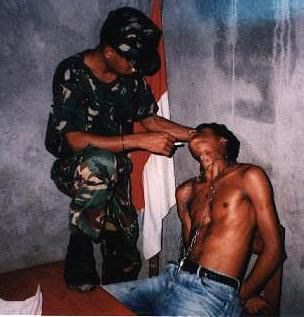
East Timorese being torturedI think the time has come to put the question of East Timor sovereignty behind us and to put the 1975 events behind us and address what is good for the people, recognizing that many people think that they carry the flag of the people and that probably all of them have some part of the truth.22
Mr. Maynard after discussing the alleged mania of Indonesian officials to collect stats, (Maynard doesn’t question whether the stats are valid), says using a metaphor that perhaps people are perceiving different parts of an Elephant and that everyone should check their sources. Mr. Maynard then says regarding his impressions:
But I don’t think that my impressions are any less valid than yours.24
I have been twice to East Timor and travelled around extensively and what you described I did not see. If you ask government officials, whether they’re American officials from the State Department, the CIA, or AID [ie USAID, US Government Overseas Aid Program], or Department of Defense, or Australian government officials, or French and German, by and large they do not see what you have described. Now, there are several things that might be going on. Number one is that they are imbeciles; number two is that they are insensitive; or number three, maybe it’s an elephant and each of us has a different part of the elephant that we are describing.25
In the same passage quoted above Mr. Maynard wonders:
My question for you is, if all the things you describe have been taking place and this is the greatest holocaust in this century by proportion, why is it that so many governments are ignoring it?27
But like any good fellow traveller Mr. Maynard shortly before he is finished, along with dismissing the idea of the East Timorese people deciding their future says:
What I’m saying is my impression, with the exception of sullen people in Iliomar, was that the people were very happy. So my impression is that the people are happy with the Indonesian government as opposed to a viable alternative of which I see none.28
On that suck up note lets us bid good bye to Mr. Maynard fellow traveller.
Later in the Colloquy a US State department official, (who remains un-named) states official US policy that work should be done to improve things in East Timor but that the Indonesian occupation should be accepted. Of course there is the usual stuff about dealing with “realities” rather than as implied airy idealism. The same official then declares it unlikely that East Timor was brought up during Ford’s visit to Indonesia in 1975. As indicated by the document quoted at the beginning of this post that is false.30
The official then goes on to wonder why the Portuguese government is so concerned now when in 1975-1976 they supported Indonesia getting East Timor. He also brings up the Goa comparison. (Goa was a small Portuguese colony on the coast of India. Invaded and occupied by India in 1961). Aside from ignoring that perhaps the Portuguese now recognized that going along with Indonesia on this was immoral, perhaps the horrible human rights abuses in East Timor have something to do with it. Further it does not appear that the inhabitants of Goa did not want to be part of India. This is of course different from East Timor. Obviously raising the issue of Goa is just an example of changing the subject.31
Another State Department official later acknowledges that perhaps knowing Portuguese would help while checking things out in East Timor. The official then admits that the languages used are Indonesian and English. Of course what is interesting is that no one discusses that the visits are guided tours during which the State Department officials will see what their Indonesian guides want them to see, and frankly what they want to see. In other words what will favour State Department policy which is in favour of Indonesia.32
In the Colloquy are a number of experts from Indonesia who are incredibly and amazingly obtuse to say nothing of to one degree or other suck up servants to power.33 It is amazing that the other participants tolerated the presence of these apologists for terror and fellow travellers.
Subsequently the Santa Cruz massacre exposed as hollow the argument that East Timorese were happy or even accepted Indonesian rule. Meanwhile brutal Indonesian repression and torture continued.
In 1996 Bishop Belo of East Timor and Jose Ramos-Horta are awarded the Noble Peace Prize for their efforts to bring peace to East Timor.
In 1998 because of a severe economic crisis and bent up frustration caused by decades of brutal autocratic rule, and corruption the Suharto regime collapses. The new President B. J. Habibie agrees to allow East Timor to have a referendum under UN Auspices to decide East Timor’s future.34
Elements in the Indonesian Military set up Militias in East Timor, which with the covert and overt support of the Indonesian military and police carry out a campaign of intimidation, torture and murder to intimidate the voters in the months before the referendum. Despite all this, including rumours that the Indonesian army and the Militia’s intend to devastate East Timor if the independence vote wins, the people of East Timor choose independence. Afterwards the Militias and the Indonesian army devastate East Timor creating over 250,000 refugees and destroying the economy and killing well over 1000 people.35
It will take decades for East Timor to recover from the brutal rule of Indonesia that people like Mr. Maynard white washed.36

3. See Chomsky, 1979 & 1982, see also East Timor at the Crossroads, Ed. Bentley, G. Carter & Carey, Peter, University of Hawaii Press, Honolulu, 1995,. The colloquy entitled Dimensions of Domination, Ed. Bentley, G. Carter, is on pp. 161-194, at pp. 166-171.
4. IBID, Gunn, Geoffrey, C., A Critical View of Western Journalism and Scholarship on East Timor, Journal of Contemporary Asia Publishers, Sydney Australia, 1994, pp. 109-134.
5. IBID Gunn, Fernandes, Clinton, Reluctant Saviour, Scribe Publications, Melbourne Australia, 2004, pp. 13-25, Kingsbury, Damien, East Timor: The Price of Liberty, Palgrave Macmillan, New York, 2009, pp. 48-50.
6. Estimates vary see Kiernan, Ben, Blood and Soil, Yale University Press, Harvard CONN, 2007, 578-580, and The Demography of Genocide in South East Asia, 2003 at Here. See also Chega! Executive Summary, p. 48 which gives a minimum figure of 102,000 killed at Here.
8. See Bentley, pp. 161-194.
9. IBID, Maynard’s first impressions are pp. 173-176, the quotes are p. 173.
10. IBID, p. 175.
11. See Footnote 1.
12. Bentley, Maynard’s impressions p. 174.
13. IBID, pp. 174-175.
14. See Minter, William, King Solomon’s Mines Revisited, Basic Books, New York, 1988.
15. Bentley, Maynard’s impressions p. 175.
16. IBID, p. 175.
17. Chomsky, 1979, pp. 205-217, Kiernan, 2007, pp. 576-578, Challis, Shadow of a Revolution, Sutton Publishing, London, 2001, pp. 104-108. 191-196. The anti-Communist massacres of 1965-1966 killed 500,000 – 1,000,000 people.
18. Bentley, Maynard’s impressions quoting the Indonesian soldier’s oath, p. 175.
19. IBID, pp. 175-176.
20. IBID, p. 176.
21. IBID, p. 176.
22. IBID, p. 179.
23. See Gunn, pp. 207-236.
24. Bentley, Maynard’s impressions p. 180.
25. IBID, p. 169.
26. See Footnote 1.
27. Bentley, Maynard’s impressions p. 169.
28. IBID, p. 181.
29, Kingsbury, pp.60-65, 71-76, Taylor, pp. 213-214, 227-228, van Klinken, Helene, Taking the Risk, Paying the Price, in Guns and Ballot Boxes, Ed. Kingsbury, Damien, Monash Asia Institute, Victoria Australia, 2000, pp. 43-68.
30. Bentley, USSD1’s impressions p. 187.
31. IBID, p. 188.
32. IBID, USSD2’s impressions pp. 189-190.
33. Footnote 8. Just read the entire colloquy it has some truly stomach turning passages.
34. Taylor, pp. 213-223.
35. Kingsbury, 2009, pp. 65-76, Taylor, pp. 223-230, Nevins, Joseph, A Not So Distant Horror, Cornell University Press, Ithaca NY, 2005, pp. 81-135, van Klinken, Kingsbury, Damien, The TNI and the Militias, in Kingsbury, 2000, pp. 69-80, Bartu, Peter, The Militia, The Military and the People of the Bobonaro District, in Kingsbury, 2000, pp. 81-98., McDonald, Hamish, Masters of Terror: The Indonesian Findings, in Masters of Terror, Ed. McDonald Hamish & Tanter, Robert, Rowman & Littlefield Publishers Inc, New York, 2006, pp. 13-20, KPP HAM, Full Report of the Investigative Commission into Human Rights Violations in East Timor, in Hamish et al, pp. 21-66, Ball, Desmond, Silent Witness: Australian Intelligence and East Timor, in Hamish et al, pp. 177-202.
36. Just how difficult it as been so far see Kingsbury, 2009.
Pierre Cloutier
Wednesday, April 28, 2010
The alleged stopping of Euthanasia in Germany in 1941
At the beginning of the movie The Mad Women of Chaillot (1969) there is brief written prologue that goes:
This is story about Good Triumphing over Evil. Of course it is a fantasy.1
In this posting I am examining another fantasy of Good triumphing over Evil. In this case it is an historical fantasy of the triumph of Good over Evil, and like most such fantasies it is not altogether false but is distorted and conceals more than it reveals.
It is also a fantasy that helps people feel good and downplays just how really difficult it is to do good and by neglecting the failure, or more accurately turning failure into success it lies. However it does serve the purpose of helping to hide a shameful series of moral failures and in making people feel good about themselves and how supposedly easy it is to do good in difficult circumstances.
The example I’m giving is the Hitler’s order to stop the Euthanasia campaign in August of 1941 due to a sermon by a Bishop Clemens August Graf von Galen of Munster (Hereinafter Galen), (1878-1946). In August 1941 Galen gave his sermon and then arranged copies of his sermon to be widely distributed. The public disquiet was so clear that Hitler then ordered that the Euthanasia campaign be halted shortly after Galen gave his sermon. Thus many lives were saved and a brutal regime was forced to back away from its plans to kill even more. It is a nice appealing story which is however so distorted as to be a lie.2
The so-called Euthanasia murder policy had been set in motion in August of 1939 its purpose was to kill, mentally and physically handicapped individuals deemed to be burdens on the state and the most common description of the individuals marked for destruction was “useless eaters”.3 Already the Nazi state had sterilized more than 360,000 individuals and was proceeding to the next step.4
Sometime in early 1939 Hitler gave oral instructions to begin the killing of handicapped children, later in the year sometime in August 1939 and again orally Hitler gave orders to begin the killing of handicapped adults.5
During all this there was a considerable amount of preparation and planning done before the mass killings began, which took time but already some killing was already taking place.6 The killing of children was called Kdf and the murder of adults was called T-4. Those were the names of the programs for the murder of the mentally ill in Germany they do not include the murder of the handicapped in areas outside of Germany.
In fact the first mass killings of the mentally and physically handicapped occurred shortly during and shortly after the invasion of Poland. Beginning on September 22, 1939 and continuing for a few weeks c. 2000 mental patients from various Polish asylums were murdered in a wood near the town of Kocborowo. They were shot by specially trained SS death squads. In a grim forecast of what was to come inmates from a hospital in the town of Owinska were stuffed into a sealed room and killed by carbon monoxide gas. The massacre of mental and handicapped patients continued until more than 12,000 had been killed.7
When August 1939 Hitler gave the go ahead to start the mass murder of the handicapped it took some time for the program to set up. However it started in 1940 and continued well into 1941.
Although they used a variety of methods, like injections, starvation etc., the chief method of murder was gas. People would be sent too frequently by bus or truck to one of 6 different facilities and then after being “processed” they would be murdered by gas, in specially constructed chambers.
Now it is known that operation T-4 had a goal of terminating the lives of c. 70,000 people which was the goal that the Nazi’s, in this case specifically Hitler, selected for the program.8 The program was also centralized in terms of co-ordination and control and most of the killing in 1940-1941 was done in 6 centralized facilities. The program of murder was subject to bureaucratic centralized control and many if not most of the people staffing the program were Nazi fanatics or at least psychopathic in their attitudes towards their victims.9
The killing centers were Grafeneck, Brandenburg, Hartheim, Sonnenstein, Bernburg and Hadamar. The inmates were told by the staff arranging them to be murdered, various stories, like they were going out on an excursion, that they were going to be medically examined and such like to put their minds at ease. At Hadamar the victims, who had been taken to the facility in buses, usually grey painted postal buses, were disembarked in one of a series of wooden garages and taken to the main building via a specially constructed wooden corridor. In the main building they were undressed and given military overcoats and then examined by a Doctor who would help in thus fabricating plausible causes of dearth to give to their loved ones.
The victims were then escorted into the basement / cellar. They were told they were going into a shower and jammed 60 at a time, into a small room and there by the turn of valve they were gassed to death by carbon monoxide gas. The victims took up to an hour to die. Experiencing terror, panic and the symptoms of carbon monoxide poisoning, such as severe headaches, dizziness, nausea, and shortness of breath. It was not a pleasant death.
After fans got rid of what was left of the gas, “disinfectors”, cleaned up and disentangled the bodies. Those who had been marked before hand of potential interest would be autopsied in another room and their brain or other organs of interest sent to various Universities for more research. Gold teeth would of course be removed. The bodies were then burned in crematoria and the ashes randomly distributed into urns to be sent to the family. Bones would be crushed, if they did not fully burn.
People could see the thick cloud of ash from the asylum chimney after each transport to Hadamar and quickly but two and two together. Arrangements were made for families to have Urns with ashes and to deceive them into thinking the ashes came from near were the patient had been in an asylum. Further Doctors had ready a list of 62 possible reasons for death to send to the relatives of the deceased giving the fabricated “reason” for their loved one’s death. They used a carefully designed form letter that had space for a few personal details, to send these lies to the bereaved. Enclosed with this fraudulent letter would be 2 death certificates listing the false cause of death.10
Sometimes it is best to let the facts speak for themselves. I have nothing to add to the above description.
The six killing centers murdered the following numbers of people between 1940-1941.
Grafeneck – 9,839
Brandenburg - 9,772
Hartheim - 18,269
Sonnenstein - 13,720
Bernburg – 8,601
Hadamar - 10,072
Total - 70,273 11
Now the figures listed above are only for German patients murdered in Germany and exclude those murdered abroad; for example those killed in Poland. In this phase of the killing program it is rather sickening to report that c. ½ of the victims were in private or ecclesiastical institutions. It just wasn’t the state institutions that were corrupted by this murderous idea but private institutions including those run by various churches.12
The corrupting ideology behind the Euthanasia murder program was eugenics the idea that lives of certain classes of handicapped individuals were devoid of value and burden on the community at large and so ought to be terminated. The language of Euthanasia was used, but it was not allowing people, legally competent, who suffered from debilitating or terminal diseases to consent to or in fact take those own lives but simple murder. It can be stated without contradiction that “Euthanasia” was used as a smoke screen to hide the fact that it was murder. The fact that those carrying out the murders went to extraordinary efforts to deceive both patients and their families indicates that the killers knew that they were engaged in murder pure and simple.13
Has mentioned above in late August 1941 Hitler gave a stop order for T-4 and this was shortly after Galen gave a sermon and distributed copies of a hard hitting sermon. Not surprisingly many people have assumed a link and in fact they are not wrong, however they are wrong to assume it stopped the killing. The story of Galen’s sermon is as follows.
Galen was made Roman Catholic Bishop of Munster in 1933 and from the get go had a rocky relationship with the Nazis, who he regarded has upstart oafs. He was especially offended by what he saw as Nazi attacks on the church. It appears that Galen had been in receipt of information regarding the Euthanasia program since July 1940, but kept quiet for the time being. It is not completely clear why he kept quiet although it appears that like other members of the Church hierarchy who knew about the program he was concerned that any protest would simply backfire on the church. It appears that he considered going public in August 1940 but was talked out of it by Cardinal Bertram who was concerned about the possible negative effect on the church.
In July 1941 Galen was incensed about the seizure of Jesuit property in Munster by the Gestapo for state purposes decided to act.14 On August 3, 1941 Galen gave his sermon. In it he said:
If you establish and apply the principle that you can kill “unproductive” human beings, then woe betide us all when we become old and frail! If one is allowed to kill unproductive people, then woe betide the invalids who have used up, sacrificed and lost their health and strength in the productive process. If one is allowed forcibly to remove one’s unproductive fellow human beings, then woe betide loyal soldiers who return to the homeland seriously disabled, as cripples, as invalids …Woe to mankind, woe to our German nation, if God’s holy commandment “Thou shalt not kill!”, which God proclaimed on Mount Sinai amidst thunder and lightening, which God our Creator inscribed in the conscience of mankind from the very beginning, is not only broken, but if this transgression is actually tolerated and permitted to go unpunished.15
We are not talking here about a machine, a horse, nor a cow …No, we are talking about men and women, our compatriots, our brothers and sisters. Poor unproductive people if you wish, but does this mean that they have lost their right to live?16
The Nazis were infuriated by Galen’s sermon and seriously considered arresting him and sending him to a concentration camp. Galen’s sermon was made illegal and possession of copies of it a crime and several people associated with the production, creation and distribution of the sermon jailed or sent to concentration camps along with people who had it in their possession. Copies were smuggled out of Germany and the allied powers dropped copies of it over German cities. There was even before Galen’s sermon a serious level of unease over the Euthanasia program, despite the effort to conceal and hide it. The Sermon raised the level of public awareness and unease. Creating a problem for the Nazis. Which wasn’t helped by the fact Galen tried to have murder charges levelled against some of those involved.17
Hitler was furious but decided to bide his time. Hitler said:
I am quite sure that a man like the Bishop von Galen knows that after the war I shall extract retribution down to the last farthing. And if he does not succeed in the meanwhile in getting himself transferred to the Collegium Germanicum in Rome, he may rest assured that in the balancing of our accounts no “t” will remain uncrossed, no “i” left undotted.18
Fortunately for Galen Hitler and the Nazis lost the war and were therefore unable to extract vengeance on him.
Aside from infuriating Hitler and creating problems for the Nazis just what effect did Galen’s sermon have on T-4 and the Euthanasia killings? It appears that it played a role in stopping the program, so that Hitler gave a oral stop order in late August 1941, but was not the sole reason and probably not as important as two other reasons. First the T-4 killings had already achieved their goal in terms of the number of killings. Secondly the personal associated with T-4 were needed for the vastly greater killings being planned for in the east, of which the so-called Final Solution, was just a part.19
Also Kdf, the murder of children, was continued on Hitler’s express orders. Also continued was the murder of Concentration camp inmates and prisoners, under the Euthanasia banner called 14f13. Finally only the T-4 program stopped, not the killings. Instead of a centralized bureaucratic system with a few killing centers the program was decentralized and a lot was left to local initiative, strongly urged by the state.20
This is the so-called period of “Wild Euthanasia”, in which the killing was to a large extent decentralized and left to local initiative. The preferred methods of killing was not the mass gassing of the previous period but hunger and / or drug overdoses. Basically patients were frequently starved to death or deliberately given diets that caused severe bodily deterioration so that moderate injections of drugs would kill them.
This included such practices as feeding the patients diets without protein or other essential foods like fats, so that they would die more easily. Sometimes patients were simply, starved to death by not being fed at all. The usual deception and lying was done to conceal how the patient actually died from the bereaved relatives. This campaign continued right until the end of the war.21
An example of how “efficient” “Wild Euthanasia” could be is that between August 1942 and March 1945 4,817 patients were sent to Hadamar of those 4,442 died. A death rate over 90%.22
The records that were kept for the “Wild Euthanasia” killings are not very complete but it appears to have been considerably more than were killed in T-4. The absolute minimum figure seems to be 100,000.23
Aside from those killed above in both the T-4 gassing's and “Wild Euthanasia” there were those killed by starvation and / or medication before the end of T-4 those numbered c. 20,000. To this must be added those killed in KdF at least 5,000 and those killed in 14f13 c. 20,000.24
The above figures total 215,000 people murdered, and this figure is probably too low, and even so they do not include the tens of thousands non-Germans killed in the Euthanasia program in areas conquered by Germany. For example the over 10 thousand killed in Poland in 1939-1940, or the over ten thousand killed in the Soviet Union or the c. 40,000 killed in France. It appears that only c. 40,000 mental patients survived the war in Germany.25
Thus this series of programs, under the Euthanasia euphemism, altogether murdered at least 275,000 human beings and the actual figure is probably over 300,000. Compared to other massacres carried out during World War II by the Nazis this may seem small but remember it is over a ¼ of a million human beings and probably close to 1/3 of a million.
At most c. 95,000 were murdered before the stop order of August 1941 most of the victims were murdered, even in Germany, after the stop order was given. The stop order was not to stop the killings but to stop the mass gassing's of inmates. The killing was ordered to go on by other methods and did so with great, indeed horrible success.
Galen’s very brave public statement although infuriating to the Nazi authorities and very embarrassing did not stop the killing. What it helped to stopped was a particular mode of killing that it must be remembered had already achieved its stated goal when it was stopped and further its practitioners were being prepared for another campaign of murder so that they were willing to for gore for the time being. Also as I’ve said before the killing did not stop at all it went on and on using other methods. Galen’s protest despite postwar myths did not stop the Euthanasia campaign. That particular hopeful myth must be laid to rest. To quote:
Hitler’s stop order of August 1941 did not end the destruction of those considered “unworthy of life.” The belief that his stop order ended the killings is based on postwar myth. The stop order applied only to the killing centers; mass murder of the handicapped continued by other means. Moreover the stop order did not apply to children’s euthanasia, which had never utilized gas chambers. As with children, after the stop order physicians and nurses killed handicapped adults with tablets, injections and starvation. In fact, more victims of Euthanasia perished after the stop order was issued than before.26
1. I’m relying on my memory since it has been 30+ years since I’ve seen the movie.
2. An excellent example of this myth is A Lost Chance to save the Jews, in The New York Review of Books, April 27, 1989, by Conor Cruise O’Brien at Here. See also O’Brien’s response to a letter critiquing his view of the stop Euthanasia order at Here, dated October 26, 1989.
3. Chorover, Stephan L, From Genesis to Genocide, MIT Press, Cambridge MASS, 1979, quoted on p. 101.
4. Evans, Richard J., The Third Reich at War, Penguin Books, London, 2008, p. 77.
5. Friedlander, Henry, The Origins of Nazi Genocide, University of North Carolina Press, Chapel Hill NC, 1995, pp. 39-41, 62-64.
6. Burleigh, Michael, Death and Deliverance, Cambridge University Press, Cambridge, 1994, pp. 93-129, Friedlander, pp. 62-80, Evans, pp. 77-90, Muller-Hill, Benno, Murderous Science, Oxford University Press, Oxford, 1988, pp. 39-45.
7. Evans, pp. 75-77.
8. IBID, pp. 99-100.
9. Burleigh, pp. 93-161, Muller-hill, pp. 39-65.
10, Burleigh, pp. 144-153, Friedlander, pp. 107-110.
11. Friedlander, p. 109.
12. Burleigh, p. 173.
13. IBID, pp. 43-92, 183-219, Friedlander, pp. 23-38, Chorover, pp. 93-104, Muller-Hill, pp. 7-13, Lifton, Robert Jay, The Nazi Doctors, Basic Books Inc., New York, 1986, pp. 22-44.
14. Burleigh, pp. 175-178.
15. IBID, quoting Galen, p. 178.
16. Lifton, quoting Galen, p. 94.
17. Burleigh, pp. 178-180, Evans, pp. 97-101, Lifton, pp. 90-95.
18. Burleigh, quoting Hitler, p. 178.
19. Friedlander, pp. 151-163, Lifton, pp. 135-148, Evans, 100-101, Sereny, Gitta, Into That Darkness, Andre Deutsch, London, 1974, pp. 79-90.
20. Friedlander, pp. 39-61, 131-163, Lifton, pp. 96-102, 134-146, Burleigh, pp. 93-129, 220-266, Evans, pp. 524-530, Muller-Hill, pp. 15, 63-65.
21. IBID.
22. Evans, p. 527.
23. Muller-Hill, p. 65, Friedlander, p. 151, Chorover, p. 101.
24. Lifton, p. 142, Friedlander, pp. 61, 150.
25, Muller-Hill, p. 65, Evans, 528-530, Burleigh, pp. 220-237, Friedlander, pp. 151-163, Chorover, p. 101.
26. Friedlander, p. 151.
Pierre Cloutier
Sunday, July 26, 2009
The Omnipotent State
This article called Cambodia: Year Zero on Trial, published in the New Internationalist; in September 2008 is an excellent example of moral cretinism.1 The author Brooks Duncan is described as a “lawyer and anthropologist who works in the field of international legal development and human rights.”2
Our author makes a good start by criticizing the trials for being used at least partially has a way of ignoring the well documented abuses of the current Hun Sen government, and the rather terrible / brutal bombing of Cambodia by the Americans between 1969-1973. The abuses by both the Chinese and Vietnamese in Cambodia and the French Colonial regime.3
Alas this good start is soon trashed by our author. For example:
There is little doubt that the defendants were engaged in a brutal civil war in which they ordered murder and destruction on a massive scale between 1975 and 1980, and that they sought to remake the country and start it again at what they called ‘Year Zero’. There is little doubt that they opposed urbanization and sought to turn the country back to an agrarian society.4
Our author states:
In order to prove its case, the prosecution will have to demonstrate a motive for the killings. Were the defendants’ beliefs and rationale reasonable? If so, is anything being done to change the circumstances that led to the choice of criminal acts, or is there potential for the same kinds of killings to occur in future? Further, are the trials just of criminal acts, or are they really attempts to outlaw beliefs, the new ‘thought crimes’ of globalism?5
Our author makes the point that a document he has read claims, incorrectly, that c. 3 million died under the Khmer Rouge. While the real figure is something between 750.000 – 1,800.000. If his point was that it was bad enough without the need to exaggerate fine but that is not his point, his point seems to be that this is unfair to the defendants. Really so instead of murdering 10 people someone only murdered 5; in terms of being guilty of murder it makes little difference.6
Let us go through some more of our our author’s fantasies.
To quote: But is forced radical de-urbanization a crime against humanity, in a world where urbanization is leading us to an environmental crisis that could result in millions of deaths from similar causes and where forced urbanization through government land-grabs has yet to be put on trial? Is rural culture – or an attempt to recreate Angkorian culture, the agricultural empire that is considered the high point of Khmer civilization and what the Khmer Rouge may have considered a model – to be criminalized?
Most scholars think the Khmer Rouge leaders legitimately believed they were returning the country to its rural Angkorian roots, and that they were seeking to do this in some kind of egalitarian way. The motive wasn’t individual enrichment for élites. The Khmer Rouge leaders weren’t impoverishing peasants and buying expensive toys for themselves – as current and previous leaders, who also killed their opponents, have done. That activity is easy to criminalize – but none of those leaders is being put on trial.7
As for seeking to do development in some sort of egalitarian way! Well that is nonsense. The system was rigid hierarchical and dictatorial, with power concentrated in the center under rule of a rigid one party state with a ruthless and brutal secret police. As for the motive not being individual enrichment. Well certainly Pol Pot and his associates in power lived vastly better than the brutalized masses below them with the best of food and medical care. And one thing Pol Pot and his associates were very rich in was power while the struggling and staving masses below them had very little. Their motive was obviously the enjoyment of untrammelled power over others and its perpetuation into the indefinite future, along with all the prerogatives that go with such power. Oh and the Khmer Rouge did impoverish and exploit the peasants under them to such an extent that many died all in the interest of extending the power of the state, and thus their own power.9 Also they did buy expensive toys for themselves like limousines and planes and lived in nice villas.
The next section is that supposedly the prosecution will criminalize Khmer Rouge opposition to the passivity and hierarchy created by the French.10
This is beautifully ironic in that what the Khmer Rouge leadership wanted was the population to passively obey it. Certainly opposition to it was ruthlessly crushed. So despite our author’s apparent belief the Khmer Rouge leadership heartily approved of passivity and obedience so long has the passivity and obedience was to it.
Our author then puts in the mouth of the Khmer Rouge on trial that most of the deaths were the result of angry out of control youth and outside of the control of the leadership. This is nonsense. The evidence indicates centralized control on a very high level.11
Our author says:
Or did the Khmer Rouge just use the killing machine that the French and Americans created, but with greater damage and the ‘wrong’ results?13
Besides as said above it appears that the Khmer Rouge “killing machine” created by the Khmer Rouge was not simply a version of the French American one but one of their own devising.14
Our author talks about the alleged fact that the Khmer Rouge opposed the passivity created by the French and traditional Khmer culture.
…the prosecutors will make their case by saying that their preferred version of Khmer culture – the one foreigners and this trial are now trying to restore – is one of blind obedience and fear of authority, and that the defendants opposed it.15
Our author then engages in a word salad about how criminalizing the Khmer Rouge leadership is criminalizing trying to change a system of unquestioning obedience and therefore reversing the principle of Nuremberg that obedience to orders is not a defence.17 This is of course nonsense in that the Khmer Rouge wanted unquestioning, “blind” obedience to their orders and also wanted to instill mindless fear.
As for foreigners trying to restore a system of system of obedience to authority? The idea that the Khmer Rouge opposed it is just ludicrous. The evidence is they were all for it.
Our author then states:
Moreover, if the principles of democracy and justice are to be applied internationally, mustn’t they give all parties equal access to international processes, to hold all abuses of power accountable, rather than selectively to prosecute and enforce the laws discriminatorily against political groups whose ideologies are in the minority, while those who remain in power commit similar crimes?18
About the Khmer Rouge attack on religion our author says:
The prosecution will say that the Khmer Rouge destroyed Khmer religion and culture by attacking Buddhism and monks. That will be easy to prove: the murders are clear and punishable crimes.19
But the Khmer Rouge leaders on trial could raise troubling questions about whether Buddhism in Cambodia is really Khmer. They will likely note that Buddhism was an Indian religion that arrived well after other religions. They will ask whether this foreign religion, and the monks promoting it, were protecting Khmer culture or making the Khmer more passive, obedient and vulnerable. They will say that they were cleansing the country of an outside religion that symbolized and presided over 600 years of the country’s decline, including the loss of most of its land to Thailand and Vietnam. They will ask about Buddhism’s effectiveness in promoting equality and protecting nature, and point to pagodas in Phnom Penh that have become concrete enclaves filled with the ostentatious funerary towers of the rich. They will ask: how does all the money spent on idol worship and chanting really confront the injustices in society? They will note that Khmer Buddhists do little themselves to promote or protect the country’s history and monuments. They will ask: how does Buddhism promote the development of a strong Khmer society, able to resist military powers both within the region and outside it?
The question for the trial is whether the criminalization of attacks on Buddhism as a religion are designed to protect the Khmer, or are designed by foreign prosecutors – and the Khmer élite aligned with them – to criminalize attempts at independence and reform.20
As for criminalizing attempt at “independence and reform”, again our author fantasizes. Although is our author saying that mass murder and cultural genocide are “attempts at independence and reform”?
The next section our author then takes up Khmer Rouge paranoia about Viet Nam.
Today, the ever-expanding Vietnamese population will likely go to the same place it went throughout most of the last century with French, then American, support – into the lands of the Khmer and Lao. Vietnamese expansion continued into Khmer lands after the near extermination of the Cham in the 17th century – an empire once the size of Vietnam – who have been almost entirely driven from Vietnam and who now number less than 400,000. This policy of imperialist expansion – tien Nam – has never been rescinded by the Vietnamese. It will be interesting to see how the trials try to make Khmer fear of Vietnamese expansionism into a crime.22
Of course the author hallucinates about turning fear of Vietnamese expansion into a crime. The crime was of course mass murder of Vietnamese by the Khmer Rouge; which it appears our author wants to forget about.
The next section our author talks about the Cham. Unable to deny that the Cham were indeed the targets of a genocidal assault our author with slacker sarcasm says:
It would, of course, be as ridiculous to think that the Khmer Rouge feared the Cham as it would be for Western countries to fear Muslims – and to suggest that preemptive strikes were necessary for protection.24
As for accusing various governments of hypocrisy for not supporting a Cham homeland. Just what does that have to do with a prosecution for mass murder? It is another beside the point polemical flourish. I also really liked how after mentioning how twice the Cham took over the government of Cambodia our author mentions that it was a long time ago and that now the Cham are loyal citizens. Then why did the Author mention this at all? It is so obvious what our Author is trying to do and it is not pretty; for our author is trying ever so subtlety to plant the idea that the Khmer Rouge had reason to doubt the loyalty of the Cham.25
Later our author states that opposition to neo-colonial trade policies and urbanization is being criminalized:
They [Khmer Rouge] saw the cities as promoting the excesses of the rich, destroying nature and human dignity, exploiting the poor and promoting squalor, under intense foreign pressure, while doing little to promote anything Khmer. Is it their fear of the kind of place that many observers say Phnom Penh has become today that is being criminalized?26
Of course our author “forgets” to mention the sort of place that Cambodia became under the Khmer Rouge, which can best be described as a huge Gulag. A city slum is better than that.
Our author then says:
The defendants are ethnically Cambodian or mixed. In order to make a case for Khmer Rouge ‘genocide’ against the ‘Khmer’ people or culture under genocide law, the prosecution will have to define what ‘Khmer’ actually is. That is something they will almost certainly try to avoid, because it is the very thing the foreign community seems intent on denying. Did the Khmer Rouge leaders try to destroy ‘Khmer’ culture, or were they reaffirming it? Who today is trying to define and defend ‘Khmer culture’? The trial materials don’t even mention it.28
In the present Convention, genocide means any of the following acts committed with intent to destroy, in whole or in part, a national, ethnical, racial or religious group, as such:
a) Killing members of the group;
b) Causing serious bodily or mental harm to members of the group;
c) Deliberately inflicting on the group conditions of life calculated to bring about its physical destruction in whole or in part;
d) Imposing measures intended to prevent births within a group;
e) Forcibly transferring children of a group to another group.29
Our author than fantasizes about the “foreign community” denying Khmer identity / culture. This is pure fantasy. It is of course ironic that it is so easy to demonstrate that the Khmer Rouge were in fact trying to destroy Khmer culture, which the attack on Buddhism was an integral part. The implied idea that foreigners are attacking Khmer culture but not the Khmer Rouge which murdered and destroyed on an impressive scale was even arguably “affirming” Khmer culture is risible. Unless of course Khmer culture consists of torture, murder and destruction.
As for who today is trying to defend / define Khmer culture. How about the present government. Certainly it has been relatively lavish with largess to various cultural institutions.
The final piece of stupidity is our author’s argument that:
‘Sane’ countries allow an insanity defence when they deal with psychopathic behaviour. Were the Khmer Rouge leaders acting rationally in their policies but insanely in their methods? If so, what made them insane?30
The author then tries to blame the fact that one of the defendants was tortured for his behaviour. So? That hardly proves that he was clinically or legally insane. The author then whines about massive consumption of luxury goods by urban elites and consumption of alcohol and tobacco. Which are apparently far greater sins than torture and mass murder. The author further complains about violence by youth today and the lack of psychological services. Of course the violence committed by Khmer Rouge youth during the years of the killing fields is of less concern or the immense psychological damage done to millions by the years of genocidal, brutal Khmer Rouge rule. That disappears down our author’s huge memory hole. Our author is simply not interested in dealing with that psychological harm. He prefers to whine about tobacco and alcohol use instead.32
The author then states the following:
How much is building a real rule of law and true democracy, with the opportunityto discuss alternatives for the country’s future – other than the one the foreign community has imposed again, as in the 1950s and 1960s?33
Our author fantasizes about how the trials have been pre-determined without of course providing evidence but by simple (minded) assertion. The statement that is there really less abuse of power or merely a different sort of power abuse is pure polemics and devoid of real content. Once again the author seeks to mitigate and excuse Khmer Rouge atrocities. There are of course different types of abuse of power. One can say categorically that abuse of power that tortures, starves, murders and crushes dissent to the extent that existed under the Khmer Rouge does not exist in anything the same extent in the Cambodia of today and in that sense there is definitely less abuse of power in today’s Cambodia.The political agenda, like the trials, has been pre-determined by those who are paying for it. Is there really less abuse of power today – or is it only of a different kind, and one that the international community doesn’t criminalize?34
This essay is so shoddy, for example there are precisely two footnotes, that I suspect that this whole piece may be a parody of what a truly asinine “defence” of the Khmer Rouge might be like. I further suspect that Brooks Duncan is not the author’s real name but an alias. Certainly the idea that a real Lawyer involved in Human Rights could come up with this piece of intellectual excrement that seeks to excuse such evil acts is breathtaking. I further wonder if New Internationalist published the piece solely for the purpose of creating a stir and so knowingly published a piece of tripe.
Assuming this piece is for real I wonder if Brooks Duncan, whoever he actually is, was once one of the apologists for the Khmer Rouge in the past and is seeking to further exercise his intellectual efforts to excuse the inexcusable.
Well whatever the “real” purpose of this article it is an outstanding example of moral cretinism.
Map of Cambodia2. IBID.
3. IBID.
4. IBID.
5. IBID.
6. IBID. The best summing up of the death total under the Khmer Rouge is Kiernan, Ben, The Pol Pot Regime, Yale University Press, New Haven CONN., 1996, pp. 456-460. Kiernan gives a figure of at least 1.5 million.
7. IBID. Duncan.
8. See Kiernan 1996, pp. 31-101, 159-250, Twining, Charles H., The Economy, in Editor, Jackson, Karl D., Cambodia: 1975-1978, Princeton University Press, Princeton NJ., 1989, pp. 109-150, Shawcross, William, Sideshow, Pocket Books, New York, 1979, pp. 365-392.
9. Kiernan 1996, pp. 159-250, 313-356, Carney, Timothy, The Organization of Power, in Jackson, pp. 79-107.
10. Duncan.
11. See Footnote 8.
13. Duncan.
14. See Kiernan 1996.
15. Duncan.
16. Kiernan 1996.
17. Duncan.
18. IBID.
19. IBID.
20. IBID.
21. Kiernan 1996, pp. 55-59, for more information on the persecution of Buddhist monks. For the text of the Genocide Convention see Kuper, Leo, Genocide, Penguin Books, London, 1981, pp. 210-214.
22. Duncan.
23. For the destruction of the Cham kingdom see Kiernan, Ben, Blood and Soil, Yale University Press, New Haven CONN., 2007, pp. 102-112. For the Khmer Rouge and their provoking of Viet Nam see Evans, Grant & Rowley, Kelvin, Red Brotherhood at War, Verso, London, 1990, pp. 81-113.
24. Duncan.
25. See Kiernan 1996, pp. 252-288, for the mass murder of the Chams.
26. Duncan.
27. See Kiernan 1996. For an example of how the Khmer Rouge regarded the safe guarding of “human dignity” how about Tuol Sleng Prison in Phnom Penh. There people numbering in the thousands were tortured into making confessions to non-existent crimes and then murdered. See Hawk, David, The Photographic Record, in Jackson, pp. 209-211.
28. Duncan.
29. Quoted in Kuper, p. 210.
30. Duncan.
31. See Kiernan 1996.
32. See Kiernan 1996, for psychological damage.
33. Duncan.
34. IBID.
Pierre Cloutier