Monday, March 03, 2008

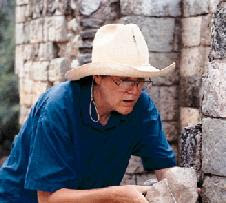
In Memory of Linda Schele

Linda Schele

This year will mark the tenth anniversary of the death of Linda Schele renowned decipher of Mayan Hieroglyphs.

In 1998 she died of pancreatic cancer which at the time was virtually untreatable and pretty close to 100% fatal.

During her later years she was perhaps the foremost reader of Mayan Hieroglyphs and her very untimely death was a great loss to the field.

It is interesting to note that her background was not Anthropology, Archaeology, linguistics or languages. In fact it was in Fine Arts.

Linda fell in love with the site of Palenque when she and her husband when on Christmas vacation in 1970. Within a few years Linda was writing and publishing papers on the Mayan Hieroglyphic system. Eventually getting a PhD with a paper on Mayan verbs.

Because of her Fine Arts background her understanding of the Hieroglyphic system has a "Fine Art" aesthetic cast to it.

Her Masterpiece is the Art Catalogue book The Blood of Kings, which was written to accommodate an exhibit of the same name. Many of her books are co-written with other people.

Beginning in the late 1980's Linda and others conducted workshops teaching Maya how to read the Glyphs and therefore restoring to the Maya part of their past.

Among her books are the following:

The Code of Kings, Linda Schele, Peter Mathews, Simon and Schuster, New York, 1998. (A posthumous publication of Linda Schele)

Maya Cosmos, Linda Schele, Joy Parker, David Freidel, William Morrow and Co., New York, 1993.

A Forest of Kings, Linda Schele, David Freidel, William Morrow and Co., New York, 1990.

The Blood of Kings, Linda Schele, Mary Ellen Miller, George Braziller Inc., New York, 1986.
Pierre Cloutier

Monday, May 21, 2007

Noam Chomsky: Prophet

Noam Chomsky

One of the most important public intellectuals of the last generation has been Prof. Noam Chomsky of MIT.

The fact he gets so many out there, their blood boiling is proof that what he says hits home.

Basically Noam Chomsky is a Old Testament Prophet castigating the wickedness of his society. What makes him worth reading is his disconcerting ability to resurrect, find, the "forgotten" fact.

Like a Old Testament Prophet Chomsky is not interested in whether or not others are worst but in the wickedness of his own society which he castigates for its sins.

What is interesting is the truly hysterical responses he gets from so many.

The society that Chomsky condemns is the United States of America, ignoring patriotic shibboleths he castigates and condemns .

If much of what Chomsky says can be castigated as unfair: a prophet is not in the business of being "fair".

But then given Chomsky's precept that you try to change things that you can change not go on endlessly about the atrocities of "official enemies" that you can do very little about while doing nothing about atrocities you can do something about. "Unfairness" is built into how Chomsky looks at the world.

The classic example for Chomsky is Cambodia and East Timor. In the case of Cambodia their was much hand wringing and detailed accounts in the media about the (truly spectacular) atrocities. Of course virtually nothing could have been done at the time too stop the atrocities by the west. But then that was not the purpose of the massive hand wringing. The purpose was to score points in the battle against the enemy.

Regarding East Timor, not only could action by the west have done something to stop the atrocities, but western action allowed the invasion to happen. (Indonesia invaded in 1975) And then relative silence descended over the truly vast atrocities that happenned at least in much of the West.

Chomsky is far from perfect and definitely not the last word but he has a truly different perspective and definitely not "politically correct". Thoughtful, less than hysterical "PC" critiques of Chomsky are virtually non-existent.

Some of Chomsky's Books.

Deterring Democracy, 1992
The Chomsky Reader, 1987
Year 501: The Conquest Continues, 1993
At War With Asia, 1970
Necessary Illusions,
1989
Manufacturing Consent, (With Edward S. Herman), 1988
Towards a New cold War, 1982

Pierre Cloutier

Wednesday, February 21, 2007

"Sunshine for Napoleon"

One of the most annoying phenomena in scholarship is the worship of certain historical figures to such an extent that it amounts to idolatry.

Such figures are worshiped to such an extent that they become omnipotent figures who can do no wrong and if they fail its always someone else's fault.

A particularly striking example of this idol worship is the slavish Stalinist suck up involved in Napoleon worship.

Portrait of Napoleon by David

Now Napoleon was indeed a very great man just has many others have been great. What is perplexing is the refusal to recognize the hubristic, brutal features of his life and reign. It is all too easy to find suck ups concerning as for example collected in Geyl's Napoleon For and Against. Which stands has a monument against Hero worshiping "scholarship". Stalin was subjected to a truly repellent amount of sycophantic "journalism". Everything he did was subject to praise. His considerable atrocities, denied, excused dressed up has "right". And like Napoleon he was characterized has surrounded by evil enemies who betray the infallible "leader". Of course these "traitors" are responsible for any mistakes made by the great Leader.

Another aspect is that such sycophancy is the identification of the Leader with the nation and any attack or disagreement, in fact anything less than full, unhesitating support of the infallible leader is "treason". It never seems to occur to such people that opposition to the leader is in fact in the interest of the nation and that the leader may be sacrificing the nation to his selfish ambitions.

A related aspect is the notion that the interest of other peoples don't matter and can be dismissed as unimportant. Thus we learn that Alexander I, growing opposition to the Continental System, which was royally screwing up the Russian economy and Government revenues, is characterized has a "betrayal". The idea that Alexander I or in fact any leader or state in Europe was in any sense duty bound to sacrifice all his interests and the interests of his people to the "infallible", Napoleon and any hesitation in not obeying Napoleon in everything was "betrayal" is a very interesting vision of leaders responsibilities to their various peoples.

And it goes hand in hand with hypersensitive reactions to any criticism of the great man for whom the only "fair" criticism is sycophantic hero worship and suck up.

I was recently reminded of this when I reading a edition of Chandler's The Campaigns of Napoleon. In which someone had written comments practically all of them of the suck up variety. There was for example a few complaints about the authors occasional negative comments about Napoleon. (The comments which concerned Napoleon's ambition, ruthlessness, cruelty etc., are in my opinion entirely fair.) There were also occasional comments about "English Gold" by our writer in the margins. This indicates that the author has read the common literature concerning Napoleon that alleges that opposition to Napoleon in Europe was the result of the English government bribing other governments. That these other governments might have legitimate grievances / interests against France and or Napoleon is of course unthinkable. And the various English government's have by definition no legitimate interests against France / Napoleon and are a force for evil; thwarting the good, virtuous Napoleon in a contest between the Sons of Light against the Sons of Darkness. Thus any opposition to Napoleon is the result of wicked base motives, and not from either "Good" principles and / or reason that can be deemed "legitimate".

It is my opinion that the Hero worship of Napoleon was and is one of the firm foundations for the support and adulation of Dictators, Dictatorial regimes and the crimes committed in their names.

Pierre Cloutier

Sunday, July 16, 2006

The Age of Justinian Part I

Justinian and his Court

Theodora and her Court
The above pictures are of mosaics from St. Vitale at Ravenna. They show the public image that the great Emperor and his equally great Empress wished to convoy. Even though many of the mosaics were usurped from mosaics designed to glorify the Gothic King of Italy Theodoric the Great, these ones seem to have been designed to glorify Justinian and Theodora. For all the glory of Justinian and Theodora's reign, like those mosaics, it seems half baked and borrowed. The appearance seems more dazzling than the prosaic reality of exhaustion and futility.

Interestingly the foremost historian, Procopius, of Justinian and Theodora's reign produced also, in secret, the salacious and libelous Secret History, which is brim full of viciousness and venomous invective. He also produced the remarkable Wars, and the classic example of suck-up brown nosing The Buildings.

Historians faced with the above productions have responded in various ways. One is to deny that Procopius wrote the Secret History, a point of view now very much out of favour and extremely unlikely anyway. The other is to explain away the Secret History. This as led and still leads to remarkable convolutions.

A typical example of a refusal to take the Secret History, seriously is the following,
We do not know why Procopius wrote the Secret History, which is so offensive that it can never have been publicly circulated. It is useless as a source of information about 'what really happened', but the the Secret History, is a goldmine of information about mid-sixth-century Byzantine social systems and is particularly informative about appropriate gender roles.
The Age of Justinian Gender and Society, Leslie Brubaker, Age of Justinian, Ed. Michael Maas, Cambridge University Press, New York, 2005, pp. 427-447, at. 432-433.

The above statement is typical of the mind set that refuses to accept that behind the invective of the Secret History, are actual facts, and it is false. For example does anyone seriously doubt that the picture of Theodora's upbringing is true or that she had in fact been a courtesan (polite term for prostitute) before she met Justinian or that she had been a actress? So much for being "useless".

Its obvious that the possibility that Procopius' Secret History, might contain reliable history is intolerable to many who prefer to mistake illusion for reality. So the rhetorical strategies to avoid this unacceptable result.

The statement that we do not know why the Secret History, was written rather conveniently ignores that in the preface to the Secret History, Procopius gives reasons. So what the author of the above means has reasons means is reasons "I",the author, can accept.

Procopius says:
As long has those responsible for what happened were still alive, it was out of the question to tell the story in the way it deserved. For it was impossible to either to avoid detection by swarms of spies, or if caught to escape death in its most agonizing form. Indeed, even in the company of my nearest relations I felt far from safe.
....

So in this part of my work I feel it my duty to reveal both the events hitherto passed over in silence and the reasons for the events already described.

Procopius The Secret History, Procopius, Trans. G. A. Williamsom, Penguin Books, London, 1966, p. 37.

I can't leave this topic without quoting two quotes from the Secret History, which demonstrate its awful salaciousness and give a good indication of why its so hard for some historians to take it seriously.

And though she brought three openings into service, she often found fault with nature, grumbling because nature had not made the openings in her nipples wider than is normal, so that she could devise another variety of intercourse in that region.
....
With such lasciviousness did she misuse her own body that she appeared to have her private parts not like other women in the place intended by nature, but in her face!
Procopius The Secret History, p. 84 & 85.

Rather remarkable examples of vicious useless invective. As a side note it is of interest that the Loeb Classical library translation translated the above passages not into English but Latin!! Thus indicating that the audience, perhaps thought of has impressible children, had to be protected from such corruption. Its probably one of the most ridiculous example of censorship in classical literature.

The Secret History complete with a very good Introduction can be located at Here

Pierre Cloutier

Thursday, January 19, 2006

George Steiner and Hitler
 
 George Steiner

One of the pre-eminent Literary critic cum philosopher is the polymath George Steiner. As a literary critic he is extraordinary as a philosophical commentator on history he occasionally leaves much to be desired.

In the late 1970's George Steiner published the short novel The Portage to San Cristobal of A.H. The novel brought together various thoughts that George Steiner had been percolating on for quite some time. It was eventually turned into a play.

In this novel Israeli commandos abduct Adolf Hitler and they are taking him to be tried amid difficult physical conditions. In the end Adolf Hitler gives a long soliloquy, and then the helicopter arrives.

The amusing thing is that George Steiner puts into the mouth of Hitler his own thoughts, rather transgressive of him.

What is remarkable is the intellectual poverty of Hitler's ideas in the novel. Of course the real Hitler would have have ranted out an hysterical anti-Semitic screed not the 3rd rate philosophizing of George Steiner.

In Hitler's screed, since repeated in numerous publications by Steiner, we have the standard "correct" posture of blaming the victim.

We have:

a), Hitler got his racist mind set and exterminatory ideas from the Jewish idea of the "chosen" people and his exterminatory ideas from the Old Testament, (unpleasant passages from the Books of Numbers, Joshua, Judges).

In other words Hitler's racism is a parody of Jewish. To quote the play "a Hungary Imitation". Further Hitler claims that he was carrying out the universal wishes of the whole world.

b), "The blackmail of transcendence", supposedly the Ten commandments of Moses, Sermon on the Mount of Jesus, the Social justice of Karl Marx. Supposedly the tortures of that are very bad. Hitler says "What were the camps compared to that?".

c), Hitler claims to be some sort of dark Messiah whose horrible acts enabled the Jews to re-establish Israel.

d), Steiner has claimed that since Kafka in his fiction in some ways pre-figured totalitarian terror he was in some sense "responsible", because it was suddenly there as a "possibility". Somehow Steiner blames Kafka for the death camps for conceiving of something like them in fiction.

e), In a interview Steiner has claimed, as a possibility, that since the Jews were the occasion for unimaginable bestiality it would have been better if they had never existed.

f) Steiner believes that the tortures of conscience "over the long run" are worst than the tortures of the camps.

Steiner has claimed that "I have demanded an answer [to those questions] and never got one".

To get to the last point first Steiner has been answered but has chosen to ignore the answers.

To go through the points.

a), One of the sources of Hitler's ideas was the semi racism of antiquity, has abundantly illustrated by comments concerning non-Greeks, non-Romans and foreigners in antiquity. Included in this could easily be the frequent exterminatory military campaigns of the Romans. But then Steiner greatly admires Greco-Roman civilization and avoids asking hard questions of it including it has a source of Racism. I note he does not refer to Plato and his myth of the four metals; breeding the master race from the Republic of Plato. Steiner prefers not to look and put the blame elsewhere. Aside from speculation Steiner gives no evidence concerning this alleged influence. Steiner further ignores the influence of Enlightenment Philosophers, who were frequently anti-Judaic and based their "racist" theories concerning humanity on their reading and interpretation of Classical learning. Regarding the passages from various books of the Bible, the irony is that many of the atrocities mentioned apparently never happened, unlike the rather frequent Roman atrocities. (The destruction of Carthage for example).

I could also point out the rather fundamental difference between the Judaic concept of "Chosen" and a "racist" one. Quite simply one could convert to Judaism. The idea of an "innate" essence corresponding to "race" can all to easily be seen in certain Greco-Roman attitudes. (for Example Plato, Greek attitudes towards barbarians etc.) As for the concept of "Choseness" what is remarkable is the tendency for so many to talk has if the concept is unusual. It is not. From the Chinese to the Romans, Greeks etc., the idea that my group is "chosen" is omnipresent. Certainly the human habit of naming themselves variations of "human", implying of course that others are not quite "human" bespeaks of a common if not universal characteristic.
Steiner's Hitler is quite wrong in asserting that "Mankind" secretly desired to destroy the Jews. After all Anti-Semitism is basically a western phenomena, (only recently spreading to Islam). The majority of "Mankind", has been quite non-affected. But then by universalizing Anti-Semitism Steiner can elide the issue of Christian responsibility.

b), "The blackmail of transcendence", this is really absurd. It goes back to St. Paul's notion that Christ came in part to liberate man from the burden of the "law". The "law" because of its "impossible" demands was a barrier between man and God dooming man to eternal hellfire because of inability to satisfy the demands of a remorseless deity. What is striking about this notion is its falsity. The actual demands of God in the Old Testament are not that every ritual rule had to be observed. Although given the immense network of custom we live in and have always lived in, why these "demands" were especially unbearable is beyond me. The Prophet Micah put it simply "This and this alone the Lord doth demand, that thou love mercy and walk humbly with thy God".

As for blackmail, are Mose's / Jesus' demands anymore impossible than those of Confucius, the Buddha, and that of hundreds of other religious teachers and philosophers? Just what was so irksome about these? Steiner just assumes irksomeness based, in my opinion, on a Christian tradition concerning Judaism. One response to Steiner has been to merely note that the demand are quite realizable and not irksome. Further the Christian tradition, (not shared by all Christians then or now), that assumed the irredeemably sinful nature of man, such that he could never satisfy God, which arose after Jesus and owes a lot to Pagan philosophical concepts concerning the divine is the one that set up a "blackmail of transcendence". I note that no one seems to be filled with a desire to exterminate Christians to deal with this blackmail. But then Steiner seems to be anxious to not deal with the Christian roots of anti-semitism and get Christianity off the hook.

Steiner seems to believe that the tortures of conscience are worst than actual torture. There speaks a mind innocent of reality, and one not interested in listening to the actually tortured.

c), Hitler has a "dark Messiah", is simply Steiner trying to "epater le Bourgeoise". It is trite and silly. Intellectually it is repulsive. The fact Hitler is no more responsible for Israel than a rapist is for his victim marrying her rescuer.

d), Steiner once again goes to silly street. Kafka was writing fiction, which can be demonstrated rather easily. Practically nobody read Kafka until after the Second World War. Besides it can be demonstrated that the concentration camp "universe", predated him. To give a few examples, The Boer War camps, the Belgian Congo camps, (also mass extermination), the South West Africa camps, (German colony along with Genocidal slaughter and murder), the Soviet concentration camp system. I could go on. The fact is Hitler didn't need Kafka and even before Kafka wrote, in real terms the murderous concentration camp existed and was well known in Europe. Aside from the fact how little known writer had this amount of influence despite the fact virtually no one read him until after 1945 is a bit mysterious.

e), No doubt if a woman was raped it would have been better if she had never lived because she was raped. This is simply contemptible. That Steiner thinks this morally repellent dross, which significantly ignores the perpetrator and blames the victim simply for existing is worth a hearing is beyond me. The Nazi sentenced the Jews to death for existing. Steiner thinks that it is worth serious thought that since Jews were the occasion for a unimaginable bestiality, i.e., for being a victim, for that reason non-existence might have been a good thing. In other words non-existence for being.

f), This is false and only a naive innocent could think this. Only someone who does not hear the testimony of terror from survivors could spout this gibberish. I rather doubt that Steiner is terribly interested in hearing this testimony. I would also like to hear about the evidence Steiner has for this assertion, otherwise it is just a flaky opinion. This is all for Steiner for the time being.
 
Bibliography
 
Steiner, George, The Portage to San Cristobal of A. H, University of Chicago Press, Chicago, 1999, (Original publication 1979).
 
Rosenbaum, Ron, Explaining Hitler, Chapter 17. George Steiner: Singling out the Jewish "Invention of Conscience", Random house Inc., New York, 1998, pp. 300-318.
 
Maccoby, Hyman, George Steiner's "Hitler", Encounter, vol. 58, No. 5, May 1982, pp. 27-34.
 
Sagiv, Assaf, George Steiner's Jewish Problem, Azure, Summer 5763 / 2003, pp. 130-154.

Pierre Cloutier