Some Art
Here are some pictures of some art I saw in New York City.
 |
| Greek Vase Showing Orestes murder of Clytemnestra |
While I was visiting New York I had a chance to see the Metropolitan Museum of Art. Here are some pictures i was able to get of some of the magnificent painted Greek vases in their collection.
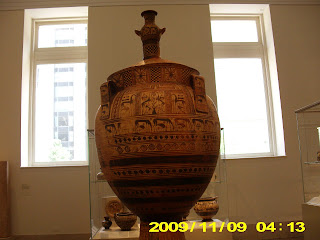
Greek Vase
The above vase is from the Geometric period of Greek vase making, c. 900 - 700 B.C.E.

Greek Vase
The above vase is a Red Figure vase dating from c. 490 B.C.E., and apparently depicting the murder of Clytemnestra by her son Orestes, from the myth of the House of Atreus.

Greek Vase
A Red Figure depiction of a Sculpter sculpting a statute of a God, dated to c. 480 B.C.E.

Greek Vase
A Black Figure vase depicting the God Dionysus, the man with the long beard, drinking wine and celebrating with Satyrs, and followers the joy brought by wine. The vase is dated to c. 550 b.C.E.

A Black figure vase depicting the Goddess Athena, dated to c. 560 B.C.E.
As mentioned above the so called Geometric style flourished from 900 - 700 B.C.E. This style was characterized by roughness, a certain crudeness but also by great vigor. Vases in this style were made throughout the Greek world during this time period.
About 700 B.C.E., there emerged the Black Figure style, apparently in Corinth, this was characterized by far greater refinement and polish, much greater realism its chief subjects were mythology and matters of everyday life. It flourished 700 - 530 B.C.E.
Strangely enough Black Figure vase manufacture / creation was confined to Corinth and Athens. Although other Greek cities continued to manufacture local utilitarian pottery, the market for fine ware was almost entirely captured by Black Figure pottery from Athens and Corinth. Although Black Figure pottery seems to have started in Corinth it spread to Athens and by 600 B.C.E. Corinthian Black Figure pottery was in serious decline and Athens was predominate in the market. Corinthian fine pottery manufacture seems to have disappeared by 550 B.C.E, leaving Athens alone in the manufacture of fine Greek pottery.
In about 530 B.C.E. Athenian pot makers and painters perfected Red Figure pottery, the manufacture of which was almost entirely confined to Athens. The height of this pottery was 530-450 B.C.E. After 400 B.C.E., the Red Figure pottery went into decline, in both quality and quantity. It appears that by 200 B.C.E., manufacture had largely ended at Athens.1
*Note The dates are the photos are wrong. I was unable to correct this problem with my camera. The actual date the photos were taken is May 5, 2010.
1. For more information on Greek vases see Murray, Oswyn, Early Greece, Fontana Books, London, 1980. pp. 36-38, 289-290, Finley, M. I., The Ancient Greeks, Penguin Books, London, 1963, pp. 166-169, Davies, J. K., Democracy and Classical Greece, Second Edition, Fontana Books, London, 1993, pp. 156-157.
Pierre Cloutier
 A Street in New York
(All the pictures in this post come from the book)
And to speak of crap, in the “Good Old Days” there was little trash pick up so that city sidewalks and roads were clogged with rubbish, that frequently was several feet deep. Pedestrians had a great time tramping through the debris. Citizens routinely dumped trash into the street or under the myriad vehicles parked in city streets.
Cleanup was haphazard and inefficient aside from being riddled with corruption, and inefficiencies. Cities routinely cut back on such “nonessential” services if they existed in any form at all.3
And if you thought it was just city life that swallowed heavily rural life also had its downside. For example cooking was a drudgery that required endlessly feeding wood into a stove that was always very hot and making everything from scratch made cooking seem an endless operation. And since the kitchen had the stove there was the endless drudgery of laundry. Without washers or dryers or modern detergents, washing required heating gallons of water on a stove and beating and rinsing clothes by hand before you hung them up to dry. You could beat the clothes by hand and use various lye soaps that very effectively chemically burned your skin and had such things has hollow logs and wooden paddles to help and of course there was repeatedly heating vast quantities of hot water for washing. After many, many hours of washing you finally finished the wash.4

Doing the Wash
Ah but was not there lots of fresh unpolluted well water. Well maybe, but then the well was usually located near the kitchen and the barn with all of its animal waste was very close. This helped to insure that well water was indeed heavily polluted and a source of disease.5
There was also the insufferable boredom of country life especially during the winter when Farms were generally almost completely isolated from each other. Sometimes people went stark raving mad from the boredom.6
Let us not talk about working conditions in any detail except to note that they were horrible. With things set at a very high pace and help for disabled workers virtually nonexistent.7
The attitude towards strikers is also of interest. In 1894 there was the Pullman strike, in which the employer managed to quite successfully portray the strikers as the bad guys. Despite the fact that in 1893 the Pullman Company had cut workers wages 5 times, the last by almost 30%! In 1892 a strike at Homestead was deliberately incited by the owner in hopes of breaking the union. The strike was violently suppressed by militiamen. In fact during this time period there were the creation of armoured units, police and planning to deal with strikers all over the place. Both media and the state was very much at the service of industry when it came to dealing with worker opposition.8

Regarding law and order. Well let’s just say crime was a serious problem, in both rural and urban settings. Including even the Mafia in New Orleans.9 The police were corrupt inefficient and engaged in massive protection rackets and payoffs. For example in New York City the position of a Patrolman could be bought for $100, a Captaincy for $1,500.10 An example of a Police protection racket, was the prostitution trade in New York City, were:
Police protection cost the bordello operator an initiation fee pf $300 to $500 and $30 to $50 monthly thereafter, traditionally collected by the precinct captain.11
 A Contemporary Cartoon about Police Corruption
In regards to the Legal system. Lawyers were notoriously incompetent and Judges and Juries were frequently easily bought by individuals and corporations. Local City governments were routinely treated as massive treasure chests by greedy politicians and contractors who pillage city coffers regularly. Of course lynching should not be forgotten.12
As for that good healthy food of yore. Well food was actually frequently putrid, especially meat, or heavily adulterated with water, (milk) or alum (flour). Cheese and butter were frequently adulterated with soap fat, lard or unmentionables. Not surprisingly people often got sick from this fare, and if you are poor you just had to put up with it.13.
Regarding health care. Doctors were frequently quacks with Diplomas from Diploma mills aside from that many were filthy. Treatments were frequently not much different from witchcraft. Knowledge of disease was minimal so epidemic diseases frequently ran wild especially in cities. Treatment of the insane or simply mentally ill bordered and frequently crossed the boundary into sadism and inhuman cruelty. Surgery was frequently performed under incredibly unhygienic conditions. Hospitals were frequently unspeakable. Helped by Doctors prescribing opiates galore drug addiction was rampant, along with alcoholism.14
 A ward in Bellevue hospital

Pollution overhead, garbage underfoot, streets choked with traffic, bursting slums, crime, labor unrest, dope addiction – problems of the future in the country with a future.
Perhaps, indeed, our nostalgia more rightfully belonged to them as they cast a sad eye on the lowering sky and longed for the good old days.18

