Sunday, November 28, 2010

More Hancock Woo

At the website Counterknowledge I recently posted the following reply to two comments. The link can be found Here. I’ve slightly modified my reply and added more references. (Note, December 2012, The Counterknowledge Website is no longer up or maintained. Although a copy of the Website is available at the Internet Archive. Sadly the copy of the page saved at the Internet Archive was copied before my reply posted below and one of the posts I was replying to. See Here.)

Kevin you say:
Sanji I to came to this site for exactly the same reasons has u and come to the same conclusion .watched both videos thanks for that .my first introduction to Bauval who I think is both intelligent and honest man listening to him now on information machine try watching black genesis by Bauval and don’t waste your time arguing with Pacal think him rude and offensive and blind to exploration of facts.
Bauval is not worth taking the slightest bit seriously along with Hancock. The whole Orion correlation thing as been exploded long ago. You are not aware that the constellation of Orion when imposed on Pyramids at Giza and the neighbouring area doesn’t match up. But then Bauval’s a joke. Have you bothered to read up on why the majority of Geologists do not accept an early date for the Sphinx as suggested by Schoch? Or how about how Bauval and Hancock were gunning for a 10,500 B.C.E., date for their Sphinx and basically ignoring that even Schoch gave a date after 8000 B,C.E. Of course do you accept the idea that the great pyramid was planned in 10,500 B.C.E., although built thousands of years later to reflect the date of 10,500 B.C.E. Which by the way Hancock got from Edgar Cayce, (the sleeping prophet). Both of them have been in the past quite ready to accuse Egyptologists of lying, of fraud, fabrication and forgery. In Fingerprints of the Gods Hancock accused an 19th century Egyptologist of fabricating Khufu’s name on stone blocks found in the chambers above the Kings chamber. Hancock has since retracted this baseless accusation but he continues to blither on about wicked Archaeologists suppressing the truth.

As for your last comment given the quite vicious names I’ve been called here I find you thinking me rude / offensive hilarious. I’ve merely said you guys were ignorant and clueless. Which you most evidently are. As for blind to exploration of the facts. Depends. If you mean the made up nonsense of Hancock and Bauval; that is speculation and fantasy not fact. But then you guys seem to have absolutely no interest in doing any sort of real research at all, but just mouth whatever Bauval and Hancock pull out of their asses.

Sanji you say:
Yeh its probably pointless to discuss with those guys, because in the end I'm just gonna repeat what Hancock and others have already said, and I m gonna read here the same critics I’ve seen, which sometimes are legitimate, but never good, solid, proven, unbreakable reasons to completely dismiss Hancock and every single aspect of his work. In the end, what he says has been going on for a quite a while through history, it s not brand new, so that debate has already been going on for ages.
Yep the debate between the cranks and Scientists as been going on for ages. Almost all of it in the minds of the cranks. Thank you for indicating that you have no desire to do any real research.

As for your request for unbreakable reason to dismiss Hancock. What about the simple fact that his lost super civilization seems to have vanished without a trace. How about the fact that each and everyone of the anomalies he points to is almost always has a “prosaic” explanation. How about Hancocks conspiracy mongering. I should not forget to note Hancock’s 2012 boosterism. From Baalbak, (built in Roman times), to the Piri Re’is map Hancock recycles mysteries that are not mysteries. Sanji then says:
Maybe because people like me haven’t yet spend a massive amount of time reading work to boost their knowledge, intelligence and ego, that what might be actually misleading or wrong, its easier to get on with the “outside the box” way of thinking.
Yep mustn’t have ones head clogged with knowledge it might inhibit one’s ability to swallow woo. I guess ignorance is a blessed state and knowing nothing is cool. Oh and Hancock doesn’t think outside the box his thought is firmly in the area of twentieth century crank Archaeology, he is right up their with Von Daniken, and especially Robert Charroux, (One Hundred Thousand Years of Man’s Unknown History). Sanji then says:
I wont go into details because they all say it better than me, but his position about C14 dating process for ancient monuments, his position about the Ice Age and its many mysteries, about maps found around the globe showing what might be locations unknown at the time, about ancient monuments that seem to have astronomical aspects to it, about underwater structures looking suspicious, about drawings, texts, interpretation of some ancient texts. and so on and so on….

There is just so much that you cant just ignore all of this, even when “it’s not a prefect match”, “most specialists disagree “, “he isn’t a professional” and blah blah blah blah.
Hancock’s position about Carbon 14 and how it is used to date monuments is deeply ignorant. Hancock never seems to get the fact that the materials that are associated with the monuments are dated. But then how Archaeologists do that would require him to read some of the many texts about Carbon 14 dating and how to use it. For dating methods see Archaeology, Second Edition, Renfrew, Colin & Bahn, Paul, Thames and Hudson, London, 1996.

He could also use with reading a book about climate history. Say Climate Change in Prehistory, Burroughs, William J., Cambridge University Press, Cambridge, 2005.

And of course has mentioned above Hancock’s “mysteries” are almost always not mysteries at all.

It is quite easy to ignore most of it, because it is generally not a mystery, and what little is “mysterious” does not require a unknown super civilization or aliens. I should mention here that for a time Hancock supported the idea of alien monuments on Mars, he as backed away from that I hope.

I lost any respect for Hancock from reading the sections of Fingerprints of the Gods (A deliberate play on Von Daniken’s Chariots of the Gods, in my opinion.), on the Maya and Tiwanaku. In the Tiwanaku chapter he almost entirely, (except for a throw away line) ignores the conventional dating of the site and instead advances a far out date based on astronomical alignments deduced from recently reconstructed buildings. These dates contradict dozens of Carbon 14 results along with ceramic, and stratigraphy studies to say nothing of ethno-historical data all of which date the site 200-1000 C.E (A.D.). Please see Ancient Tiwanku, Janusek, John Wayne, Cambridge University Press, Cambridge, 2008, The Tiwanaku, Kolata, Alan L., Blackwell, Oxford, 1993. As for the Maya please see The Ancient Maya, Sixth Edition, Sharer, Robert J, & Traxler, Loa P, Stanford University Press, Stanford CA, 2006, pp. 102-120, for the Mayan calendar. It also shows why Hancock’s discussion of it is a crock. Hancock’s discussion of the Sarcophagus lid in the tomb of Pacal at Palenque is also totally bogus. Sanji also says:
There are obviously a lot yet to discover about ourselves and our past, and that dude and his mates definitely bring something worth looking into. If a lot of experts of our time are against even debating or considering all this with a new eye, then so be it. It happened countless times before. Doesn’t mean we should blindly believe people like him, but if you sit on your books and ignore such character, then you really have shit in your eyes and your ears, and your slowing down the learning process of mankind. Anyway, I'm wasting my time typing all this, lets agree to disagree.

Guys I m still waiting to hear your opinion about those two videos
Thank you for the Galileo gambit, the typical cliché of cranks everywhere. However for every Galileo who was right there were 10,000 cranks who were way wrong.

As for seeing it with a new eye? Nope! It is the same old same old processed woo. In the 19th century Ignatius Donnelly was touting woo in his Atlantis: The Antediluvian World, in the early twentieth century we had Edgar Cayce and in the late 60’s and into the 70’s we had Von Daniken, along with countless others. It is the same old crap served for another generation.

As for shit in eyes and ears. Since people like Hancock listen to other woo miesters and ignore reams and reams of data while continuing their diet of woo. It is clear who has shit in their eyes and ears and it is Hancock and those who believe like him.

Although it is nice to know that you think the hard won knowledge of the past won over the past century or so is shit.

Some more reading:

Invented Knowledge, Fritze, Ronald, H, Reaktion Books, London, 2009.

Ancient Astronauts, Cosmic Collisions and other Popular Theories about Man’s Past, Stiebing, William H, Prometheus Books, Buffalo NY, 1984.

Giza: The Truth, Lawton, Ian & Ogilvie-Herald, Chris, Invisible Cities Press, Montpelier Vermont, 2001.

The Atlantis Syndrome, Jordan, Paul, Sutton Publishing, Gloucestershire, 2001.

Frauds, Myths and Mysteries, Feder, Kenneth L, Mayfield Pub. Co., Toronto, 1999.

Ancient Mysteries, James, Peter & Thorpe, Nick, Ballantine Books, New York, 1999.

Imagining Atlantis, Ellis, Richard, Vintage Books, New York, 1998.

The Space God’s Revealed, Story, Ronald, Barnes and Noble Books, New York, 1976.

The Code of Kings, Schele, Linda & Mathews, Peter, Simon & Schuster, New york, 1998.

Lost Continents, de Camp, L. Sprague, Dover Pub. Inc, New York, 1970.

In Search of Ancient Astronomies, Editor Krupp, E.C, McGraw-Hill, New York, 1978.

The New Age, Gardner, Martin, Prometheus Books, Buffalo, 1991.

From the website In the Hall of Maat, Here, are the following articles of interest.

Tiwanaku: Alternative History in Action, Fagan, Garrett, Here.

Antarctic Farce, Fagan, Garrett, Here.

Analysis of Hancock's Position Statement on C-14 Dating, Fagan, Garrett, Here.

An Answer to Graham Hancock, Fagan, Garrett, Here.
The Gentle Art of Myth Management, Edlin, Duncan, Here.

Fingerprints of the Gods: A Review, Malek, Jaromir, Here.

An Analysis of the Quality of Graham Hancock's Science, Bass, Mickey, Here.

Myth of the Open Mind, Edlin, Duncan, Here.

Going Orion in a Circle (Or: The Challenging Cayce of 10,500BC), Wall, John, Here.

Age of the Sphinx, Bordeau, Alex, Here.

The New Atlantis and the Dangers of Pseudohistory, Fagan, Garrett, & Hale, Chris, Here.

Tracing Graham Hancock's Shifting Cataclysm, Bass, Mickey, Here.

The Lost Civilization in Historical Perspective Déjà vu all over again, Feder, Ken, Here.

P.S. The two links are to films that are merely the same dull old nostrums that have been coming from those two for quite sometime.

Pierre Cloutier

Thursday, November 04, 2010

Notes on Christopher Columbus

Christopher Columbus

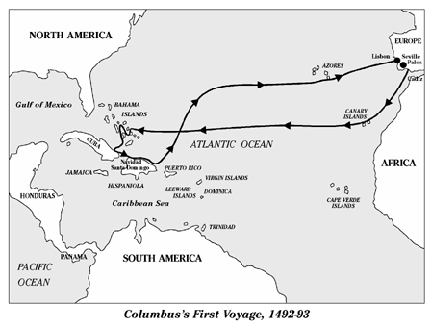
There is the the opinion that the explorer Christopher Columbus was an amazingly far-sighted genius who saw that the world was round when everyone else thought it was flat and convinced people to fund his effort to reach India / China by sailing west and that no on had thought of that before.

Of course virtually everything in the above paragraph is myth. It was for example received educated opinion in Europe in Columbus’ time and had been so since the Greeks that the Earth was round.1 That particular myth I may look at at another time. Here I will look at the myth of Christopher Columbus as lone genius.

Supposedly the received view is that Columbus was a lone genius who had an idea that no-one had before. The idea being that one could reach Asia by sailing west. This is false as the following quotes from Admiral of the Ocean Sea, by Samuel Eliot Morison indicate.

Morison was to put it mildly a hero worshipper of Columbus, as indicated by his grossly apologetic way of dealing with the way Columbus dealt with native Americans, so his comments are of interest. For Example Morison says:

Why not try sailing west, to Japan, China and India?

What would prevent it? No flat-earth theory certainly; for of all the vulgar errors connected with Columbus, the most persistent and the most absurd is that he had to convince people "the world was round." Every educated man in his day believed the world to be a sphere, every European university so taught geography, and seamen, though they might doubt the practical possibility of sailing "down under" or holding on when you got there, knew perfectly well from seeing ships "hull down" and raising mountains as they approached, that the surface of the globe was curved. Aristotle was reported to have written that you could cross the ocean from the Spains to the Indes paucis diebus, in comparatively few days; and Strabo, the Greek geographer who died about a.d. 25, hinted that it had actually been tried. "Those who have returned from an attempt to circumnavigate the earth do not say that they have been prevented from continuing their voyage by any opposing continent for the sea remained perfectly open, but through want of resolution and the scarcity of provision.”2
Also:
Whilst no valid ground exists to question the traditional concept that Columbus's purpose was to reach Asia by sailing west, there is plenty of room for argument as to where he got the idea, and when.
....

Certainly the theory was not original with him. We have already seen what Aristotle was reputed to have said, and what Strabo did say, about the possibility of sailing west to the Orient. Since there was no doubt of the world being a sphere, almost everyone admitted that Columbus's theory was valid;...3
Interestingly enough this Columbus worshipper said in his The European Discovery of America: The Northern Voyages, Samuel Eliot Morison, Oxford University Press, New York, 1971, the following concerning L'Anse Aux Meadows, (this is c. 11 years after the discovery):

Finally in 1960, a Norwegian archaeologist named Helge Ingstad located a spot in northern Newfoundland, L'Anse aux Meadows, which he thought might be "it". Years of summertime diggings by competent archaelogists have (it seems to me beyond a reasonable doubt) proved this place to have indeed been Vinland, where Leif Ericsson spent one winter, and where members of his family founded a short-lived colony. So, now that the location of Vinland has been solved, we may proceed with the story told in the sagas.4

Nope; Columbus did not see things no-one else did and this as long been known and acknowledged.

Just where did Christopher Columbus thought he was heading for? Some have asserted he knew that he was going to America. This seems to be rather unlikely given what the man wrote himself.

The following are quotes from the following The Four Voyages of Christopher Columbus.5 Which consists of translations of Columbus' logs letters and contemporary or near contemporary histories of his voyages.

From the log-book of Christopher Columbus' first voyage. I note that Bartolome De la Casas,6 preserves Columbus' log in the form of a digest with extensive direct quotes, unfortunately the original is now lost. From the preamble:

...your Highnesses decided to send me, Christopher Columbus, to see those parts of India and the princes and peoples of those lands and consider the best means of their conversion.7

Wednesday, 3 October

,...his {Columbus} purpose being to journey to the indies. He says that he would be foolish to delay.8

Saturday, 6 October

That night Martin Alonso said that it would be well to sail south-west by west, and the Admiral thought that he had the island of Cipangu {Japan} in mind, and saw that if they missed it they would not so easily come to the mainland and that the best thing would be to go there first and to the islands afterwards.9

Saturday, 13 October

But in order not to waste time I wish to go and see if I can strike the island of Chipangu.{Japan again slightly different spelling}10

Wednesday, 17 October

It has rained practically every day since I have been in those Indies.11

Sunday, 21 October

After this i shall set out for another island which, according to the indications given me by the Indians whom I have aboard, must be Chipangu.{Japan}12.

In passing I shall see the others that lie between and according to whether I find a quanity of gold or spices I shall decide what to do next. But I am determined to go to the city of Quinsay {in China}, to deliver your Highnesses' letters to the Grand Khan and request his answer which I shall bring back.13

Tuesday, 23 October

I should like to depart today for the island of Colba {Cuba}, which I believe according to the indications of its size and riches given us by these people must be Chipangu.{Japan}14

Wednesday, 24 October

...for if I am to believe the indications of all those Indians and those I have on board - I do not know their language - this is the island of Chipangu {Japan} of which marvelous tales are told, and which in the globes that I have seen and on the painted map of the world appears to lie in this region.15

Sunday, 28 October

The Admiral understood that the Gran Khan's {Title of the ruler of China} ships come there and that they are large and that the mainland is ten days' journey away.16
The next material is from a letter of Columbus describing his first voyage and written on his return trip.

When I reached Cuba, I followed its north coast westwards, and found it so extensive that I thought this must be the mainland, the province of Cathay.{China}17

In this island of Hispaniola I have taken possession of a large town which is most conveniently situated for the goldfields and for communications with the mainland both here, and there in the territory of the Grand Khan, with which there will be very profitable trade.18
The next material is from a letter of Columbus describing his fourth voyage (1502-1504).

They say that Ciguare is surrounded by water, and that ten days' journey away is the river Ganges. These lands seem to lie in the same relation to Veragua as Tortosa to Fuentarabia or Pisa to Venice.19

I arrived on 13 May at the province of Mago, which borders on Cathay {China}, and from there set out to Hispaniola.20

It is said that inland in the country lying towards Cathay {China} they have gold-embroidered materials.21
The above make it quite clear where Columbus thought he was going. It is also clear that he still thought he was near Cathay (China) during his last voyage. Which is a little strange given that by this time some Europeans were talking about the Americas as not being Asia but a “New World”.

1. For more about this myth see Myth of the Flat Earth, Wikipedia Here.

2. Morison, Samuel Eliot, Admiral of the Ocean Sea, Little Brown and Company, Boston, 1942, vol. 1, p. 45. Here are two fuller translations of the passage that Morison quotes part of:

8. Perception and experience alike inform us, that the earth we inhabit is an island: since wherever men have approached the termination of the land, the sea, which we designate ocean, has been met with: and reason assures us of the similarity of those places which our senses have not been permitted to survey. For in the east the land occupied by the Indians, and in the west by the Iberians and Maurusians, is wholly encompassed [by water], and so is the greater part on the south and north. And as to what remains as yet unexplored by us, because navigators, sailing from opposite points, have not hitherto fallen in with each other, it is not much, as any one may see who will compare the distances between those places with which we are already acquainted. Nor is it likely that the Atlantic Ocean is divided into two seas by narrow isthmuses so placed as to prevent circumnavigation: how much more probable that it is confluent and uninterrupted! Those who have returned from an attempt to circumnavigate the earth, do not say they have been prevented from continuing their voyage by any opposing continent, for the sea remained perfectly open, but through want of resolution, and the scarcity of provision.(Strabo, The Geography of Strabo, Book 1, Ch. 1, s. 8)

From Strabo, The Geography of Strabo, v. 1, The Macmillan Co., New York, 1903. Copy available from the Internet Archive Here.

8 We may learn both from the evidence of our senses and from experience that the inhabited world is an island; for wherever it has been possible for man to reach the limits of the earth, sea has been found, and this sea we call "Oceanus." And wherever we have not been able to learn by the evidence of our sense, there reason points the way. For example, as to the eastern (Indian) side of the inhabited earth, and the western (Iberian and Maurusian) side, one may sail wholly around them and continue the voyage for a considerable distance along the northern and southern regions; and as for the rest of the distance around the inhabited earth which has not been visited by us up to the present time (because of the fact that the navigators who sailed in opposite directions towards each other never met), it is not of very great extent, if we reckon from the parallel distances that have been traversed by us. It is unlikely that the Atlantic Ocean is divided into two seas, thus being separated by isthmuses so narrow and that prevent the circumnavigation; it is more likely that it is one confluent and continuous sea. For those who undertook circumnavigation, and turned back without having achieved their purpose, say that the they were made to turn back, not because of any continent that stood in their way and hindered their further advance, inasmuch as the sea still continued open as before, but because of their destitution and loneliness. (Strabo, The Geography of Strabo, Book 1, Ch.
1, s. 8)

From Strabo, The Geography of Strabo, available from LacusCurtius Here.

3. IBID, p. 78.

4. Morison, Samuel Eliot, The European Discovery of America: The Northern Voyages, Oxford University Press, New York, 1971, p. 38.

5. Columbus, Christopher, The Four Voyages of Christopher Columbus, Edited by J. M. Cohen, Penguin Books, London,1969.

6. Bartolome De la Casas, who became known as defender of the Indians, and is almost the perfect choice for becoming the patron Saint of human rights was a 15th-16th century monk who is also invaluable for editing and preserving many documents related to the European discovery of the Americas. Columbus; log of his first voyage being the most important.

7. Columbus, p. 37.

8. IBID, p. 49.

9. IBID, p. 50.

10. IBID, p. 57.

11. IBID, p. 67.

12. IBID, p. 71.

13. IBID, p. 71-72.

14. IBID, p. p. 72.

15. IBID, p. 73.

16. IBID, p. 76.

17. IBID, p. 115.

18. IBID, p. 120.

19. IBID, p. 288.

20. IBID, p. 294.

21. IBID, p. 298.

Pierre Cloutier

Friday, October 29, 2010

Libertarian Absurdities

The following is a long Blog posting I made at another Blog.1

No.15
I'm beginning to understand why some leftists loathe libertarians despite the latter's supposed irrelevance: Libertarians can actually defend the morality of their position quite easily; leftists cannot despite their identity as the most moral and enlightened.

The mere existence of libertarians is a painful reminder that there are those who actually stick to moral principle. This causes some leftists much pain, hence the use of strawmen and distortions. Their unwillingness to confront libertarianism as it actually is reflects the bankruptcy of their arguments.
The idea that Libertarians stick to moral principle is shall we say debatable. As for the use of strawmen and distortions that of course is a very familiar Libertarian technique.

To get to strawmen and distortions first, go to any libertarian website say Mies or Cato and you will find them replent with strawmen and distortions. For example perhaps the most flea dog of all the distortions is the notion that government is generally evil, (and in some libertarian language all evil). This is pure agit-prop relying for its effect on pure polemic and also based on the tired and simple-minded binary notion of an absolute distinction between private and public. I.E., private production goods etc., are good public (i.e., Government) is bad. This is coupled with the notion that collective action is by definition bad and individuals must act as individuals as much as possible. Coupled with this is the notion that individuals should not be coerced. The assumption usually implicit but sometimes explicit is that the only "real" source of coercion is public or government power.

Now it is clear to me that many libertarians are not the slightest opposed to private power, utterly unaware about how that easily blends into public or governmental power. Thus many Libertarians are absolutely incapable of seeing Corporations as governmental like bureaucracies of power. They also seem to have a great deal trouble recognizing private power as in reality often coercive. Often they live in a dream world that the only real coercive power is governmental. They also live in the dream world of everyone being responsible for themselves and a desire to reduce the ability of individuals to act collectively on the grounds that it is coercive. Yet when large private authoritarian institutions act coercively they ignore these limits on individuals freedom by talking as if individuals are free to leave / choose.

A particularly hilarious piece about this nonsense is a series of articles about how great Somalia is without government, ignoring that Somalia may have no formal government, but it is run by a series of clan based bureaucratic like systems which regiment and control life in a very authoritarian way.

What is further amusing is the solution that Libertarians suggest to if private power screws you, (i.e., pollutes your water); well just sue!? Thats right litigate, litigate litigate! After gutting governmental power to an absolute minimum if a big holder of private power screws you just go to the courts and sue. No doubt the fact that one side as vastly greater power than you in terms of wealth etc., will make no difference in how long it takes or what sort of decision the courts make. Yeah right! Of course the courts will also receive the massive and huge funding that will be necessary to deal with the vast increase of cases they will have to deal with. And of course this won't represent a vast increase in judicial power and the influence of lawyers in our society.

Sarcasm aside it is also obvious to me that a Libertarian society will see the growth of corporations into the gap left by government in effect replacing government with something that in present day North America is even more authoritarian.

Of course one of the more interesting features of Libertarianism is its implicit and at times explicit contempt for democracy. Basically contempt for people acting collectively. Democracy is characterized as hopelessly corrupt and well "evil", because it could lead to a individuals rights being abridged in a fundamental way.

Now I realize that the above doesn't characterize all Libertarians but I've seen it in far too many.

As for the moral argument. You really think they can easily defend their position morally? Well since a certain species of Libertarianism seems to think that individuals are atomized and entirely separate from all others and should act in their own (hopefully) enlightened self interest. Ah but self interest might require collective action and even worst coercion! Of course frequently this atomized view of human relations leads to a celebration of the ideal Libertarian society as all against all. Of course since humans form groups this view of basic human nature is false. Of course the biggest moral problem with Libertarianism in this form is that all to many Libertarians have no problem and no awareness of private power and coercion, (aside from the fact that this Manichean duality is an illusion). It appears that the exercise of such private power to screw people over, so long as it doesn't involve the evil of government, raises no problems with many Libertarians. Thus a wealthy merchant during a famine using his private power to hoard grain during a famine in hopes that prices will go up raises no moral problem in this singularly blinkered view.

Further it is of interest that to many Libertarians the liberty that matters is the ability to make money, own property etc., and that restrictions on that ability, like unions, child labour laws pollution controls etc., are unacceptable restrictions on liberty. Translated their liberty to screw others for their advantage. Basically the right to manage, property and make money trump everything else. Thus we get many Libertarians voting for the Republicans because they lower taxes, sacrificing other liberties for that. Also given this tendency of so many Libertarians to vote Republican; so much for sticking to moral principles. Of course of the most embarrassing examples of Libertarian sellout is Penn Jillette's paling around with Glen Beck, wingnut for quite a while. Yep standing up for real moral principles there.

As for other moral principles we get the following nonsense from some Libertarians, i.e., that a starving mob looting a train load of someone else's grain during a famine is utterly morally reprehensible and they have no moral problems with the person in question not just hoarding and moving the grain but shipping it out of the famine area if he can get a higher price elsewhere. Doesn't that at least raise a moral issue? But of course the right to manage and control ones own property trumps everything else and if it screws you over just sue and wait years, if it come at all, for the settlement.

Thus we read in Libertarian screeds stuff about personal responsibility. Thus I have read how about during famines feeding the starving with free or cheap food, would destroy the price mechanism and interfere with the magic invisible hand and besides people must learn to prioritize and be rational and giving them food might just encourage them to continue to be lazy and irrational. Yes nothing like having a few of your nearest and dearest starve to death in front of you to encourage rational sensible behavior. Either that or rely on completely voluntary agencies which might or might not, depending on if your cause is fashionable at the time, have the resources to help you. But at all costs any sort of coercion to help others is to be avoided. Meanwhile coercion must be employed to enable people to enjoy to the full their property rights.

In the end much Libertarianism is simple selfishness. I have / want mine and to keep it all for myself without feeling any guilt about others.

Now of course the central hypocrisy of Libertarian hatred of coercion is their general lack of interest in private power or coercion as they separate that from public coercion i.e., government.

Now a consistent Libertarian position must at a minimum be against private power / institution of coercion that restrict peoples freedom. I would suggest that a consistent Libertarian position must be against the Corporation and must be against those private power institutions that inhibit peoples ability to choose. And if they really believe that suing as a solution to private power screwing you. I would like to see a comprehensive and detailed description of how such a system would work especially about how its decisions would be enforced. Of course a thoroughly consistent Libertarian position is not much different from Anarchism.

Finally I would like to see a lot less of the Manichean bullshit / lies Libertarians spout when they talk about government.

Some people might object that I'm creating a caricature of a Libertarian position above. Sorry to say but its all stuff I've read about or heard in the last year.

1. See Dispatches From the Culture Wars Here

Pierre Cloutier

Saturday, October 09, 2010

"Natural" and "Unnatural"

I really hate the use of the terms "natural" and "unnatural" being used to describe things / acts, actions that exist in the real world. It is in my opinion a semantic slight of hand to give a more "objective" feel to moral / judgemental beliefs / statements. To me if something is "unnatural" it simply cannot happen. If it can happen it is "natural". Thus wearing clothes is "natural", so is loving someone, or writing a essay or saving someone from drowning with a life preserver. Of course murder, rape etc., all acts we deem bad etc., are also "natural".

What people almost always mean when they describe something as "unnatural" is that they feel / think that the thing or act described is immoral and / or evil. However talking about something as "unnatural" avoids the objection that the statement is simply a subjective statement of moral belief and hence easily countered by other, different statements of moral belief. Instead it elevates the belief to a more objective "higher" plane of argument that is, superficially objective and hence no longer merely a subjective moral belief.

Of course this type of argument is merely pseudo-objective, but it often achieves its purpose of getting people to discuss whether or not something is "unnatural" rather than the morality or lack thereof of some thing or act. It in fact makes no difference to the morality of something whether or not it is "natural" or "unnatural", but it does create the illusion of objectivity to argue about that and it avoids overtly talking about morality when that is what your in fact talking about. In other words it is a semantic con.

Associated with this is the concept of "natural law". I do not mean things like Newton's first law, or Kepler's laws of planetary motion, which like a real "natural" law are virtually unbreakable but the philosophical notion of "unnatural law", which is nothing more than a semantic trick designed to shroud the discussion of morality and ethics in a pseudo-objective disguise and further import false notions of scientific rigor into the discussion of morality and ethics.

Discussions of whether or not something is "natural" or 'unnatural" are just semantic games to avoid a clear discussion of ethics and morality.

Pierre Cloutier

Friday, September 24, 2010

Stolen Fantasy

The Pyramids of Giza

The following is an old posting I did years ago in reply to a posting at the Website In the Hall of Maat concerning the Book Stolen Legacy by G. M. James.1 The posting can be fond at the In the Hall of Maat website.2 The posting is by Ra Hotep Amen and he posted in its entirety a review by Femi Akomolafe called Review of George G. M. James Stolen Legacy. All quotes from the review in italics.

I notice that the author, of the review posted, very carefully avoids mentioning that G. M. James in his book says that Aristotle stole Egyptian books from the Library of Alexandria. A truly remarkable feat given that the library did not exist until after his death.3 Has for the rest of the piece please find below some comments on selected excerpts.

Ye shall know the truth, and the truth shall make you free.- Ancient Egyptian saying, wrongly credited to the Christian bible.

Is it or is it not in the Bible and if it is how can it be "falsely" attributed to the Bible?

Question: To what country do we owe our Civilization, Philosophy, the Arts and the Sciences? Answer: Greece.

Who is this "We" and who the hell says this?

Question: Who is the wisest man the world has ever seen?
Answer: Aristotle
Says Who?

Question: Name the world three greatest thinker of all times?
Answer: Socrates, Plato and Aristotle?

Says Who? and what about Jesus, the Buddha and Confucius.

Question: Who is the world greatest mathematician of all times, the [person] who invented the theorem of the Square of the Hypotenuse?
Answer: Pythagoras

Says Who?

All in all a collection of Agitation Propaganda points and assertions designed to generate much heat and little light.

I have quoted from an encyclopedia, which is often defined as 'volumes containing collections of human knowledge.' You don't argue with an encyclopedia, do you?

Why Not? and I certainly do!

You will be adjudged CORRECT and RIGHT if you give the above answers in an examination. But actually, none of the answers are TRUE. Based on what we know of history, they are FALSE.

Pure Agitation propaganda.

The greatest crime Europe committed against the world is the intellectual theft of Africa's heritage. Empires could be stolen, whole countries snatched and named after pirates rapists and swindlers. Palaces and monumental edifices destroyed could be rebuild. But when you steal a people's cultural patrimony, and used it to enslaved and insult them, you have committed unforgivable acts that border on the sacrilege.

I can think a few things more serious than alleged "theft" of intellectual ideas like, the slave trade and colonialism. Of course how can intellectual property be the collective property of a group and that use of it, borrowing it or being influenced by it can be theft?

That Greece invented philosophy, the Arts and the Sciences is the only basis on which the arrogance of Europe stands.It is those things credited to the Greek that made every European believed himself superior to other peoples\races. Conversely, it is the awe with which the other races view these grand ancient achievements, which made them cringe at the altar of supposed European superiority.

Again more agitation propaganda, the belief in European superiority rested mainly on the rather unpleasant fact that Europeans were able too by force impose themselves on most of the world and this lead to the belief in European superiority. Not just the idea that the Greeks invented philosophy, but also the idea that since the Europeans had steamships, the telegraph, etc., etc., a great many foolish Europeans thought they were superior to everyone else. This argument that European belief in their superiority rests entirely on a set of beliefs about the Greek achievements is hopelessly simple-minded. Besides it ignores the European belief in some sort of superiority based on the Christian tradition.

What course would the history of the world had taken if the European scholars[?] had not FALSELY claim for the Greeks what is certainly not theirs? Would the arrogance of Europeans not have been diminished if the truth about the contribution of Africa to human civilization have been correctly stated and interpreted? Would Africans have held themselves in such self-contempt if they have tried sooner to uncover the truth about their past? Would Africans be cringing at the altar of westernism if they know that almost every idea Europeans are using today was brazenly stolen from us? Would we be supplicating to a supposed son of an imaginary god if we knew that we gave RELIGION to the world?

So you are openly stating that your purpose is political and not a disinterested search for the truth. Some more agitation propaganda about "brazenly Stolen" ideas, again with the notion that ideas are collective property of a group and no other group may use them. Guess what no one society or people invented "religion" it is a universal.
Every European hold 'Greek Civilization' as an inspiration.

More agitation propaganda and besides it is not true.

They go around the world with volumes upon volumes celebrating Greek this, Greek that. From their original abode in Europe to the real estate they stole from other people, they shouted on top-voice about how they single-handedly invented and sustained human civilization! Sororities are created at institutions of higher learning. 'Great thinkers' waxed lyrical and sentimental about 'Greek Civilization.'

More useless polemics, designed to create heat and not light.

"The term Greek philosophy, to begin with is a misnomer, for there is no such philosophy in existence. The ancient Egyptians had developed a very complex religious system, called the Mysteries, which was also the first system of salvation." That was the opening statement from Stolen Legacy: Greek Philosophy is Stolen Egyptian Philosophy, by George G.M. James.

Some Greeks did "philosophy", since some Greeks did Philosophy there is Greek Philosophy. QED. But then this is a insult to the Greeks arguing that they contributed very little. G.M. James Mysteries are very strange in that he tells us very little about the mysteries except that they were secret but he is sure that the Greeks ripped them off even though they were secret and little can be said about them.4

George James began his book by informing us that the Egyptian Mystery System was the oldest in the world and was 'also a Secret Order, and membership was gained by initiation and a pledge to secrecy. The teaching was graded and delivered orally to the Neophyte; and under these circumstances of secrecy, the Egyptians developed secret systems of writing and teaching, and forbade their Initiates from writing what they had learn.' - p.1

Thus G.M. James can avoid telling us much about it because it was secret. It removes the need to supply evidence on the part of G.M. James. This does not prevent him from pontificating about theft. Needless to say the Greeks are given no credit for getting these ideas into the light of day rather than being secret knowledge available only to a few.

The Egyptians have developed their systems and taught same to Initiates around the world long before the Greeks were allowed into the temples. It was only after the invasion of Alexander the Destructor (called the Great by western mythorians) when the temples and the libraries were plundered, that the Greek gained access to all the ancient books, on which Aristotle built his own school and his reputation as the wisest man that ever lived!

Lots of assertions and nonsense. Aristotle had established his own school more than twenty years before the conquest of Egypt by Alexander. And regarding the ideas that Alexander "ripped off", How he could have gotten his Politics, (a discussion of overwhelmingly Greek political systems) or his The Athenian Constitution from Egypt is beyond me. Most of Aristotle's writing are prior to Alexander conquering Egypt and of course there is little to no evidence that Aristotle ever went to Egypt. (he died in 322 B.C.E.)5

In the first chapter of his book, James masterfully destroyed the myth of a Greek philosophy. Pythagoras, the oldest of the so-called Greek-thinkers was a student in Egypt for several years. He was exiled when he started to teach what he had learned. Socrates was executed for teaching 'foreign ideas.' Plato was sold into slavery. Aristotle was also exiled. What we are asked to believed by western scholars was that these ancient Greeks were persecuted in a society that is sufficiently advanced in philosophy.

It is possible that Pythagoras went to Egypt although not likely. Regarding Plato he was not sold into slavery. Also Pythagoras was not the oldest of Greek thinkers that honour was given to Thales of Militus. What does the Greek persecution of Philosophers have to do with where the Greeks got their philosophy. The comment about persecution is pure polemics what does that have to do with anything? The French Philosophers of the Enlightenment were often persecuted and harassed also.6

On what basis do western scholars claim philosophy for Greece? Because the literature were written in Greece. As is still in existence unto today, most Orders prohibit their members from writing down what they learn. This explains why Socrates, as even the Encyclopedia Britannica admitted, did not commit anything to writing! The Babylonians and the Chaldeans, who also studied under the Egyptian Masters, also refused to publish those teachings. It is usurpers like Plato and Aristotle that brought into book forms all the secret teachings of Egyptian and claim authorship!

Mere assertion. Evidence please. Note the polemical flourish of describing Plato and Aristotle has "usurpers". I note that the touch that it was all oral saves the need to provide evidence.

George James pointed out the absurdity of this stance. The Hebrew scriptures, called the Septuagint, the Gospels and the Epistles were also written in Greek, why are the Greek not claiming authorship of them? 'It is only the unwritten philosophy of the Egyptians translated into Greek that has met such an unhappy fate: a legacy stolen by the Greeks.'

Maybe because specific works were specifically claimed to be the work of Plato, Aristotle etc. And maybe they wrote them! I note that Plato wrote dialogues about conversations that various people he knew allegedly had. I note that since the Greeks did not claim to have written the Septuagint it was because they didn't write it so that if they claimed they wrote something (i.e., a Greek wrote it) maybe they did.

This is not the only absurdities James pointed out in the book. Another instance: The number of books whose authorship is credited to Aristotle is simply impossible to be the work of one single man, even in our age when word-processing software makes writing a lot easier.

We know that a lot of Aristotle's books were lecture notes and he had students help him with projects. I note that Isaac Asimov wrote over 500 books.7

We also have to keep in mind that Aristotle was purported to have been taught by Plato. Plato, as the books, show was a philosopher. Aristotle is still regarded as the greatest scientist of antiquity. The question thus beggared is how could Plato taught Aristotle what he didn't know himself?

Plato did teach Aristotle any evidence otherwise (i.e., that someone else taught him?) Excuse me but can't Aristotle have found things for himself?

The truth of the matter was that Aristotle, aided by Alexander the Destroyer (some called him the Great), secured the books from the Egyptian Royal Libraries and Temples. 'In spite however of such great intellectual treasure, the death of Aristotle marked the death of philosophy among the Greeks, who did not seem to possess the natural abilities to advance these sciences.' p. 3

Aside from if the Egyptian knowledge was oral how could Aristotle find it in written form, what evidence that Aristotle pillaged Royal libraries in Egypt. The statement about Greek philosophy ending with Aristotle is completely false. The purest form of drivel.8

'The aim of this book is to establish better race relations in the world, by revealing a fundamental truth concerning the contribution of the African Continent to civilization. It must be borne in mind that the first lesson in the Humanities is to make a people aware of their contribution to civilization; and the second lesson is to teach them about other civilizations. By this dissemination of the truth about the civilization of individual peoples, a better understanding among them, and a proper appraisal of each other should follow. This notion is based upon the notion of the Great Master Mind: Ye shall know the truth, and the truth shall make you free.' Consequently, the book is an attempt to show that the true authors of Greek philosophy were not the Greeks; but the people of North Africa, commonly called the Egyptians; and the praise and honor falsely given to the Greeks for centuries belong to the people of North Africa, and therefore to the African Continent. Consequently this theft of the African legacy by the Greeks led to the erroneous world opinion that the African Continent has made no contribution to civilization, and that its people are naturally backward. This is the misrepresentation that has become the basis of race prejudice, which has affected all people of color.

How falsehoods and disparaging the Greeks will do this is beyond me.

To leave no one in doubt about the cogency of his impressive arguments, chapter one (Greek Philosophy is Stolen Egyptian Philosophy) opens with an examination of the stories of the so- called 'Greek Philosophers. Pythagoras, after receiving his training in Egypt, went back to his native Samos and established an Order as was the custom in those days. Anaximander and Anaximenes, native, Parmenides, Zeno and Melissus were all native of Ionia and they taught nothing but Egyptian mysteries. Ditto, Heraclitus, Empedocles, Anaxagoras and Democritus. What we have to remember here is that Ionia was a colony of Egypt (readers are directed to Martin Bernal's, Black Athena, published by Vintage, especially vol. I, ISBN 0 09 988780 0). At the apex of its glory, Egypt held sway over much of the known world. The Ionians would later become Persian subjects after the fall of Egypt, before they even became Greek citizens.

Lots of assertions backed by no evidence. Pythagoras went to Italy, not to Samos, to establish his school. Ionia was never a part of Egypt.9

All of these Ionians did not claim for themselves the glory of philosophy or the sciences. The Persians and the Chaldeans were also introduced to the Ancient Mystery Systems, yet they did not claim authorship. It was the Athenians - Socrates, Plato and Aristotle who usurped this African legacy and thereby distorted the reality of human history. What is quite clear was that it was Athens that those who taught the mysteries were persecuted the most until Alexander's time. We know with certainty that these philosophers were roundly persecuted by the Athenian Government for teaching foreign doctrines.

Any evidence? of course not.10

What is incredible about these 'Great Philosopher' is the total lack of any knowledge about their early lives. The world is asked to believe that these men who possessed all the super-natural abilities attributed to them had no education, no training, philosophy, mathematics and the sciences just came to them!

Again mere polemical assertion and agit-prop. Who says that they had no education after all Plato was a disciple of Socrates and Aristotle was a student of Plato and besides they could read the Ionian philosophers.

The only evidence adduced for this fraud was that the books were written by the Orders founded by the Athenian impostors. But as James repeatedly reminded us, the ancient Egyptians forbade their pupils from writing, and this injunction was obeyed by all but the Athenians. We have to excuse Socrates, whom James believed to be the only properly trained Initiate. Instead of divulging the secrets he had learned, he drank a poison. Both Plato and Aristotle fled. Yet they came back and claim the credits!

"Athenian impostors", let the useless, polemical insults fly! Has for not allowing them to write how convenient for G.M. James but of course our impostors get no credit for saving knowledge from obliteration. The stuff about Socrates is nonsense Socrates drank poison because he was tried and convicted for corrupting the youth, not to avoid telling secrets.12

The crucial question of how Aristotle got all the books that bore his credit is easily answered by the simple historical fact that he went with his friend, Alexander, in the latter campaign and conquest. After Egypt was conquered and destroyed, the Royal Library and the Temples were looted by Aristotle. It was with these books that he established his own school and, aided by his pupils, Theophrastus, Andronicus of Rhodes and Eudemus, started to copy the books. These men were also credited with the authorship of several books, and it was them who formed the organization of 'The Learned study of Aristotle Writings.' 'It would certainly appear that the object of the Learned Association was to beat Aristotle's own drum and dance. It was Aristotle's idea to compile a history of philosophy, and it was Aristotle's school and its alumni that carried out the idea, we are told." (p.19)

A collection of assertions and insults about Aristotle. The "simple historical fact" is that there is NO evidence that Aristoltle was ever in Egypt or that he looted libraries (of written down information that was supposidly only past down oraly!?).13

Chapter II, 'So-Called Greek Philosophy was Alien to the Greeks And their Conditions of Life.' Here James drew for us the conditions under which the Greeks were living at this period in history. According to the western mythorians, the period of 'Greek Philosophy' was located 640-322 BC.

The statement Greek philosophy was confined to the period 640-322 B.C.E. is simply false.14

'The period of Greek philosophy (640-322 BC was a period of internal and external wars, and was therefore unsuitable for producing philosophers. History supports the fact that from the time of Thales to the time of Aristotle, The Greeks were victims of internal disunion, on the one hand, while on the other, they lived in constant fear of invasion from the Persians who were a common enemy to the city states.

This is mere assertion Philosophy seems to have flourished in Europer in the past few centuries despite constant wars. I could also give China in the Era of warring states (c. 600-221 B.C.E.)15

When Western mythorians roll out Aristotle, Plato and Socrates, they fail to tell their audience how these guys were persecuted by their own government.

The Death of Socrates is one of the Cliches of the western tradition.16

These 'philosophers' were persecuted for the exactly the same reason - 'introducing strange divinities.' Socrates charge sheet read, in part, 'Socrates commit a crime by not believing in the Gods of the city, and by introducing other new divinities. He also commit a crime by corrupting the youth.' He was further accused of 'busying himself with investigating things beneath the earth and in the sky,a nd who makes the worse appear the better reason, and who teaches others the same thing.' Whereas astronomy was part of the required study in the Egyptian schools, the Athenian government was persecuting its citizens for pursuing such studies. Who, now, is the father of what?

More Agit-prop and so what how does this prove that Greek scholars did not write the books or make the discoveries atributed to them? Also Socrates new god was his personal "daemon" not a Egyptian deity. Oh and the story of Athens presecuting philosophers seems to be seriously exagerated. After all Athens attracted thinkers from all over the Greek speaking world.

The conquest of Alexander and the destruction of the Lodges and the libraries plus the edicts of Theodosius and Justinian suppressed the Egyptian mystery systems and the Greek philosophy schools alike, paving the way for christianity which is nothing but a badly mis-understood Egyptian religion.

After insulting the Greeks lets insult Christians.

In Chapter five through chapter seven, George James analyzed the doctrines of the so-called Greek philosophers and convincingly show their Egyptian origin. From pre-Socratic 'Philosophers' like Thales, Anaximander, Anaximenes and Pythagoras to Eleatic 'philosophers' like Xenophanes, Parmenides, Zeno and Melissus, to the Ionian school of Heraclitus, Anaxagoras and Democritus, he showed that what history has attributed to these impostors were nothing but what they copied from the Egyptians.

"Impostors", more insults. Besides perviously our Author had said the Ionians were good guys unlike the evil Athenian three (Socrates, Plato, Aristotle). G.M. James shows no such thing except very vague alleged similarities.17

In these, the most important chapters, James concluded that the Greeks were guilty of plagiarism of the highest order.

Once again ideas are property of one particular group and of course the Greeks are guilty of "plagiarism", basically by mere assertion.

Chapter eight dealt with the Memphite Theology which 'is an inscription on a stone, now kept in the British Museum. It contains the theological, cosmological and philosophical views of the Egyptians. It has already been referred to in my treatment of Plato's doctrines; but it must be repeated here to show its full importance as the basis of the entire field of Greek philosophy.' p. 139. Here James show how portions of the philosophy of the Memphite Theology were assigned to the Greeks. This is a very important chapter as it throws enough light, not only on the whole argument of where the Greek got the ideas credited to them, but also about the true source of modern scientific knowledge.'

G.M. James chapter fails quite competly to show any influence on the Greeks of this theology or even that the Greeks were aware of it.

If the modern Nebular hypothesis credited to Laplace which holds that our present solar system was once a molten gaseous nebula is ever proven right, credit should go to the ancient Egyptians. Their cosmology is strikingly similar. They knew that the universe was created from fire. The Egyptian God Atum (Atom) together with his eight Created Gods that composed the Ennead or Godhead of nine, this correspond with our nine major planets. Atom, the sun God, was the Unmoved Mover, a doctrine which has been falsely attributed to Aristotle. Likewise, the injunction, 'Know Thyself,' was wrongly attributed to Socrates. As James pointed out, it was an inscription found on every Egyptian Temple. The Cardinal virtues, justice, wisdom, temperance and courage which was falsely credited to Plato owed their origin to the Egyptian Masters.


The idea that the world emerged out of swerling chaos is quite common. Again more vague similarities that G.M. James interprets as consistant with Greek thought, with little thought to providing a link to Greek thought. Oh and is our author asserting that the Egyptians knew of nine planets, (now eight since Pluto as been demoted)? If so our author as a serious case of woo.

In the concluding chapter nine, 'Social Reformation through the New Philosophy of African Redemption,' James wrote: 'Now that it has been shown that philosophy, and the arts and sciences were bequeathed to civilization by the people of North Africa and not by the people of Greece; the pendulum of praise and honor is due to shift from the people of Greece to the people of the African continent who are the rightful heirs of such praise and honor.


Open admission that this is designed to "steal the heritage" how revealing.

No one, IMO, should be allowed to teach African history who has not read Stolen Legacy. No one should call himself educated who has not read Stolen Legacy. The next time anyone brandishes a Ph.D in your face, your question should be, 'Have you read Stolen Legacy?'

Yes I have and it is very bad book full of distorions, falsehoods and insults all for a very clear political purpose to which honesty and accuracy and simple good scholarly etiquite are sacrificied.18

Aristotle

1. James, G. M., Stolen Legacy, Philosophical Library, New York, 1954.

2. In the Hall of Maat at Here.

3. Snowden, Frank M. Jr., Bernal’s “Blacks” and the Afrocentrists, in Black Athena Revisted, Ed. Lefkowitz, Mary R., & Rogers, Guy, Mclean, The University of Noth Carolina Press, Chapel Hill NC, 1996, pp. 112-128, p. 121.

4. For early Greek philosophy see Kirk, G. S., Raven, J. E., & Schofield, M., The Presocratics, Second Edition, Cambridge University Press, Cambridge, 1983, Waterfield, Robin, The First Philosophers, Oxford University Press, Oxford, 2000, Barnes, Jonathan, Early Greek Philosophers, Second Revised Edition, Penguin Books, 2001. The above books contain the surviving fragments of the pre-Socratics with commentary.

5. See Aristotle, The Politics, Penguin Books, London, 1962, and his The Athenian Constitution, Penguin Books, London, 1984.

6. See Footnote 4 for more detail on Pythagoras.

7. See Wikipedia Bibliography of Isaac Asimov Here

8. For Greek Philosophy after Aristotle see Long, A. A., & Sedley, D. N., The Hellenistic Philosophers, v. 1 & 2, Cambridge University Press, Cambridge 1987. See also Walbank, F. W., The Hellenistic World, Fontana Press, London, 1992, pp. 176-199.

9. Footnote 9.

10. For an evaluation of the idea idea that Athens routinely prsecuted philosophers and how very dubious the whole idea is see Stone, I. F., The Trial of Socrates, Little, Brown and Co., Boston, 1988, pp. 231-247.

11. Footnote 3.

12. Footnote 10.

13. Footnote 3.

14. Footnote 8.

15. Nivison, David Shepherd, The Classical Philosophical Writings, in Loewe, Michael & Shaughnessy, Edward L., The Cambridge History of Ancient China, Press, Cambridge, 1999, pp. 745-789, Harper, Donald, Warring States, Natural Philosophy and Occult Thought, in Loewe, pp. 790-884.

16. Footnote 10.

17. For more about these Ionian Philosophers see Footnote 4.

18. For more about Afrocentrism see Howe, Stephen, Afrocentrism, Verso, London, 1999. See also the essays in Black Athena Revisted and Lefkowitz, Mary, Stolen Legacy ( or Mythical History): Did the Greeks Steal Philosophy From the Egyptians? In Skeptic, v. 2 No. 4, 1994, pp. 98-103, Appiah, Kwane Anthony, Beyond Race: Fallacies of Reactive Afrocentrism, in Skeptic, v. 2 No. 4, 1994, pp. 104-107. For Why people believe strange stuff see Shermer, Michael, Why People Believe Weird Things, W. H. Freeman and Co., New York, 1997.

Pierre Cloutier