Sunday, December 12, 2010

Losing all by Winning all

 Page of Treaty of Troyes

One of the greatest humiliations in French history was the Treaty of Troyes, signed May 21, 1420, by which Charles VI and the Burgundian party in the then French civil war between the Armagnacs and Burgundians agreed to disinherit Charles VI’s son Charles VII and to make Henry V of England heir to the French Kingdom and to marry Charles VI’s daughter Catherine de Valois to Henry V.

Henry V, one of the most formidable of English kings, had recently restarted the Hundred Years War and had, in 1415, achieved the crushing and one-sided victory over the French at Agincourt. The Civil war between the French along with his own considerable military talents had enabled Henry to conquer the Duchy of Normandy in 1417-1420.

At the time Henry’s aim seems to have been extensive lands in France in full sovereignty, i.e., without having to acknowledge the overriding authority of the French crown.

In France the English successes seems to bring together the two factions. One led by the Burgundians had control over the Royal court and Paris and was led by Jean sans peur, (John the Fearless) Duke of Burgundy. The other faction had been led by first Louis Duke of Orleans and then Bernard Count of Armagnac, who in 1418 gained control of the young Charles VII, the Dauphin. The bad blood between the factions was considerable, characterized by tit for tat slaughters.

The crises had been precipitated originally by the intermittent madness Charles VI; which has he grew older became permanent. In this situation court factions developed and fought over control of the state because the king was incapable of governing some of the time and then all of the time.

In 1407 Jean sans peur arranged to have Louis Duke of Orleans assassinated. By threats and force majeur Jean was able to get a royal pardon for his murderous deed, from the now quite ill king. By 1410 government in France was paralyzed by infighting and the civil war had begun. Only occasionally in the next 10 years were the French able to act together. The resulting divisions helped produce the English victory at Agincourt.

The aftermath of said battle was mutual recriminations between the Armagnac faction and the Burgundian faction. The result was all out civil war between the factions. The result was much fighting and in Paris first one faction and then the other engaging in horrible massacres. The climax came in 1418 when the Burgundians regained control of Paris and thousands of Armagnacs and their supporters were butchered including most of the leaders. The remaining Armagnacs still had control of the young Dauphin Charles VII.

Jean and the Armagnacs were frightened by the English advance and tried to negotiate a truce and then an alliance. Several agreements were solemnized and as a final seal on the new agreement a meeting was arranged between the Dauphin, Charles VII, and Jean sans peur at a bridge located at the town of Montereau, c. 45 miles from Paris.

Apparently anxious to avenge their murdered leaders and friends the Armagnacs murdered Jean sans peur on the bridge.

The involvement of Charles VII in the plot to murder Jean sans peur is not clear. It is hard to believe that he didn’t at least know about it ahead of time and at the same time it appears that at this juncture he was very much the puppet of the Armagnac faction. In other words it is hard to believe that he was behind the plan to murder Jean sans peur. Certainly Charles VII had little reason to seek personal vengeance against Jean sans peur. It is more likely he went along with the plan. Charles VII turned into an intelligent and rather devious politician so it is hard to believe that he would see that murdering Jean sans peur was in the context of the situation of 1419 anything but a really bad idea.

The results were predictable. The gulf between the factions became much, much larger and Henry V took immediate advantage and drove a very hard bargain. Jean sans peur son Philip called le bel, the good, was not surprisingly utterly furious. The result was an unexpected opportunity for Henry V to get everything. The price of his support was that he be recognized as heir to the kingdom of France.

As for Jean sans peur himself. Given his crimes and general foulness it is very hard to see his violent death as anything but well deserved. However regardless of his personal criminality the fact remains that murdering him was a mistake and doubly so under the circumstances prevailing. The remnants of the Armagnac faction had let their personal, understandable though it was, hatred cloud sober political judgment and made things much worst for themselves and France. For not only did the murder turn many Frenchmen against them, murdering Jean sans peur at a parley, with oaths of safe conduct violated etc., was regarded as particularly loathsome. Involving the Dauphin, Charles VII, in the murder greatly damaged his position, and even worst gave an opening to the English king Henry V.1

A little over a century later a monk showing then French king Francois I the tombs of the Burgundian dukes in Dijon remarked when picking up Jean sans peur badly damaged skull:

This is the hole through which the English entered France.2
In the ensuing debacle Henry V was able to get the Royal court and the Burgundian faction to accept him as the heir to Charles VI as king of France and of course to disinherit the Dauphin Charles VII. As a diplomat Henry V had played his hand brilliantly. As for why he asked for the big prize, becoming king of France, rather than lands in full sovereignty in France? I suspect Henry felt that this was a too good opportunity to waste to get everything. So why not get everything?

Later I will go into the problems with the treaty here I will print a copy of the treaty as printed in The Chronicles of Monstrelet. The sections below in brackets are from an incomplete, copy of the treaty printed in, A Source Book of Medieval History.3

De Monstrelet was a Burgundian chronicler of the first half of the 15th century and was contemporary with the events he describes. His version of the Treaty of Troyes was slightly different in wording in some respects from the actual treaty which is why some of the clauses have alternative variations below them in brackets.4

Charles, by the grace of God, king of France, to all our bailiffs, provosts, seneschals, and to all the principal of our officers of justice, or to their lieutenants, greeting. Be it known, that we have this day concluded a perpetual peace, in our town of Troyes, with our very dear and well-beloved son Henry king of England, heir and regent of France, in our name and in his own, in consequence of his marriage, with our well-beloved daughter Catherine, and by other articles in the treaty concluded between us, for the welfare and good of our subjects, and for the security of the realm; so that henceforward our subjects, and those of our said son, may traffic and have a mutual intercourse with each other, as well on this as on the other side of the sea.

1. It has been agreed that our said son king Henry, shall henceforth honour us as his father, and our consort the queen as his mother, but shall not by any means prevent us from the peaceable enjoyment of our crown during our life.

2. Our said son king Henry, engages that he will not interfere with the rights and royalties of our crown so long as we may live, nor with the revenues, but that they may be applied as before to the support of our government and the charges of the state; and that our consort the queen shall enjoy her state and dignity of queen, according to the custom of the realm, with the unmolested enjoyment of the revenues and domains attached to it.

3. It is agreed that our said daughter Catherine shall have such dower paid her from the revenues of England as English queens have hitherto enjoyed, namely, sixty thousand crowns, two of which are of the value of an English noble.

4. It is agreed that our said son king Henry, shall, by every means in his power, without transgressing the laws he has sworn to maintain, and the customs of England, assure to our said daughter Catherine the punctual payment of the aforesaid dower of sixty thousand crowns from the moment of his decease.

5. It is agreed, that should it happen that our said daughter survive our said son, king Henry, she shall receive, as her dower from the kingdom of France, the sum of forty thousand francs yearly; and this sum shall be settled on the lands and lordships which were formerly held in dower by our very dear and well beloved the lady Blanche, consort to king Philip of France, of happy memory, our very redoubted lord and great grandfather.

6. It is agreed that immediately on our decease, and from thenceforward, our crown and kingdom of France, with all its rights and appurtenances, shall devolve for ever to our said son king Henry, and to his heirs.

(6. After our death [Charles VI], and from that time forward, the crown and kingdom of France, with all their rights and appurtenances, shall be vested permanently in our son [son-in law], King Henry [of England], and his heirs.)

7. Because we are for the greater part of our time personally prevented from attending to the affairs and government of our realm with the attention they deserve, the government of our kingdom shall in future be conducted by our said son king Henry, during our life, calling to his assistance and council such of our nobles as have remained obedient to us, and who have the welfare of the realm and the public good at heart, so that affairs may be conducted to the honour of God, of ourself and consort, and to the general welfare and security of the kingdom ; and that tranquillity may be restored to it, and justice and equity take place everywhere by the aid of the great lords, barons, and nobles of the realm.

(7.....The power and authority to govern and to control the public affairs of the said kingdom shall, during our lifetime, be vested in our son, King Henry, with the advice of the nobles and wise men who are obedient to us, and who have consideration for the advancement and honor of the said kingdom....)

8. Our said son shall, to the utmost of his power, support the courts of parliament of France, in all parts that are subject to us, and their authority shall be upheld and maintained with rigour from this time forward.

9. Our said son shall exert himself to defend and maintain each of our nobility, cities, towns and municipalities in all their accustomed rights, franchises, and privileges, so that they be not individually nor collectively molested in them.

10. Our said son shall labour diligently, that justice be administered throughout the realm, according to the accustomed usages, without exception of anyone, and will bodily defend and guard all our subjects from all violence and oppression whatever.

11. It is agreed that our said son king Henry shall appoint to all vacant places, as well in the court of parliament as in the bailiwicks, seneschalships, provostships, and to all other offices within our realm, observing that he do nominate fit and proper persons for such offices, fully acquainted with the laws and customs of the country, so that tranquility may be preserved, and the kingdom flourish.

12. Our said son will most diligently exert himself to reduce to our obedience all cities, towns, castles and forts, now in rebellion against us, and of the party commonly called Dauphinois or Armagnac.

13. For the more secure observance of these articles, and the more effectually to enable our said son king Henry to carry them into execution, it is agreed that all the great lords, as well spiritual as temporal, all the cities, towns, and municipalities within our realm, and under our obedience, shall each of them take the following oaths: They shall swear obedience and loyalty to our said son king Henry, in so much as we have invested him with the full power of governing our kingdom of France in conjunction with such counsel of able men as he may appoint. They will likewise swear to observe punctually whatever we, in conjunction with our consort the queen, our said son king Henry, and the council, may ordain. The cities, towns, and municipalities, will also swear to obey and diligently follow whatever orders may particularly affect them.

14. Instantly on our decease the whole of the subjects of our kingdom shall swear to become liegemen and vassals to our said son king Henry, and obey him as the true king of France, and, without any opposition or dispute, shall receive him as such, and never pay obedience to any other as king or regent of France but to our said son king Henry, unless our said son should lose life or limb, or be attacked by a mortal disease, or suffer diminution in person, state, honour, or goods. But should they know of any evil designs plotted against him, they will counteract them to the utmost of their power, and give him information thereof by letters or messages.
15. It is agreed that whatever conquests our said son may make from our disobedient subjects shall belong to us, and their profits shall be applied to our use; but should any of these conquests appertain to any noble who at this moment is obedient to us, and who shall swear that he will faithfully defend them, they shall be punctually restored to him as to the lawful owner.

16. It is agreed that all ecclesiastics within the duchy of Normandy and the realm of France, obedient to us, to our said son, and attached to the party of the duke of Burgundy, who shall swear faithfully to keep and observe all the articles of this treaty, shall peaceably enjoy their said benefices in the duchy of Normandy, and in all other parts of our realm.

17. All universities, colleges, churches, and monasteries, within the duchy of Normandy or elsewhere, subject to us, and in time to come to our said son king Henry, shall freely enjoy all rights and privileges claimed by them, saving the rights of the crown and of individuals.

18. Whenever the crown of France shall devolve by our decease on our said son king Henry, the duchy of Normandy, and all the other conquests which he may have made within the kingdom of France, shall thenceforward remain under the obedience and jurisdiction of the monarchy of France.

19. It is agreed that our said son king Henry, on coming to the throne of France, will make ample compensation to all of the Burgundian party who may have been deprived of their inheritances by his conquest of the duchy of Normandy, from lands to be conquered from our rebellious subjects, without any diminution from the crown of France. Should the estates of such not have been disposed of by our said son, he will instantly have the same restored to their proper owners.
20. During our life all ordinances, edicts, pardons and privileges, must be written in our name, and signed with our seal; but as cases may arise which no human wisdom can foresee, it may be proper that our said son king Henry should write letters in his own name, and in such cases it shall be lawful for him so to do, for the better security of our person, and the maintaining good government ; and he will then command and order in our name, and in his own, as regent of the realm, according as the exigency of the occasion may require.
21. During our life our said son king Henry will neither sign nor style himself king of France, but will most punctually abstain there from so long as we shall live.

22. It is agreed that during our life we shall write, call and style our said son king Henry as follows: Our very dear son Henry, king of England, heir to France and in the Latin tongue, Noster praecharissimus filius Henricus rex Anglias heeres Franciae.

(22. It is agreed that during our life-time we shall designate our son, King Henry, in the French Language in this fashion, Nortre tres cher fils Henri, roi d’angleterre, heritier de France; and in the Latin Language Noster praecarissimus filius Henricus, rex Angliae, heres Francae.)

23. Our said son king Henry will not impose any taxes on our subjects, except for a sufficient cause, or for the general good of the kingdom, and according to the approved laws and usages observed in such cases.

24. That perfect concord and peace may be preserved between the two kingdoms of France and England henceforward, and that obstacles tending to a breach thereof (which God forbid) may be obviated, it is agreed that our said son king Henry, with the aid of the three estates of each kingdom, shall labour most earnestly to devise the surest means to prevent this treaty from being infringed: that on our said son succeeding to the throne of France, the two crowns shall ever after remain united in the same person, that is to say, in the person of our said son, and at his decease, in the persons of those of his heirs who shall successively follow him: that from the time our said son shall become king of France the two kingdoms shall no longer be divided, but the sovereign of the one shall be the sovereign of the other, and to each kingdom its own separate laws and customs shall be most religiously preserved.

(24.....[It is agreed] that the two kingdoms shall be governed from the time that our said son, or any of his heirs shall assume the crown, not divided between different kings at the same time, but under one person who shall be king and sovereign lord of both kingdoms; observing all pledges and all other things to each kingdom its rights, liberties or customs, usages and laws, not submitting in any manner one kingdom to the other.)

25. Thenceforward, therefore, all hatreds and rancour that may have existed between the two nations of England and France shall be put an end to, and mutual love and friendship subsist in their stead: they shall enjoy perpetual peace, and assist each other against all who may any way attempt to injure either of them. They will carry on a friendly intercourse and commerce, paying the accustomed duties that each kingdom has established.

26. When the confederates and allies of the kingdoms of France and of England shall have had due notice of this treaty of peace, and within eight months after shall have signified their intentions of adhering to it, they shall be comprehended and accounted as the allies of both kingdoms, saving always the rights of our crown and of that of our said son king Henry, and without any hindrance to our subjects from seeking that redress they may think just from any individuals of these our allies.

27. It is agreed that our said son king Henry, with the advice of our well-beloved Philip duke of Burgundy, and others of the nobles of our realm, assembled for this purpose, shall provide for the security of our person conformably to our royal estate and dignity, in such wise that it may redound to the glory of God, to our honour, and to that of the kingdom of France and our subjects; and that all persons employed in our personal service, noble or otherwise, and in any charge concerning the crown, shall be Frenchmen born in France, and in such places where the French language is spoken, and of good and decent character, loyal subjects, and well suited to the offices they shall be appointed to.

28. We will that our residence be in some of the principal places within our dominions, and not elsewhere.

29. Considering the horrible and enormous crimes that have been perpetrated in our kingdom of France, by Charles, calling himself dauphin of Vienne, it is agreed that neither our said son king Henry, nor our well beloved Philip duke of Burgundy, shall enter into any treaty of peace or concord with the said Charles, without the consent of us three and of our council, and the three estates of the realm for that purpose assembled.

(29. In consideration of the frightful and astounding crimes and misdeeds committed against the kingdom of France by Charles, the said Dauphin, it is agreed that we, our son Henry, and also our very dear son Philip, duke of Burgundy, will never treat for peace or amity with the said Charles.)

30. It is agreed, that in addition to the above articles being sealed with our great seal, we shall deliver to our said son king Henry, confirmatory letters from our said consort the queen, from our said well-beloved Philip duke of Burgundy, and from others of our blood royal, the great lords, barons, and cities, and towns under our obedience, and from all from whom our said son king Henry may wish to have them.
31. In like manner, our said son king Henry, on his part, shall deliver to us, besides the treaty itself sealed with his great seal, ratifications of the same from his well-beloved brothers, the great lords of his realm, and from all the principal cities and towns of his kingdom, and from any others from whom we may choose to demand them.

In regard to the above articles, we, Charles king of France, do most solemnly, on the word of a king, promise and engage punctually to observe them; and we swear on the holy Evangelists, personally touched by us, to keep every article of this peace inviolate, and to make all our subjects do the same, without any fraud or deceit whatever, so that none of our heirs may in time to come infringe them, but that they may be for ever stable and firm.

In confirmation whereof, we have affixed our seal to these presents.
Given at Troyes, 21st day of May, in the year 1420, and of our reign the 40th.
Sealed at Paris with our signet, in the absence of the great seal.
Signed by the king in his grand council.
Countersigned,
J. Millet
The treaty provided for the creation of a dual monarchy united only in the person of the monarch. The treaties as many provisions that clearly indicate the two realms are to be kept separate, with their own laws and customs, and personal. Henry agreed to employ Frenchmen in France and Englishmen in England. On both sides there was fear of one side coming to dominate the other.

Hence the clauses guaranteeing the rights and privileges of various groups and institutions. Including but not limited too, nobility, towns, universities etc.

The extent of French humiliation is indicated in the various clauses mentioning Normandy. Those clauses indicated that Normandy would continue to be separately governed by Henry V and would not be reincorporated back into the French realm until after Henry V had succeeded Charles VI as king of France. Further the Burgundians who had lost land in Normandy during the English conquest, which Henry V had distributed to his supporters, (overwhelmingly English) would not get it back.

The actual defects of the Treaty as a legal document are patently obvious which probably explains the emphasis in the document on oath taking. Which were designed to make breaking the oath to accept the treaty very hard.

The most obvious defect was that one of signatories, Charles VI, king of France was insane and quite incapable of entering into valid contracts. As such any treaty with his signature on it was so much, legally speaking, waste paper.

Secondly it is too put it mildly very dubious that the king of France could dispose of his kingdom as if it was a personal possession and disinherit the legitimate heir. Of course the fact, mentioned above, that Charles VI was also quite mad at the time made the whole thing even more dubious.5

It is the above problem that accounts for the treaties many statements regarding oaths and getting the approval of the various estates, parliaments, the different classes of people, etc. Of course given that more than half of France rejected the treaty such approval as Henry V got from the various estates etc., was legally dubious.

Also for a treaty designed to be a peace treaty it talked a lot about war and enforcing obedience. There are clauses calling for continual war against the Dauphin, Charles VII and his supporters until they are subdued. In other words it called for continued war. And of course disinheriting Charles VII virtually assured a prolonged bloody war. That clause (29) making it impossible to make a separate peace with the Dauphin was also a call to perpetual war.

Further the treaty called for the Burgundians to be compensated for land taken by Henry V in Normandy with land captured from the Dauphin’s supporters. Which again was a call for perpetual war.

Also the treaty wasn’t quite clear about what would happen if Henry V predeceased Charles VI. Which Henry V did. This rather sophistical argument was later given as one of the reasons for Philip le bel to break the treaty.6

Another reason, and by far the most important one, given by Philip le bel to break the treaty was the limitation on making peace with the Dauphin, Charles VII. Philip le bel’s legal experts considered this clause to be such a violation of a Princes Christian duty to seek peace that it was along with the rest of the treaty null and void as being insupportable and immoral. In other words it violated the basic laws governing relations between states and men and as such had no legal standing.7

Thus right from the start the treaty had grave defects in and of itself.

In terms of less legalistic issues. The treaty faced the problem that the Burgundian faction was at best only lukewarm in support of the treaty. Philip le bel and most of the Burgundian faction quite simply didn’t like Henry V or the English. In fact in Lancastrian France there was little enthusiasm for Henry V as king of France. Even such Burgundian supporters as the Bourgeois of Paris there was precious little liking for Henry V or the English and much animosity and in fact hate. For a time the quite real, almost rabid hatred of the Burgundians for the Armagnacs gave grudging support to the English cause of a dual monarchy. But it was to put it bluntly a very weak reed. Philip le bel, despite his very great hatred of the Armagnacs and the Dauphin for the murder of his father had no love of Henry V or the English and if Dauphin was not swiftly overwhelmed would start moving to reconciliation with him.

Another problem was that before the treaty the Dauphin, Charles VII was firmly in the grasp of one faction, the Armagnacs, afterwards all those Frenchmen who were outraged by his disinheritance and the prospect of an English king becoming king of France became his supporters. Thus making Charles VII more than just the nominal head of one faction but the head of coalition of forces trying to preserve French independence. It also gave Charles VII room to maneuver and lessen his dependence on the Armagnac faction and create an independent power base.

The chances of the treaty working in the long term were to put it bluntly poor. The longer it took to crush Charles VII and his supporters the more likely the whole setup would unravel. The opposition of more than half of France could not be wished away. Further this opposition was allied to the fact that what French support there was of the treaty was grudging and lukewarm, based mostly on hatred of the Armagnac faction than on any positive belief in the treaty.

As for Henry V and English. By the treaty Henry V yoked English policy to an all or nothing outcome, which meant all too likely prolonged if not perpetual war. It precluded negotiation since the English would only treat on Charles VII giving up everything and being left nothing. This was war to the knife / to the death. It also morally tied English policy to an untenable position, i.e., acceptance of an English king as king of France. Basically the English would not settle for anything less than total capitulation by Charles VII and his supporters. Charles VII could not compromise on his claim to be king of France because to do so would put his entire position in danger.

The results were terrible with the price paid by the French people. The war which had restarted in earnest in 1415 was not even momentarily interrupted by the Treaty of Troyes (1420) but continued without a truce until 1444. In that year a temporary truce was finally negotiated. (Truce of Tours). English negotiations were constantly hamstrung by the insistence by many Englishman that they were entitled to all that the Treaty of Troyes gave them, including kingship of France, irregardless of the fact that by 1444 the English would be lucky to keep anything. For the French they could not accept Henry VI’s (Henry V’s son) claim to the throne of France without undermining Charles VII’s claim to the throne.

The war was renewed in 1449 and in 1450 the English were expelled from Normandy, and by 1453 the English were entirely expelled from France. The war ended in complete defeat for England, and in an ironic coda to the Treaty of Troyes Henry VI whose mother Catherine de Valois was married to Henry V at Troyes in the events associated with the Treaty of Troyes inherited from his grandfather, Charles VI his madness. And like in France madness in a king precipitated civil war.

Henry V’s bold diplomatic move at Troyes aiming at having it all ended up with nothing except losing all.8

Henry V meeting Catharine de Valois

1. For the sources for the above narrative see: De Monstrelet, Enguerrand, The Chronicles of Monstrelet, v. 1, William Smith, London, 1840, see pp. 320-438, Seward, Desmond, The Hundred Years War, Atheneum, New York, 1978, pp. 143-188, Allmand, Christopher, The Hundred Years War, Cambridge University Press, Cambridge, 1988, pp. 26-31, Perroy, Edouard, Perroy, The Hundred Years War, Capricorn Books, New York, 1965, pp. 219-244, Barker, Juliet, Conquest, Little, Brown, London, 2009, pp. 3-45, Curry, Anne, The Hundred Years War, St. Martin’s Press, New York, 1993, pp. 89-108, Seward, Desmond, Henry V As Warlord, Penguin Books, London, 1987, pp. 130-151, Allmand, Christopher, Lancastrian Normandy 1415-1450, C;arendon Press, Oxford, 1983, pp. 1-49.

2. Seward, 1978, p. 180.

3. De Monstrelet, pp. 439-442. Ogg, F. A., A Source Book of Medieval History, American Book Company, New York, 1907, p. 443.

4. Curry, pp. 12-13.

5. Dickinson, Joycelyne Gledhill, The Congress of Arras, 1435, Clarendon Press, Oxford,1955.

6. IBID, Seward, 1978, p. 230.

7. IBID, Dickinson.

8. See Seward, 1978, pp. 189-265, 1987, pp. 159-169, 214-220, Curry, pp. 103-121, Griffiths, R.A., The Reign of King Henry VI, Sutton Pub, London, 2004, pp. 178-230, 443-550, Allmand, 1988, pp. 26-36, The Bourgeois of Paris, A Parisian Journal 1405-1449, Clarendon Press, Oxford, 1968, Perroy, 235-322, Barker, Allmand, 1983, pp. 211-283.

Pierre Cloutier

Sunday, November 28, 2010

More Hancock Woo

At the website Counterknowledge I recently posted the following reply to two comments. The link can be found Here. I’ve slightly modified my reply and added more references. (Note, December 2012, The Counterknowledge Website is no longer up or maintained. Although a copy of the Website is available at the Internet Archive. Sadly the copy of the page saved at the Internet Archive was copied before my reply posted below and one of the posts I was replying to. See Here.)

Kevin you say:
Sanji I to came to this site for exactly the same reasons has u and come to the same conclusion .watched both videos thanks for that .my first introduction to Bauval who I think is both intelligent and honest man listening to him now on information machine try watching black genesis by Bauval and don’t waste your time arguing with Pacal think him rude and offensive and blind to exploration of facts.
Bauval is not worth taking the slightest bit seriously along with Hancock. The whole Orion correlation thing as been exploded long ago. You are not aware that the constellation of Orion when imposed on Pyramids at Giza and the neighbouring area doesn’t match up. But then Bauval’s a joke. Have you bothered to read up on why the majority of Geologists do not accept an early date for the Sphinx as suggested by Schoch? Or how about how Bauval and Hancock were gunning for a 10,500 B.C.E., date for their Sphinx and basically ignoring that even Schoch gave a date after 8000 B,C.E. Of course do you accept the idea that the great pyramid was planned in 10,500 B.C.E., although built thousands of years later to reflect the date of 10,500 B.C.E. Which by the way Hancock got from Edgar Cayce, (the sleeping prophet). Both of them have been in the past quite ready to accuse Egyptologists of lying, of fraud, fabrication and forgery. In Fingerprints of the Gods Hancock accused an 19th century Egyptologist of fabricating Khufu’s name on stone blocks found in the chambers above the Kings chamber. Hancock has since retracted this baseless accusation but he continues to blither on about wicked Archaeologists suppressing the truth.

As for your last comment given the quite vicious names I’ve been called here I find you thinking me rude / offensive hilarious. I’ve merely said you guys were ignorant and clueless. Which you most evidently are. As for blind to exploration of the facts. Depends. If you mean the made up nonsense of Hancock and Bauval; that is speculation and fantasy not fact. But then you guys seem to have absolutely no interest in doing any sort of real research at all, but just mouth whatever Bauval and Hancock pull out of their asses.

Sanji you say:
Yeh its probably pointless to discuss with those guys, because in the end I'm just gonna repeat what Hancock and others have already said, and I m gonna read here the same critics I’ve seen, which sometimes are legitimate, but never good, solid, proven, unbreakable reasons to completely dismiss Hancock and every single aspect of his work. In the end, what he says has been going on for a quite a while through history, it s not brand new, so that debate has already been going on for ages.
Yep the debate between the cranks and Scientists as been going on for ages. Almost all of it in the minds of the cranks. Thank you for indicating that you have no desire to do any real research.

As for your request for unbreakable reason to dismiss Hancock. What about the simple fact that his lost super civilization seems to have vanished without a trace. How about the fact that each and everyone of the anomalies he points to is almost always has a “prosaic” explanation. How about Hancocks conspiracy mongering. I should not forget to note Hancock’s 2012 boosterism. From Baalbak, (built in Roman times), to the Piri Re’is map Hancock recycles mysteries that are not mysteries. Sanji then says:
Maybe because people like me haven’t yet spend a massive amount of time reading work to boost their knowledge, intelligence and ego, that what might be actually misleading or wrong, its easier to get on with the “outside the box” way of thinking.
Yep mustn’t have ones head clogged with knowledge it might inhibit one’s ability to swallow woo. I guess ignorance is a blessed state and knowing nothing is cool. Oh and Hancock doesn’t think outside the box his thought is firmly in the area of twentieth century crank Archaeology, he is right up their with Von Daniken, and especially Robert Charroux, (One Hundred Thousand Years of Man’s Unknown History). Sanji then says:
I wont go into details because they all say it better than me, but his position about C14 dating process for ancient monuments, his position about the Ice Age and its many mysteries, about maps found around the globe showing what might be locations unknown at the time, about ancient monuments that seem to have astronomical aspects to it, about underwater structures looking suspicious, about drawings, texts, interpretation of some ancient texts. and so on and so on….

There is just so much that you cant just ignore all of this, even when “it’s not a prefect match”, “most specialists disagree “, “he isn’t a professional” and blah blah blah blah.
Hancock’s position about Carbon 14 and how it is used to date monuments is deeply ignorant. Hancock never seems to get the fact that the materials that are associated with the monuments are dated. But then how Archaeologists do that would require him to read some of the many texts about Carbon 14 dating and how to use it. For dating methods see Archaeology, Second Edition, Renfrew, Colin & Bahn, Paul, Thames and Hudson, London, 1996.

He could also use with reading a book about climate history. Say Climate Change in Prehistory, Burroughs, William J., Cambridge University Press, Cambridge, 2005.

And of course has mentioned above Hancock’s “mysteries” are almost always not mysteries at all.

It is quite easy to ignore most of it, because it is generally not a mystery, and what little is “mysterious” does not require a unknown super civilization or aliens. I should mention here that for a time Hancock supported the idea of alien monuments on Mars, he as backed away from that I hope.

I lost any respect for Hancock from reading the sections of Fingerprints of the Gods (A deliberate play on Von Daniken’s Chariots of the Gods, in my opinion.), on the Maya and Tiwanaku. In the Tiwanaku chapter he almost entirely, (except for a throw away line) ignores the conventional dating of the site and instead advances a far out date based on astronomical alignments deduced from recently reconstructed buildings. These dates contradict dozens of Carbon 14 results along with ceramic, and stratigraphy studies to say nothing of ethno-historical data all of which date the site 200-1000 C.E (A.D.). Please see Ancient Tiwanku, Janusek, John Wayne, Cambridge University Press, Cambridge, 2008, The Tiwanaku, Kolata, Alan L., Blackwell, Oxford, 1993. As for the Maya please see The Ancient Maya, Sixth Edition, Sharer, Robert J, & Traxler, Loa P, Stanford University Press, Stanford CA, 2006, pp. 102-120, for the Mayan calendar. It also shows why Hancock’s discussion of it is a crock. Hancock’s discussion of the Sarcophagus lid in the tomb of Pacal at Palenque is also totally bogus. Sanji also says:
There are obviously a lot yet to discover about ourselves and our past, and that dude and his mates definitely bring something worth looking into. If a lot of experts of our time are against even debating or considering all this with a new eye, then so be it. It happened countless times before. Doesn’t mean we should blindly believe people like him, but if you sit on your books and ignore such character, then you really have shit in your eyes and your ears, and your slowing down the learning process of mankind. Anyway, I'm wasting my time typing all this, lets agree to disagree.

Guys I m still waiting to hear your opinion about those two videos
Thank you for the Galileo gambit, the typical cliché of cranks everywhere. However for every Galileo who was right there were 10,000 cranks who were way wrong.

As for seeing it with a new eye? Nope! It is the same old same old processed woo. In the 19th century Ignatius Donnelly was touting woo in his Atlantis: The Antediluvian World, in the early twentieth century we had Edgar Cayce and in the late 60’s and into the 70’s we had Von Daniken, along with countless others. It is the same old crap served for another generation.

As for shit in eyes and ears. Since people like Hancock listen to other woo miesters and ignore reams and reams of data while continuing their diet of woo. It is clear who has shit in their eyes and ears and it is Hancock and those who believe like him.

Although it is nice to know that you think the hard won knowledge of the past won over the past century or so is shit.

Some more reading:

Invented Knowledge, Fritze, Ronald, H, Reaktion Books, London, 2009.

Ancient Astronauts, Cosmic Collisions and other Popular Theories about Man’s Past, Stiebing, William H, Prometheus Books, Buffalo NY, 1984.

Giza: The Truth, Lawton, Ian & Ogilvie-Herald, Chris, Invisible Cities Press, Montpelier Vermont, 2001.

The Atlantis Syndrome, Jordan, Paul, Sutton Publishing, Gloucestershire, 2001.

Frauds, Myths and Mysteries, Feder, Kenneth L, Mayfield Pub. Co., Toronto, 1999.

Ancient Mysteries, James, Peter & Thorpe, Nick, Ballantine Books, New York, 1999.

Imagining Atlantis, Ellis, Richard, Vintage Books, New York, 1998.

The Space God’s Revealed, Story, Ronald, Barnes and Noble Books, New York, 1976.

The Code of Kings, Schele, Linda & Mathews, Peter, Simon & Schuster, New york, 1998.

Lost Continents, de Camp, L. Sprague, Dover Pub. Inc, New York, 1970.

In Search of Ancient Astronomies, Editor Krupp, E.C, McGraw-Hill, New York, 1978.

The New Age, Gardner, Martin, Prometheus Books, Buffalo, 1991.

From the website In the Hall of Maat, Here, are the following articles of interest.

Tiwanaku: Alternative History in Action, Fagan, Garrett, Here.

Antarctic Farce, Fagan, Garrett, Here.

Analysis of Hancock's Position Statement on C-14 Dating, Fagan, Garrett, Here.

An Answer to Graham Hancock, Fagan, Garrett, Here.
The Gentle Art of Myth Management, Edlin, Duncan, Here.

Fingerprints of the Gods: A Review, Malek, Jaromir, Here.

An Analysis of the Quality of Graham Hancock's Science, Bass, Mickey, Here.

Myth of the Open Mind, Edlin, Duncan, Here.

Going Orion in a Circle (Or: The Challenging Cayce of 10,500BC), Wall, John, Here.

Age of the Sphinx, Bordeau, Alex, Here.

The New Atlantis and the Dangers of Pseudohistory, Fagan, Garrett, & Hale, Chris, Here.

Tracing Graham Hancock's Shifting Cataclysm, Bass, Mickey, Here.

The Lost Civilization in Historical Perspective Déjà vu all over again, Feder, Ken, Here.

P.S. The two links are to films that are merely the same dull old nostrums that have been coming from those two for quite sometime.

Pierre Cloutier

Thursday, November 04, 2010

Notes on Christopher Columbus

Christopher Columbus

There is the the opinion that the explorer Christopher Columbus was an amazingly far-sighted genius who saw that the world was round when everyone else thought it was flat and convinced people to fund his effort to reach India / China by sailing west and that no on had thought of that before.

Of course virtually everything in the above paragraph is myth. It was for example received educated opinion in Europe in Columbus’ time and had been so since the Greeks that the Earth was round.1 That particular myth I may look at at another time. Here I will look at the myth of Christopher Columbus as lone genius.

Supposedly the received view is that Columbus was a lone genius who had an idea that no-one had before. The idea being that one could reach Asia by sailing west. This is false as the following quotes from Admiral of the Ocean Sea, by Samuel Eliot Morison indicate.

Morison was to put it mildly a hero worshipper of Columbus, as indicated by his grossly apologetic way of dealing with the way Columbus dealt with native Americans, so his comments are of interest. For Example Morison says:

Why not try sailing west, to Japan, China and India?

What would prevent it? No flat-earth theory certainly; for of all the vulgar errors connected with Columbus, the most persistent and the most absurd is that he had to convince people "the world was round." Every educated man in his day believed the world to be a sphere, every European university so taught geography, and seamen, though they might doubt the practical possibility of sailing "down under" or holding on when you got there, knew perfectly well from seeing ships "hull down" and raising mountains as they approached, that the surface of the globe was curved. Aristotle was reported to have written that you could cross the ocean from the Spains to the Indes paucis diebus, in comparatively few days; and Strabo, the Greek geographer who died about a.d. 25, hinted that it had actually been tried. "Those who have returned from an attempt to circumnavigate the earth do not say that they have been prevented from continuing their voyage by any opposing continent for the sea remained perfectly open, but through want of resolution and the scarcity of provision.”2
Also:
Whilst no valid ground exists to question the traditional concept that Columbus's purpose was to reach Asia by sailing west, there is plenty of room for argument as to where he got the idea, and when.
....

Certainly the theory was not original with him. We have already seen what Aristotle was reputed to have said, and what Strabo did say, about the possibility of sailing west to the Orient. Since there was no doubt of the world being a sphere, almost everyone admitted that Columbus's theory was valid;...3
Interestingly enough this Columbus worshipper said in his The European Discovery of America: The Northern Voyages, Samuel Eliot Morison, Oxford University Press, New York, 1971, the following concerning L'Anse Aux Meadows, (this is c. 11 years after the discovery):

Finally in 1960, a Norwegian archaeologist named Helge Ingstad located a spot in northern Newfoundland, L'Anse aux Meadows, which he thought might be "it". Years of summertime diggings by competent archaelogists have (it seems to me beyond a reasonable doubt) proved this place to have indeed been Vinland, where Leif Ericsson spent one winter, and where members of his family founded a short-lived colony. So, now that the location of Vinland has been solved, we may proceed with the story told in the sagas.4

Nope; Columbus did not see things no-one else did and this as long been known and acknowledged.

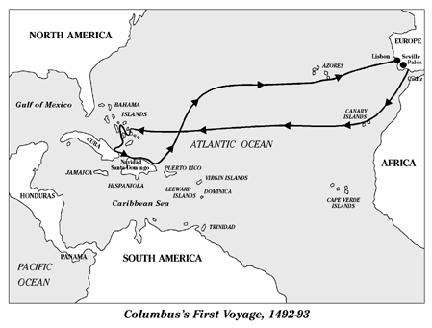
Just where did Christopher Columbus thought he was heading for? Some have asserted he knew that he was going to America. This seems to be rather unlikely given what the man wrote himself.

The following are quotes from the following The Four Voyages of Christopher Columbus.5 Which consists of translations of Columbus' logs letters and contemporary or near contemporary histories of his voyages.

From the log-book of Christopher Columbus' first voyage. I note that Bartolome De la Casas,6 preserves Columbus' log in the form of a digest with extensive direct quotes, unfortunately the original is now lost. From the preamble:

...your Highnesses decided to send me, Christopher Columbus, to see those parts of India and the princes and peoples of those lands and consider the best means of their conversion.7

Wednesday, 3 October

,...his {Columbus} purpose being to journey to the indies. He says that he would be foolish to delay.8

Saturday, 6 October

That night Martin Alonso said that it would be well to sail south-west by west, and the Admiral thought that he had the island of Cipangu {Japan} in mind, and saw that if they missed it they would not so easily come to the mainland and that the best thing would be to go there first and to the islands afterwards.9

Saturday, 13 October

But in order not to waste time I wish to go and see if I can strike the island of Chipangu.{Japan again slightly different spelling}10

Wednesday, 17 October

It has rained practically every day since I have been in those Indies.11

Sunday, 21 October

After this i shall set out for another island which, according to the indications given me by the Indians whom I have aboard, must be Chipangu.{Japan}12.

In passing I shall see the others that lie between and according to whether I find a quanity of gold or spices I shall decide what to do next. But I am determined to go to the city of Quinsay {in China}, to deliver your Highnesses' letters to the Grand Khan and request his answer which I shall bring back.13

Tuesday, 23 October

I should like to depart today for the island of Colba {Cuba}, which I believe according to the indications of its size and riches given us by these people must be Chipangu.{Japan}14

Wednesday, 24 October

...for if I am to believe the indications of all those Indians and those I have on board - I do not know their language - this is the island of Chipangu {Japan} of which marvelous tales are told, and which in the globes that I have seen and on the painted map of the world appears to lie in this region.15

Sunday, 28 October

The Admiral understood that the Gran Khan's {Title of the ruler of China} ships come there and that they are large and that the mainland is ten days' journey away.16
The next material is from a letter of Columbus describing his first voyage and written on his return trip.

When I reached Cuba, I followed its north coast westwards, and found it so extensive that I thought this must be the mainland, the province of Cathay.{China}17

In this island of Hispaniola I have taken possession of a large town which is most conveniently situated for the goldfields and for communications with the mainland both here, and there in the territory of the Grand Khan, with which there will be very profitable trade.18
The next material is from a letter of Columbus describing his fourth voyage (1502-1504).

They say that Ciguare is surrounded by water, and that ten days' journey away is the river Ganges. These lands seem to lie in the same relation to Veragua as Tortosa to Fuentarabia or Pisa to Venice.19

I arrived on 13 May at the province of Mago, which borders on Cathay {China}, and from there set out to Hispaniola.20

It is said that inland in the country lying towards Cathay {China} they have gold-embroidered materials.21
The above make it quite clear where Columbus thought he was going. It is also clear that he still thought he was near Cathay (China) during his last voyage. Which is a little strange given that by this time some Europeans were talking about the Americas as not being Asia but a “New World”.

1. For more about this myth see Myth of the Flat Earth, Wikipedia Here.

2. Morison, Samuel Eliot, Admiral of the Ocean Sea, Little Brown and Company, Boston, 1942, vol. 1, p. 45. Here are two fuller translations of the passage that Morison quotes part of:

8. Perception and experience alike inform us, that the earth we inhabit is an island: since wherever men have approached the termination of the land, the sea, which we designate ocean, has been met with: and reason assures us of the similarity of those places which our senses have not been permitted to survey. For in the east the land occupied by the Indians, and in the west by the Iberians and Maurusians, is wholly encompassed [by water], and so is the greater part on the south and north. And as to what remains as yet unexplored by us, because navigators, sailing from opposite points, have not hitherto fallen in with each other, it is not much, as any one may see who will compare the distances between those places with which we are already acquainted. Nor is it likely that the Atlantic Ocean is divided into two seas by narrow isthmuses so placed as to prevent circumnavigation: how much more probable that it is confluent and uninterrupted! Those who have returned from an attempt to circumnavigate the earth, do not say they have been prevented from continuing their voyage by any opposing continent, for the sea remained perfectly open, but through want of resolution, and the scarcity of provision.(Strabo, The Geography of Strabo, Book 1, Ch. 1, s. 8)

From Strabo, The Geography of Strabo, v. 1, The Macmillan Co., New York, 1903. Copy available from the Internet Archive Here.

8 We may learn both from the evidence of our senses and from experience that the inhabited world is an island; for wherever it has been possible for man to reach the limits of the earth, sea has been found, and this sea we call "Oceanus." And wherever we have not been able to learn by the evidence of our sense, there reason points the way. For example, as to the eastern (Indian) side of the inhabited earth, and the western (Iberian and Maurusian) side, one may sail wholly around them and continue the voyage for a considerable distance along the northern and southern regions; and as for the rest of the distance around the inhabited earth which has not been visited by us up to the present time (because of the fact that the navigators who sailed in opposite directions towards each other never met), it is not of very great extent, if we reckon from the parallel distances that have been traversed by us. It is unlikely that the Atlantic Ocean is divided into two seas, thus being separated by isthmuses so narrow and that prevent the circumnavigation; it is more likely that it is one confluent and continuous sea. For those who undertook circumnavigation, and turned back without having achieved their purpose, say that the they were made to turn back, not because of any continent that stood in their way and hindered their further advance, inasmuch as the sea still continued open as before, but because of their destitution and loneliness. (Strabo, The Geography of Strabo, Book 1, Ch.
1, s. 8)

From Strabo, The Geography of Strabo, available from LacusCurtius Here.

3. IBID, p. 78.

4. Morison, Samuel Eliot, The European Discovery of America: The Northern Voyages, Oxford University Press, New York, 1971, p. 38.

5. Columbus, Christopher, The Four Voyages of Christopher Columbus, Edited by J. M. Cohen, Penguin Books, London,1969.

6. Bartolome De la Casas, who became known as defender of the Indians, and is almost the perfect choice for becoming the patron Saint of human rights was a 15th-16th century monk who is also invaluable for editing and preserving many documents related to the European discovery of the Americas. Columbus; log of his first voyage being the most important.

7. Columbus, p. 37.

8. IBID, p. 49.

9. IBID, p. 50.

10. IBID, p. 57.

11. IBID, p. 67.

12. IBID, p. 71.

13. IBID, p. 71-72.

14. IBID, p. p. 72.

15. IBID, p. 73.

16. IBID, p. 76.

17. IBID, p. 115.

18. IBID, p. 120.

19. IBID, p. 288.

20. IBID, p. 294.

21. IBID, p. 298.

Pierre Cloutier

Friday, October 29, 2010

Libertarian Absurdities

The following is a long Blog posting I made at another Blog.1

No.15
I'm beginning to understand why some leftists loathe libertarians despite the latter's supposed irrelevance: Libertarians can actually defend the morality of their position quite easily; leftists cannot despite their identity as the most moral and enlightened.

The mere existence of libertarians is a painful reminder that there are those who actually stick to moral principle. This causes some leftists much pain, hence the use of strawmen and distortions. Their unwillingness to confront libertarianism as it actually is reflects the bankruptcy of their arguments.
The idea that Libertarians stick to moral principle is shall we say debatable. As for the use of strawmen and distortions that of course is a very familiar Libertarian technique.

To get to strawmen and distortions first, go to any libertarian website say Mies or Cato and you will find them replent with strawmen and distortions. For example perhaps the most flea dog of all the distortions is the notion that government is generally evil, (and in some libertarian language all evil). This is pure agit-prop relying for its effect on pure polemic and also based on the tired and simple-minded binary notion of an absolute distinction between private and public. I.E., private production goods etc., are good public (i.e., Government) is bad. This is coupled with the notion that collective action is by definition bad and individuals must act as individuals as much as possible. Coupled with this is the notion that individuals should not be coerced. The assumption usually implicit but sometimes explicit is that the only "real" source of coercion is public or government power.

Now it is clear to me that many libertarians are not the slightest opposed to private power, utterly unaware about how that easily blends into public or governmental power. Thus many Libertarians are absolutely incapable of seeing Corporations as governmental like bureaucracies of power. They also seem to have a great deal trouble recognizing private power as in reality often coercive. Often they live in a dream world that the only real coercive power is governmental. They also live in the dream world of everyone being responsible for themselves and a desire to reduce the ability of individuals to act collectively on the grounds that it is coercive. Yet when large private authoritarian institutions act coercively they ignore these limits on individuals freedom by talking as if individuals are free to leave / choose.

A particularly hilarious piece about this nonsense is a series of articles about how great Somalia is without government, ignoring that Somalia may have no formal government, but it is run by a series of clan based bureaucratic like systems which regiment and control life in a very authoritarian way.

What is further amusing is the solution that Libertarians suggest to if private power screws you, (i.e., pollutes your water); well just sue!? Thats right litigate, litigate litigate! After gutting governmental power to an absolute minimum if a big holder of private power screws you just go to the courts and sue. No doubt the fact that one side as vastly greater power than you in terms of wealth etc., will make no difference in how long it takes or what sort of decision the courts make. Yeah right! Of course the courts will also receive the massive and huge funding that will be necessary to deal with the vast increase of cases they will have to deal with. And of course this won't represent a vast increase in judicial power and the influence of lawyers in our society.

Sarcasm aside it is also obvious to me that a Libertarian society will see the growth of corporations into the gap left by government in effect replacing government with something that in present day North America is even more authoritarian.

Of course one of the more interesting features of Libertarianism is its implicit and at times explicit contempt for democracy. Basically contempt for people acting collectively. Democracy is characterized as hopelessly corrupt and well "evil", because it could lead to a individuals rights being abridged in a fundamental way.

Now I realize that the above doesn't characterize all Libertarians but I've seen it in far too many.

As for the moral argument. You really think they can easily defend their position morally? Well since a certain species of Libertarianism seems to think that individuals are atomized and entirely separate from all others and should act in their own (hopefully) enlightened self interest. Ah but self interest might require collective action and even worst coercion! Of course frequently this atomized view of human relations leads to a celebration of the ideal Libertarian society as all against all. Of course since humans form groups this view of basic human nature is false. Of course the biggest moral problem with Libertarianism in this form is that all to many Libertarians have no problem and no awareness of private power and coercion, (aside from the fact that this Manichean duality is an illusion). It appears that the exercise of such private power to screw people over, so long as it doesn't involve the evil of government, raises no problems with many Libertarians. Thus a wealthy merchant during a famine using his private power to hoard grain during a famine in hopes that prices will go up raises no moral problem in this singularly blinkered view.

Further it is of interest that to many Libertarians the liberty that matters is the ability to make money, own property etc., and that restrictions on that ability, like unions, child labour laws pollution controls etc., are unacceptable restrictions on liberty. Translated their liberty to screw others for their advantage. Basically the right to manage, property and make money trump everything else. Thus we get many Libertarians voting for the Republicans because they lower taxes, sacrificing other liberties for that. Also given this tendency of so many Libertarians to vote Republican; so much for sticking to moral principles. Of course of the most embarrassing examples of Libertarian sellout is Penn Jillette's paling around with Glen Beck, wingnut for quite a while. Yep standing up for real moral principles there.

As for other moral principles we get the following nonsense from some Libertarians, i.e., that a starving mob looting a train load of someone else's grain during a famine is utterly morally reprehensible and they have no moral problems with the person in question not just hoarding and moving the grain but shipping it out of the famine area if he can get a higher price elsewhere. Doesn't that at least raise a moral issue? But of course the right to manage and control ones own property trumps everything else and if it screws you over just sue and wait years, if it come at all, for the settlement.

Thus we read in Libertarian screeds stuff about personal responsibility. Thus I have read how about during famines feeding the starving with free or cheap food, would destroy the price mechanism and interfere with the magic invisible hand and besides people must learn to prioritize and be rational and giving them food might just encourage them to continue to be lazy and irrational. Yes nothing like having a few of your nearest and dearest starve to death in front of you to encourage rational sensible behavior. Either that or rely on completely voluntary agencies which might or might not, depending on if your cause is fashionable at the time, have the resources to help you. But at all costs any sort of coercion to help others is to be avoided. Meanwhile coercion must be employed to enable people to enjoy to the full their property rights.

In the end much Libertarianism is simple selfishness. I have / want mine and to keep it all for myself without feeling any guilt about others.

Now of course the central hypocrisy of Libertarian hatred of coercion is their general lack of interest in private power or coercion as they separate that from public coercion i.e., government.

Now a consistent Libertarian position must at a minimum be against private power / institution of coercion that restrict peoples freedom. I would suggest that a consistent Libertarian position must be against the Corporation and must be against those private power institutions that inhibit peoples ability to choose. And if they really believe that suing as a solution to private power screwing you. I would like to see a comprehensive and detailed description of how such a system would work especially about how its decisions would be enforced. Of course a thoroughly consistent Libertarian position is not much different from Anarchism.

Finally I would like to see a lot less of the Manichean bullshit / lies Libertarians spout when they talk about government.

Some people might object that I'm creating a caricature of a Libertarian position above. Sorry to say but its all stuff I've read about or heard in the last year.

1. See Dispatches From the Culture Wars Here

Pierre Cloutier

Saturday, October 09, 2010

"Natural" and "Unnatural"

I really hate the use of the terms "natural" and "unnatural" being used to describe things / acts, actions that exist in the real world. It is in my opinion a semantic slight of hand to give a more "objective" feel to moral / judgemental beliefs / statements. To me if something is "unnatural" it simply cannot happen. If it can happen it is "natural". Thus wearing clothes is "natural", so is loving someone, or writing a essay or saving someone from drowning with a life preserver. Of course murder, rape etc., all acts we deem bad etc., are also "natural".

What people almost always mean when they describe something as "unnatural" is that they feel / think that the thing or act described is immoral and / or evil. However talking about something as "unnatural" avoids the objection that the statement is simply a subjective statement of moral belief and hence easily countered by other, different statements of moral belief. Instead it elevates the belief to a more objective "higher" plane of argument that is, superficially objective and hence no longer merely a subjective moral belief.

Of course this type of argument is merely pseudo-objective, but it often achieves its purpose of getting people to discuss whether or not something is "unnatural" rather than the morality or lack thereof of some thing or act. It in fact makes no difference to the morality of something whether or not it is "natural" or "unnatural", but it does create the illusion of objectivity to argue about that and it avoids overtly talking about morality when that is what your in fact talking about. In other words it is a semantic con.

Associated with this is the concept of "natural law". I do not mean things like Newton's first law, or Kepler's laws of planetary motion, which like a real "natural" law are virtually unbreakable but the philosophical notion of "unnatural law", which is nothing more than a semantic trick designed to shroud the discussion of morality and ethics in a pseudo-objective disguise and further import false notions of scientific rigor into the discussion of morality and ethics.

Discussions of whether or not something is "natural" or 'unnatural" are just semantic games to avoid a clear discussion of ethics and morality.

Pierre Cloutier